
IHEDN Mondays are now available in audio format!
Click below to listen:
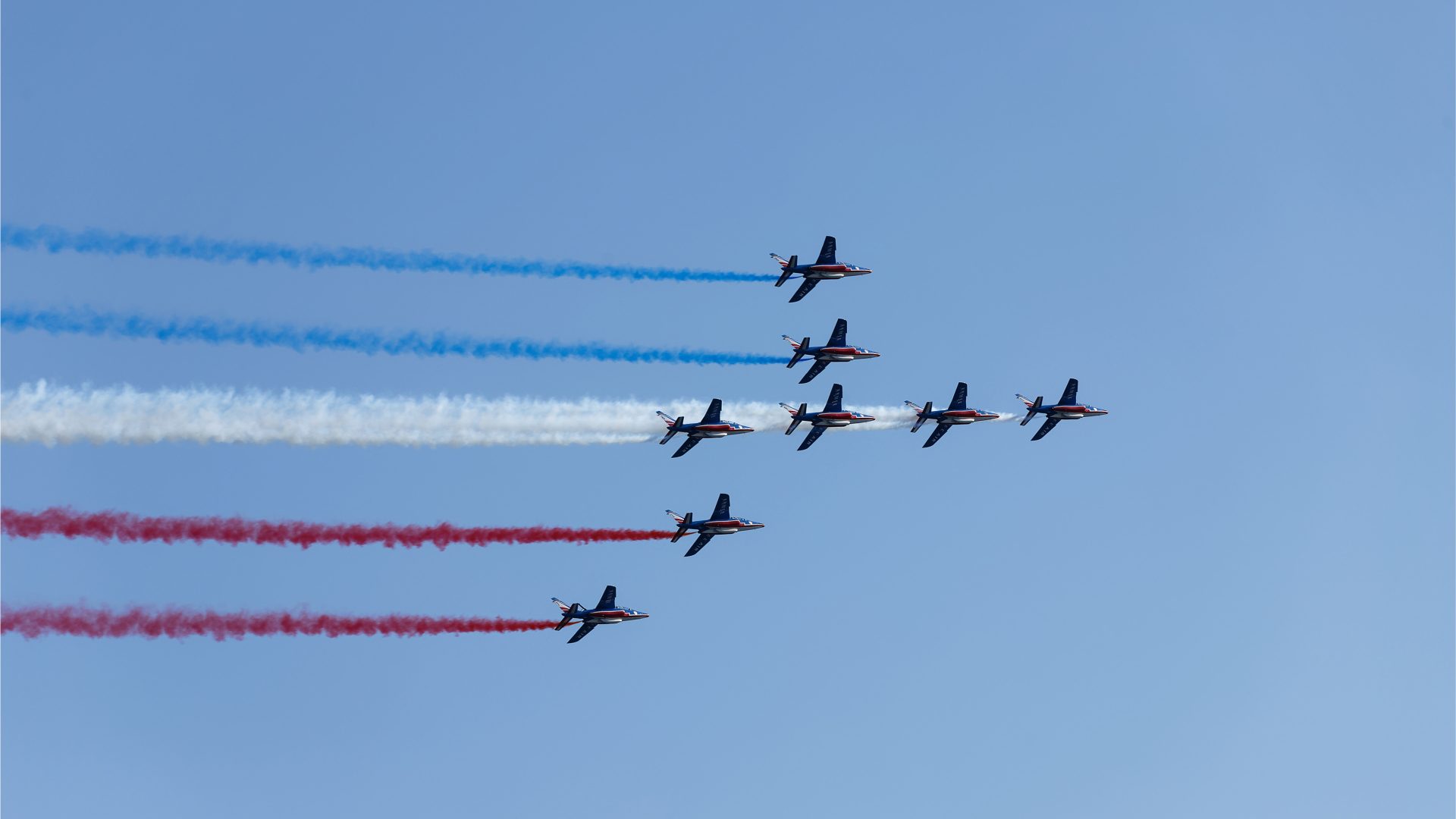
Every year since 1880, 14 July has brought the French people together to celebrate their national holiday, a symbol of history and national unity. Traditionally marked by a grand military parade — held on the Champs-Élysées since 1919 and permanently established on that avenue in 1980, except in 2024 —, this celebration remains the unmissable occasion bringing the nation and its armed forces together.
Like the IHEDN, this event serves to reaffirm and strengthen the vital link between civil society and the armed forces. This celebration honours the men and women dedicated to serving their country and enables the general public to discover the capabilities and units deployed on missions.
For the 2026 edition, the event is taking place against a backdrop of historic upheaval, characterised by the erosion of the certainties that emerged after the Cold War, the return of war to the European continent and the intensification of global rivalries.
In the face of these upheavals, the fashion show has adopted a central theme: «Europe’s strategic awakening». Visually, the event showcases the new multi-environment camouflage combat uniform currently being rolled out. In substance, it illustrates the growing awareness of global rearmament and France’s determination to reject any illusion of strategic complacency.
THE 2026 PARADE IN FIGURES
To embody this continuum of security and global power, the Champs-Élysées will host a parade this year 6,686 men and women, supported by 299 vehicles and 193 chevaux. The air, maritime and sovereign dimension, meanwhile, will be showcased in the skies above Paris through the coordinated flypast of 90 aircraft and 32 helicopters.
A «COMBAT-READY PARADE» AND A COMPREHENSIVE SECURITY CONTINUUM
This year, the parade is explicitly conceived as a «parade in battle formation». It provides a schematic and educational illustration of the modern battlefield, highlighting the dynamic interaction between ground forces and air support in an increasingly complex and contested environment.
This scenario highlights the importance of an optimised hierarchical structure (intelligence, communications, precision strikes, logistics) in order to adapt rapidly to developments in high-intensity conflicts.
The event also reaffirms the principle of security continuum by highlighting the crucial synergy between:
- The armed forces, responsible for external defence, the protection of interests abroad and the projection of power.
- Internal security forces (police, gendarmerie, prison service, customs) and emergency services (fire brigade, marine fire brigade), which are responsible for maintaining public order, combating crime and managing internal crises.
This initiative highlights the modernisation of the armed forces driven by the implementation of the 2024–2030 Military Planning Act. It is being orchestrated under the responsibility of the Military Governor of Paris, Lieutenant-General Loïc Mizon (in post since late 2024), and under the direction of the Chief of the Defence Staff, Air Force General Fabien Mandon (appointed in September 2025).
ARMED FORCES DEPLOYED ACROSS ALL THEATRES OF OPERATIONS
With a comprehensive military structure, an independent nuclear deterrent and a global presence, France deploys nearly 30,000 military personnel every day to protect its citizens and defend its economic and sovereign interests:
- Within the country: cyber defence, space defence, airspace and maritime approach surveillance, and Operation Sentinelle. National cohesion has been strengthened this year by the introduction of the new National Service and the expansion of the operational reserve.
- In Europe and on the eastern flank: reassurance and monitoring missions (NATO battalions in Estonia and Romania, operation Baltic Sentry). In 2026, France will play a key role as the lead nation for NATO’s Response Force (ARF). It will also continue to provide long-term support to Ukraine (through the EUMAM mission and the transfer of equipment).
- Internationally: developments in partnerships in Africa (marked by the end of the permanent presence in West Africa and the handover of military bases in Senegal in the summer of 2025); stabilisation operations and defence agreements in the Near and Middle East; and sovereignty or disaster relief missions in the Indo-Pacific region, carried out in particular by the sovereignty forces based in New Caledonia and French Polynesia.
ALLIANCES, MEMORY AND CELEBRATIONS: THE COLLECTIVE DIMENSION
France is asserting itself in this edition as a force capable of bringing coalitions together. As General Loïc Mizon pointed out during his press conference, «Our competitors say we are on our own. That is not true. And we will prove it, alongside our partners and allies.».
This international dimension is reflected in the presence of the flags of NATO, the European Union and the nations of the Volunteer Coalition (Coalition of the Willing – CotW) for Ukraine. Launched on 17 February 2025 by France and the United Kingdom, this initiative now brings together around forty countries committed to providing Ukraine with robust security guarantees as soon as hostilities cease, in order to ensure the long-term security of the European continent.
The 2026 edition also features a number of significant commemorative events. In particular, it celebrates the 400 years of the French Navy, which for four centuries has defended France’s freedom of action and the security of its supply routes across the world’s oceans. The parade’s closing performance will be dedicated to this historic anniversary, bringing together the French Navy Band and the Celtic sounds of the Lann-Bihoué bagad.
The parade will draw to a close in a highly symbolic manner with a performance of the European anthem, a significant decision intended to cement solidarity amongst the nations contributing to the continent’s security.
Finally, this public event celebrates the republican value of the national emblem, the current version of which – known as the «1880» model – was first presented on 14July of that same year, cementing the unbreakable and age-old bond between the nation, its history and those who defend it at the risk of their lives.
 French
  English