
IHEDN Mondays are now available in audio format!
Click below to listen:
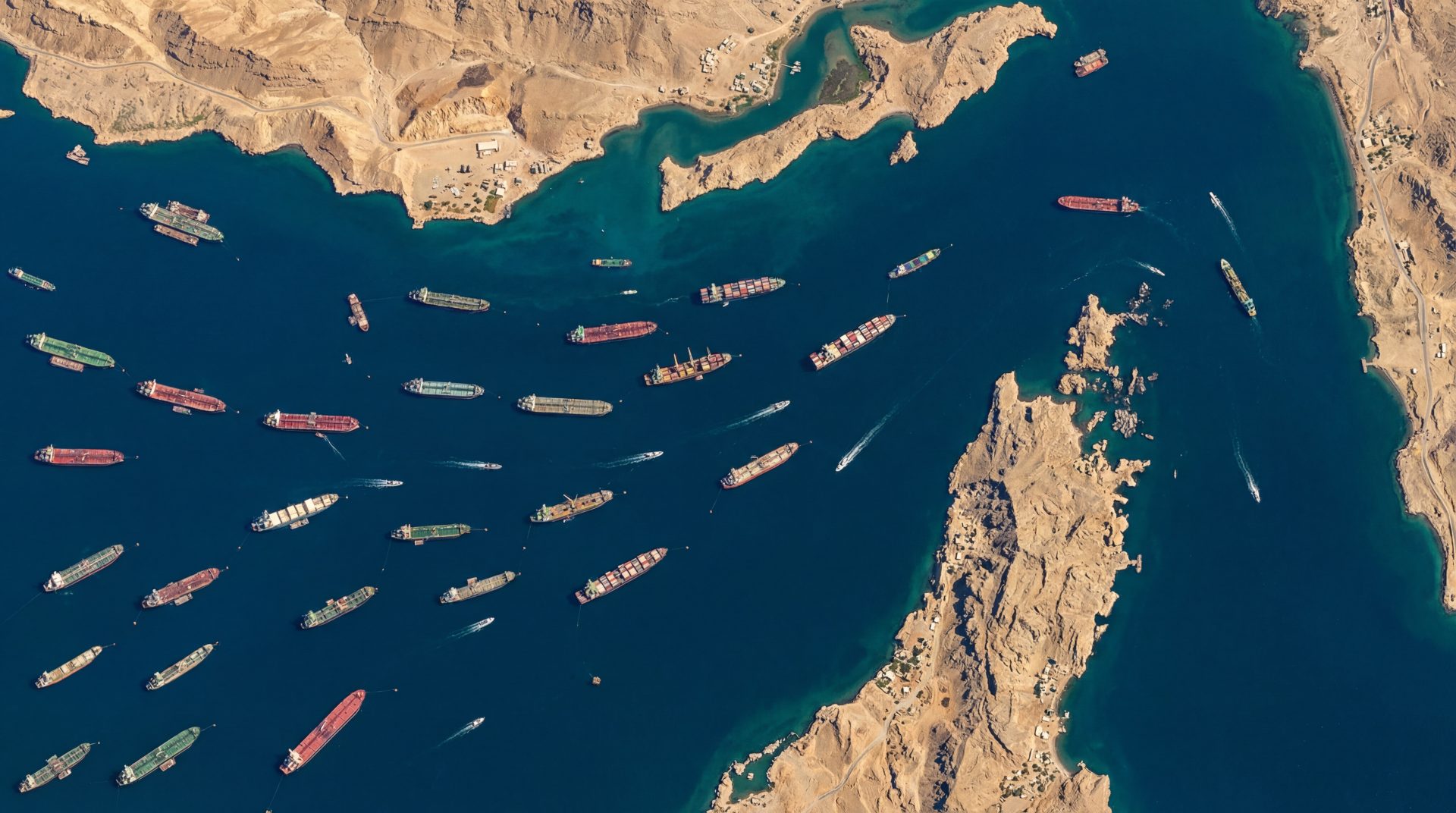
In the grammar of global power, straits are not merely geographical features: they are essential points of passage (bottlenecks, in English chokepoints) of globalisation. Whilst 80 % of world trade by volume and more than 60 % of hydrocarbon flows are transported by sea, control of these chokepoints has a direct bearing on states’ national security, economic stability and power projection.
From the perspective of defence and global security, a strait brings together all forms of contemporary vulnerabilities:
- denial of access: The narrow width of the straits enables state and non-state actors to threaten commercial or military traffic through coastal defence systems, drones, mines or naval harassment.
- security of supply: Even a temporary blockage of a bottleneck has an immediate knock-on effect on global value chains, inflation and the energy security of the major powers.
- sovereignty and the law of the sea : Governed by the Montego Bay Convention and the right of transit passage, the straits are the scene of ongoing legal and military tensions between the freedom of navigation promoted by the naval powers and the territorial claims of the coastal states.
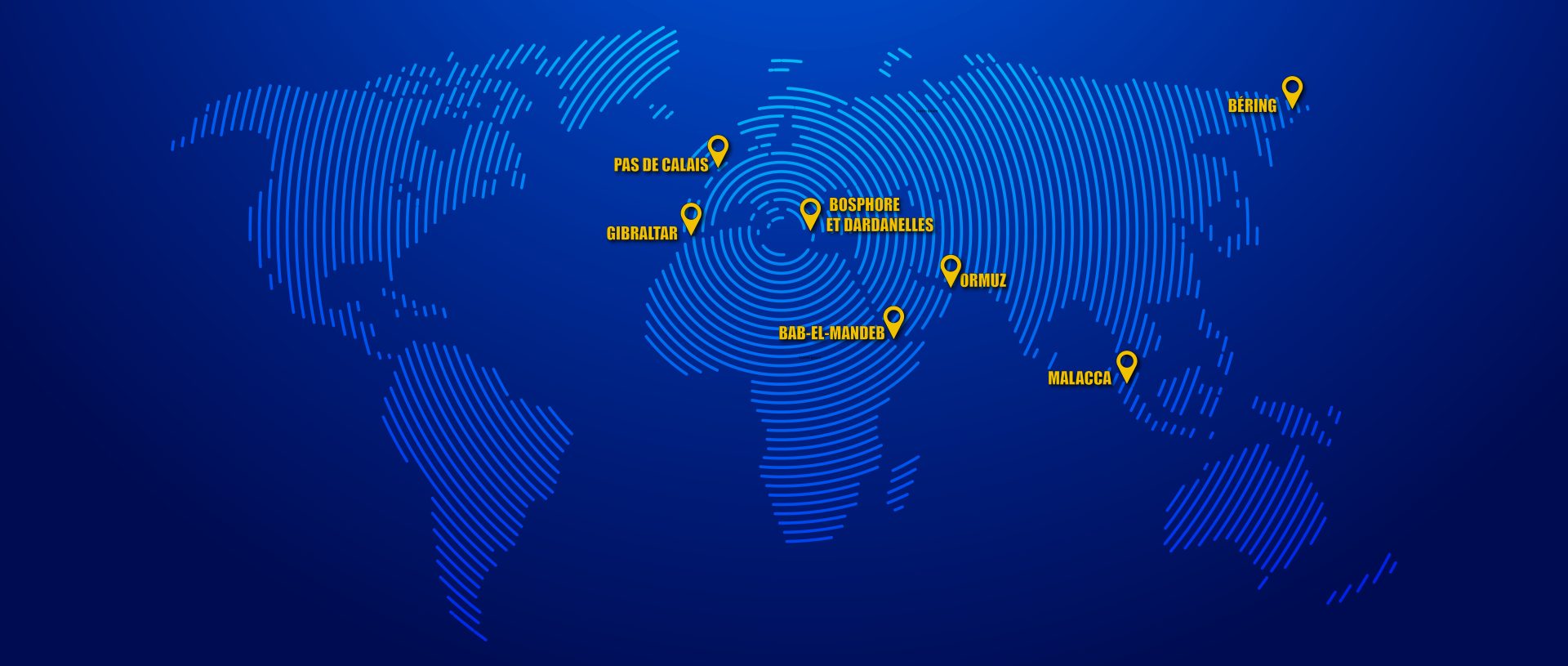
The world’s main straits. Source: MapsforUPSC
The global maritime network, the very backbone of trade, comprises 28 strategic passages, including 12 major ones at the heart of geopolitical and economic flows: two canals (Suez, Panama), two capes (Good Hope, Magellan) and the ten busiest straits on the planet — Malacca, Taiwan, Pas-de-Calais, Gibraltar, the Bosphorus and the Dardanelles, Bab-el-Mandeb, Makassar, Hormuz and Öresund. This vital network is complemented by 16 secondary routes, which are essential to the smooth flow of international trade.
A focus on seven major strategic straits:
The Strait of Hormuz: the energy lifeline under strain
Location: separates Iran from Oman and the United Arab Emirates (Persian Gulf – Indian Ocean).
Economic issues: it’s the chokepoint the world’s most critical oil pipeline. Around 20 to 21 million barrels per day (representing approximately 20 % of global liquid oil consumption) and a third of the world’s liquefied natural gas pass through it.
Strategic issues : Iran regularly uses this 39-kilometre-wide chokepoint as a means of geopolitical coercion (threats to close it, the boarding of oil tankers, and mine warfare). The presence of the US Fifth Fleet and European maritime security initiatives (Operations EMASOH/Agénor) aims to guarantee freedom of navigation in the face of the risk of a disruption to global energy supplies.
The Strait of Malacca: the lifeline of the global economy
Location: between the Malay Peninsula and the Indonesian island of Sumatra.
Economic issues: the world’s main shipping route linked to the Port of Singapore, with over 85,000 ships passing through each year. It accounts for 25 per cent of global trade and transports oil from the Middle East to the industrial giants of East Asia (China, Japan and South Korea).
Strategic issues: China’s dependence on this narrow strait has given rise to the concept of the «Malacca Dilemma»: Beijing fears that, in the event of a conflict (particularly over Taiwan), a US-led coalition might impose a naval blockade in the strait. In addition to heavy traffic and a long history of piracy, it is the focal point of Sino-American rivalry in the Indo-Pacific.
Bab el-Mandeb: the strait under fire in the Red Sea
- Location : between the Horn of Africa (Djibouti, Eritrea) and the Arabian Peninsula (Yemen).
Economic issues: As the southern gateway to the Suez Canal, it handles around 10 to 12 % of global maritime trade (containers, manufactured goods, oil).
Strategic issues: The region suffers from chronic instability. Attacks by Houthi rebels on merchant shipping have highlighted the extreme vulnerability of this route, forcing shipowners to divert their vessels round the Cape of Good Hope (adding 10 to 14 days at sea). The militarisation of the area is unprecedented, illustrated by the concentration – unique in the world – of foreign military bases in Djibouti (France, the United States, China, Japan).
The Bosphorus and the Dardanelles: the strategic gateway to the Black Sea
Location: Turkish straits linking the Black Sea to the Aegean Sea via the Sea of Marmara.
Economic issues: a vital route for the transit of cereals (Ukrainian and Russian wheat), fertilisers, oil and raw materials from countries bordering the Black Sea (around 40,000 ships a year).
Strategic issues: Governed by the 1936 Montreux Convention, these straits grant Turkey strict control over the passage of warships belonging to non-littoral powers. In the context of the war in Ukraine, Ankara has blocked the passage of military vessels belonging to the warring parties, asserting its role as an indispensable geopolitical pivot between NATO – of which it is a member – Russia and the Mediterranean.
The Strait of Gibraltar: the Euro-African gateway
Location: a 14-kilometre-wide strait separating Spain from Morocco.
Economic issues: As the world’s second busiest strait (with over 100,000 ships passing through each year), it is the only natural link between the Atlantic Ocean and the Mediterranean Sea, at the heart of trade between Asia and Europe.
Strategic issues: As well as its importance for NATO’s naval projection, Gibraltar is a strategic border for the EU in terms of controlling migration flows and combating drug trafficking. It involves complex issues of sovereignty (the British status of the Rock of Gibraltar in the face of Spanish claims) and the growing importance of regional ports (the Tangier Med complex).
Pas-de-Calais (in English Dover Strait): the busiest road
Location: separates France (Hauts-de-France) from the United Kingdom (the County of Kent), linking the English Channel to the North Sea.
Economic issues: holds the world record for traffic, with more than 400 commercial vessels per day – that is, more than 146,000 per year. It is the main logistics corridor supplying the economic heart of north-western Europe.
Strategic issues: an area at high risk of maritime collisions and pollution, requiring a highly regulated traffic separation scheme. Since Brexit, the Strait has been the scene of mounting tensions relating to the control of the EU’s external borders, the management of irregular migrant crossings and the division of fishing zones.
The Bering Strait: the new Arctic frontier
- Location: a stretch of 82 km separating Russia (Chukotka) from the United States (Alaska), linking the Pacific Ocean to the Arctic Ocean.
- Economic issues : although still marginal in terms of volume, its potential is growing as a result of global warming and the melting of the ice, which are opening up the Northern Sea Route (NSR) operated by Russia. This route shortens the sea journey between East Asia and Europe by nearly 40 % compared with the traditional route via the Suez Canal.
- Strategic issues: a direct front line in the standoff between Moscow and Washington. Russia’s militarisation of the Arctic and China’s stated interest are turning the Bering Strait into an emerging flashpoint over control of natural resources (gas, oil, minerals) and new polar trade routes.
The role of France and European operations in securing the straits
In the face of a growing number of maritime crises and renewed challenges to the law of the sea, France and the European Union are implementing a naval strategy that combines a permanent presence, coordinated coalitions and high-intensity operations.
The French Navy: a permanent deployment to hotspots
France draws on its status as a coastal state and its position as a global archipelago (through its overseas territories) to maintain a naval presence around key straits:
- Sovereign strongholds and forward bases: The presence of the French military base in the United Arab Emirates (French Forces in the UAE) enables direct control at the entrance to the Strait of Hormuz. In Djibouti, the French Forces stationed there (FFDj) are securing the Bab el-Mandeb Strait.
Monitoring of metropolitan approaches: in the Manche department (Pas-de-Calais) and in the Mediterranean (Strait of Gibraltar), the French Navy ensures maritime safety through the CROSS (Regional Operational Surveillance and Rescue Centres), the maritime prefecture and the regular deployment of patrol vessels and first-class frigates to regulate traffic and combat illicit trafficking.
Interception and escort capability: Multi-mission (FREMM) and air defence (FDA) frigates operate as close as possible to the threats, armed with Aster missiles, large-calibre guns and on-board helicopters (Panther/NH90) equipped to destroy drones and suicide boats.
EMASoH / Operation AGENOR: targeted de-escalation in the Strait of Hormuz
Launched by France in early 2020 and supported by a coalition of European nations (Belgium, Italy, the Netherlands, Denmark, etc.), the EMASoH (European-led Maritime Awareness in the Strait of Hormuz) mission illustrates Europe’s quest for an independent course:
A dual military and diplomatic pillar: the military aspect (Operation AGENOR) monitors and provides support to merchant ships facing the risk of Iranian boarding. Its civilian arm promotes regional dialogue and de-escalation.
Operational independence: Distinct from the US-led coalition (IMSC), AGENOR aims to safeguard freedom of navigation whilst avoiding a direct confrontation in the Gulf.
Launched by the European Union in response to the direct threat posed by Houthi rebels to maritime traffic, Operation ASPIDES represents the EU’s most demanding naval deployment in decades:
Strictly defensive mandate: unlike the Anglo-American operation Poseidon Archer, ASPIDES does not carry out pre-emptive strikes on Yemeni territory. Its role is focused on providing close escort to merchant ships and neutralising Houthi drones, anti-ship ballistic missiles and unmanned surface vessels (USVs) whilst in flight.
A test of endurance for European frigates: The French Navy is deploying its leading-class frigates there, which are forced to engage in combat in real time and at very close range to protect the traffic passing through Bab el-Mandeb and the Suez Canal.
Environmental protection and flow management: As well as protecting containers, the European force intervenes to prevent major environmental disasters (rescuing and escorting damaged oil tankers such as the MV Sounion).
French and European involvement in securing the straits meets a threefold requirement in terms of national and European defence:
Economic security of the continent: to prevent European supply chains from being choked off by keeping key trade routes open (Malacca, Hormuz, Bab el-Mandeb, Pas-de-Calais).
A demonstration of naval power: to demonstrate Europe’s ability to operate in areas where access is denied without relying exclusively on the US military umbrella.
Defence of international law: to safeguard the freedom of transit enshrined in the Montego Bay Convention in the face of the increasing militarisation of the straits.
 French
 English