
Click below to listen:
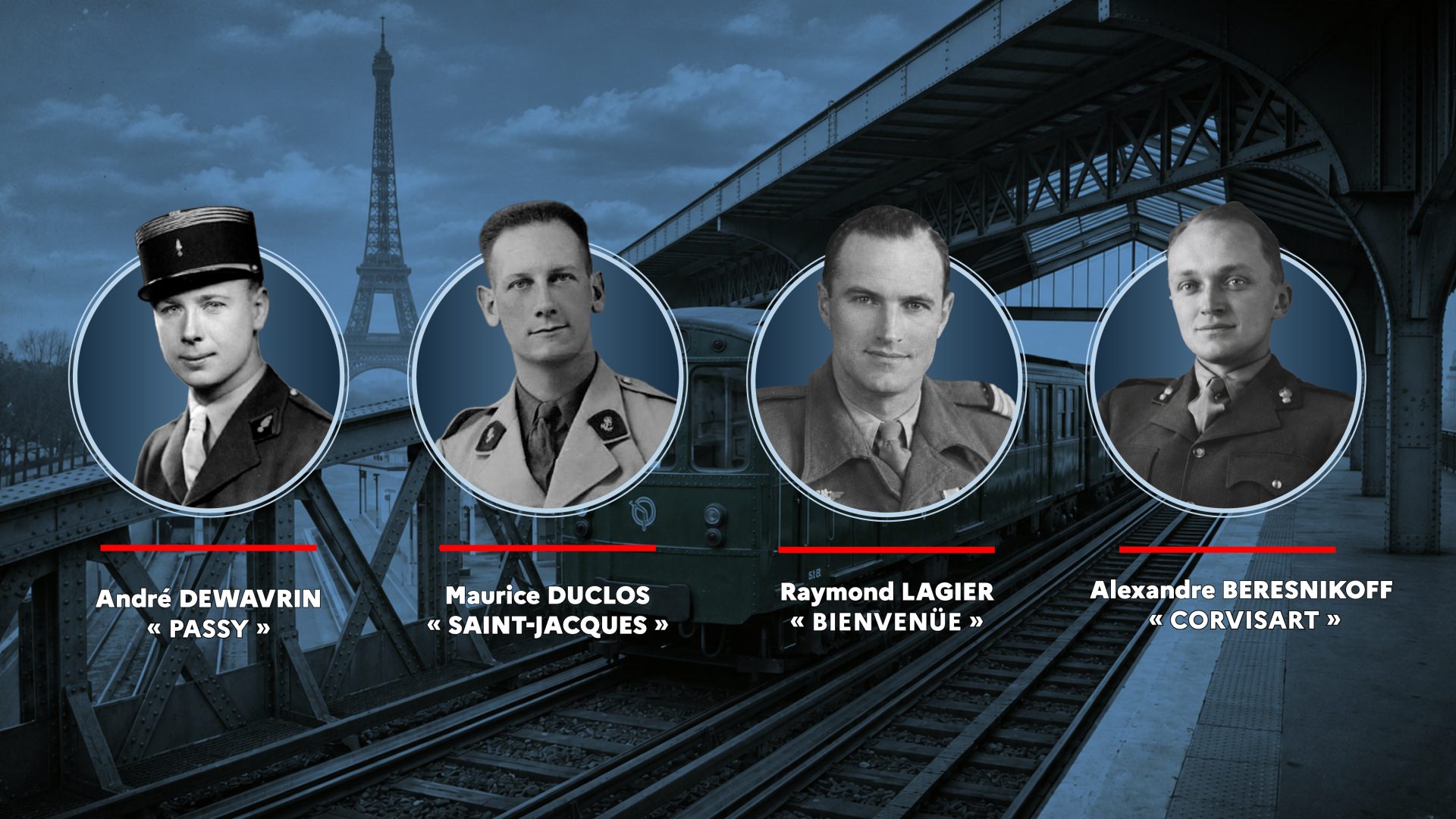
One end of the line is Charles de Gaulle station – ÉThe line passes through Bir-Hakeim (site of a strategic victory for the Free French in 1942) and Denfert-Rochereau – Colonel Rol-Tanguy (regional commander of the French Forces of the Interior at the time of the liberation of Paris), but these are not the only links between Line 6 of the Paris Metro and the Second World War: four prominent members of the Resistance – André Dewavrin (Passy), Alexandre Beresnikoff (Corvisart), Maurice Duclos (Saint-Jacques) and Raymond Lagier (Bienvenüe) – took their aliases from stations on this very line.
The aim is to shed new light on these figures from the Central Bureau of Intelligence and Action (BCRA), the Free French Forces’ intelligence and covert operations service, that Cécile Beresnikoff, Corvisart’s great-granddaughter, and Marie Dewavrin, Passy’s granddaughter, have launched a call for donations in partnership with the RATP. As part of the Free French Foundation’s «BCRA Remembrance» initiative, four commemorative panels will be unveiled at these stations once the €30,000 required for the project has been raised.
Before the war, none of these four men was a professional «spy». Their actions, however, proved so decisive that after the war, the American General William J. Donovan, who founded the’Office of Strategic Services (the forerunner of the CIA), «will say that 80 per cent of the intelligence used for the landings on 6 June 1944 came from the BCRA,» says Marie Dewavrin. «They were all people with a deep-seated sense of commitment.»
By the end of the war, more than 500 people would have served at the BCRA headquarters in London and Algiers, with around 400 agents being sent to mainland France, where they would coordinate the efforts of nearly 10,000 people. The history of the DGSE’s predecessor began at St Stephen’s House, the Free French headquarters in London, less than two weeks after the appeal of 18 June.
André Dewavrin (1911–1998): Colonel Passy
A captain in the Engineers, having only just returned from the Norwegian campaign, André Dewavrin decided to join General de Gaulle and reported for duty on the 1ster July 1940 at his London headquarters. Marie Dewavrin, who has asked her grandfather about this on numerous occasions, recounts:
«When De Gaulle asked him his name, his educational background and his age, he replied, «I attended the École Polytechnique; I’m 29.» De Gaulle replied, «Very well, you will be head of my second office.»” [name of the French army’s intelligence service since 1871, Editor’s note]. And my grandfather said to him: «I’d still need 24 hours to think it over. I’d need men, means of communication and money.»
To which De Gaulle replied: «Listen, I’ve got no money. I’ve got no means of communication. And as for men, you’ll just have to go and find them on the streets of London.» That’s how it all started.»
«Their meeting was very curt,» confirms Guillaume Pollack, who holds a PhD in contemporary history from the University of Paris 1 Panthéon-Sorbonne, having written a thesis on the resistance networks of the French Resistance from 1940 to 1945. «Dewavrin emerged as head of the Second and Third Staff Bureaux – that is, intelligence and operations – despite having no particular experience in these fields. Starting from scratch, he set up this secret service – which became the BCRA in 1942 – and for four years it sent agents to gather intelligence in occupied France», as well as carrying out military operations, counter-espionage, escape operations and political missions.
Working from London, André Dewavrin was dropped into France on 25 February 1943 with an agent from the Special Operations Executive to Britain to find his deputy, Pierre Brossolette (1903–1944): this was the Arquebuse-Brumaire mission. Before his return on 16 April, they managed to lay the foundations for the future Secret Army, which coordinated the military actions of all the resistance movements, and to pave the way for the National Council of the Resistance (CNR).
«The role played by this extraordinary figure was absolutely decisive,» says Guillaume Pollack, who laments the smear campaign waged against him in 1946 by Communists and Christian Democrats from the MRP, who accused him of embezzling funds to finance the General’s cause. The legal proceedings were dropped, but Colonel Passy left the army and went on to pursue a career in industry. Today, «the memory of André Dewavrin is very much alive within the DGSE», said its director in 2025, Nicolas Lerner. Colonel Passy remains «the man who laid the foundations for what the DGSE is today: an intelligence service geared towards action».
Alexandre Beresnikoff (1908–1996): Corvisart
Born in Russia into a noble family that subsequently fled the Bolshevik Revolution, this quadrilingual doctor of law, who became a naturalised French citizen in 1934, eventually decided to become an officer. When he arrived in London in July 1940, De Gaulle appointed him Passy’s deputy. «Corvisart literally broke new ground,» says Guillaume Pollack, «as he was sent as early as August 1940 to carry out his first mission in occupied France. He managed very well and returned to London via Spain. At the time, it was no mean feat to carry out this sort of clandestine mission without being caught.»
According to the historian, this first mission by Corvisart laid the foundations for the training of all BCRA agents:
«When agents were sent to occupied France in 1940, they were literally sent into the unknown. From London, we had no idea what might be happening in France.”.
Corvisart is back with some very basic information on the restrictions»information, train timetables – that sort of thing, which is very important for everyday life and for knowing how to behave in a crowd. He plays a very important role; we owe him a great deal.’
After the war, Alexandre Beresnikoff became a senior international civil servant at the UN and, according to Guillaume Pollack, gradually «faded from the collective memory of the clandestine war». «As post-war memories began to take shape, a few key figures from the clandestine struggle were singled out, and there was a drive to portray the BCRA as a military force, as a fully-fledged secret service. The pioneers were somewhat sidelined, and what came to matter greatly was sabotage – an activity in which he did not engage.»
Maurice Duclos (1906–1981): Saint-Jacques
He joined the colonial artillery at the age of 20, then worked as an insurance broker; Maurice Duclos joined ‘La Cagoule’, a far-right terrorist organisation, in the 1930s, to the extent that he was imprisoned on suspicion of having supplied the explosives used in two attacks in 1937, each of which killed a police officer.
When he met Passy in London in July 1940, «he introduced himself very frankly to him as a member of the Cagoulards», recounts Guillaume Pollack. By August, he had been sent to France, where he founded the Saint-Jacques network, the first Free French intelligence network operating on French soil – and, what is more, in the occupied zone.
According to the historian, «what is very interesting is that he finds immediate support. Contrary to popular belief, not all French people in 1940 were Nazis, Vichy supporters or sit-and-wait types. It’s more complicated than that. Saint-Jacques found support on the ground, and it was thanks to the support of the social fabric that he was able to build up his network.»
In April 1941, his network managed to establish the first radio link between Paris and Free France in London, from a building on Place Vendôme. «He had arrived from England with carrier pigeons, but had lost them on arrival,» says Guillaume Pollack.
The historian, who consulted the Saint-Jacques network file at the National Archives, found there «stacks upon stacks of information covering everything from German military activities to the state of mind of the population and daily life in occupied France. Duclos is truly a fascinating figure».
After the war, Saint-Jacques moved to Argentina, where he worked for French companies such as L’Oréal. He returned to France in 1948 to stand trial in the ‘Cagoule’ trial, where he was one of 11 acquitted out of 49 defendants.
Raymond Lagier (1914–2001): Bienvenüe
For Guillaume Pollack, Raymond Lagier is «a figure who has been unjustly forgotten»; the historian found it «extremely difficult to gather information about him: there are a few letters here and there, that’s all. »He is the hardest of the BCRA’s senior officers to document.« Yet Bienvenue was the founder of the famous »Service action’ within the French intelligence services.
The son of an industrialist and a graduate of the École supérieure de commerce de Paris, he began the war as a lieutenant in the Alpine Hunters. Having joined the Free French Forces in London in July 1940, he was tasked in 1942 with setting up the Military Action (A/M) section of the BCRA. «At that time, the BCRA was increasingly incorporating military operations and sabotage into its activities,» explains Guillaume Pollack.
Bienvenüe organised the recruitment, training, parachuting and operational liaison for undercover agents sent into occupied France to carry out sabotage operations and build up the ‘Action de la France combattante’ networks.
After the Liberation, Raymond Lagier briefly continued his work in the intelligence services by becoming chief of staff to Colonel Passy at the Directorate-General for Studies and Research (DGER), the successor to the BCRA, in 1946, before embarking on a career as a senior civil servant serving as France’s trade adviser. And so he faded into obscurity, for several reasons, according to Guillaume Pollack:
«In 1945, it was the image of the bearded resistance fighter that was highlighted, not that of the secret agent, particularly as some of the clandestine agents were co-opted by the DGER and subsequently by the External Documentation and Counter-Espionage Service (SDECE).”.
By its very nature, covert action is not intended to be known to the general public, particularly as some of the methods devised by the BCRA are still in use today, such as the infiltration of agents. Secret agents are therefore the forgotten figures in the history of the Second World War.»
 French
 English