
This fact sheet is also available in audio format
Click below to listen:
Summary
- Romania has established itself as a pivotal state on NATO’s south-eastern flank, having strengthened its Euro-Atlantic integration since 2004–2007, modernising its armed forces and structuring its strategic role around its key position on the Black Sea and its increased support for the Atlantic Alliance since the large-scale invasion of Ukraine in 2022.
- The war in Ukraine has transformed the Black Sea into a key theatre of confrontation with Russia, within a framework governed by the Montreux Convention (1936), which automatically reinforces the role of the littoral states, and in particular Romania, as key pillars of NATO’s posture, in close but sometimes ambiguous cooperation with Turkey.
- This strategic rise in power is accompanied by internal fragility characterised by political polarisation and the intensification of hybrid threats, as illustrated by the interference and influence campaigns during the 2024 presidential election (particularly concerning Călin Georgescu and the annulment of the election), which make democratic and informational resilience a central issue of national security.
Background – Romania’s growing geostrategic influence on NATO’s eastern flank
Situated on the eastern border of the European Union and NATO, Romania occupies a key geostrategic position at the crossroads of Central Europe, the Balkans, the Black Sea basin and the post-Soviet space. Bordering Ukraine and Moldova, and with a coastline of nearly 250 kilometres along the Black Sea, it serves as a vital link between the region’s land, river (notably the Danube) and maritime domains. This location gives Romanian territory particular importance for the surveillance of the Atlantic Alliance’s south-eastern flank, the protection of regional transport routes and access to the corridors linking Europe to the Caucasus and the Caspian Sea. This geographical centrality forms part of a process of Euro-Atlantic integration that began after the end of the Cold War. A member of NATO since 2004 and of the European Union since 2007, Romania has made its integration into Euro-Atlantic institutions the main pillar of its foreign and security policy.
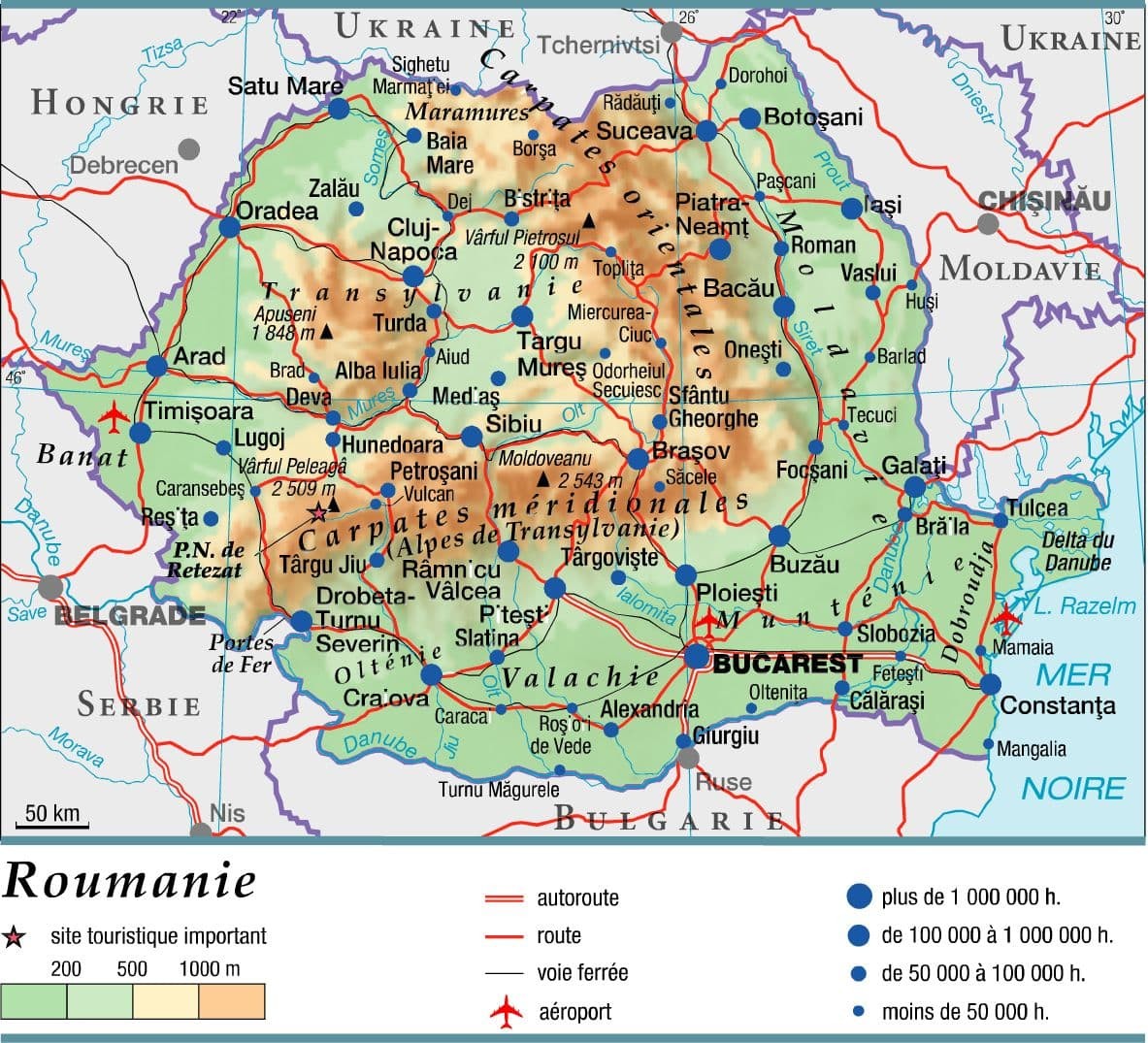
Romania also has close historical ties with the Republic of Moldova. The two countries share a long common history, with most of the territory of present-day Moldova having formed part of the Principality of Moldova before being partially united with the Kingdom of Romania in 1918 following the First World War. This union was interrupted in 1940 with the annexation of Bessarabia by the Soviet Union under the terms of the German-Soviet Pact, and was subsequently consolidated after 1945 through the region’s integration into the Moldavian Soviet Socialist Republic. Moldova gained independence in 1991, following the break-up of the USSR. This shared history explains Moldova’s central role in Romanian regional policy and the current debates on possible reunification. Bucharest is one of Chișinău’s main supporters, particularly when it comes to reducing energy dependence on Russia.
This strategic proximity forms part of a broader, long-standing perception of Russia as the main source of instability in its strategic environment and has resulted in consistent support for strengthening the Alliance’s deterrence and defence posture on its eastern flank, particularly following the annexation of Crimea in 2014. The strategic partnership with the United States constitutes another key pillar of this policy, as illustrated by the establishment of the Deveselu missile defence site in 2013 and by the regular presence of US forces on Romanian territory. This special relationship has helped to make Romania one of the allies most committed to strengthening the Alliance’s military presence in South-Eastern Europe.
At the same time, Bucharest has embarked on a gradual modernisation of its military capabilities in order to strengthen its credibility within the Alliance. Romania is among the first Member States to have allocated at least 2.1 per cent of its gross domestic product to defence spending, before increasing this to 2.5 per cent from 2023 onwards. This drive is accompanied by major procurement and modernisation programmes, particularly in the fields of air defence, land forces and combat aviation. It is also underpinned by the development of strategic military infrastructure, such as the Mihail Kogălniceanu airbase, situated north of the city of Constanța, which was already in use by US forces prior to 2022 and is set to become one of NATO’s main military hubs in Europe.
The Russian invasion of Ukraine in February 2022 acted as a catalyst for these developments. The rapid deterioration of the regional security environment has reinforced Romania’s role as a frontline state on NATO’s eastern flank. Romanian territory has gradually become a major base for allied operations, whilst the port of Constanța has established itself as a vital logistics hub for Ukrainian exports and international support for Kyiv. At the same time, the Allied military presence has been strengthened with the deployment of the NATO multinational battlegroup under French command, stationed mainly at the Cincu base in the centre of the country. Established on 1 May 2022 from the «spearhead» battalion deployed a few days after the Russian invasion, this battlegroup now comprises around 1,200 military personnel from several allied countries, including nearly 800 French troops, in addition to French support and command elements, bringing the French presence in Romania to more than 1,400 soldiers. Beyond its permanent deterrence and defence mission, this force is put to the test during large-scale multinational exercises, such as Dacian Fall, Eagle Warrior or Carpathian Arch, which aim to strengthen the interoperability of allied forces and to validate the formation’s gradual build-up to brigade strength, as well as the reinforcement of air policing and regional surveillance missions. Beyond its land-based role, Romania also advocates an adjustment to the Alliance’s posture in the Black Sea, prioritising the strengthening of the capabilities of the littoral states and the improvement of maritime situational awareness (maritime situational awareness) and the development of regional cooperation with Bulgaria and Turkey, whilst complying with the restrictions imposed by the Montreux Convention. The war in Ukraine has, moreover, highlighted the persistent threat posed by drifting mines in the Black Sea: more than 120 mines have been detected over the past three years, prompting the Romanian Navy to step up its efforts to secure maritime routes and safeguard freedom of navigation in the region.
Analysis – Romania at the heart of security realignments in the Black Sea
The war in Ukraine has profoundly altered the strategic balance in the Black Sea, transforming an area long regarded as peripheral into a major theatre of confrontation between Russia and the Euro-Atlantic powers. This development goes beyond the Russian-Ukrainian conflict alone: it now concerns the security of maritime transport routes, the protection of critical infrastructure, energy corridors and the trade flows linking Europe to the Caucasus and Central Asia. Against this backdrop, the Black Sea has emerged as one of the most sensitive areas within the European security architecture. This dynamic also forms part of older institutional frameworks that have now taken a back seat, such as BLACKSEAFOR or the Black Sea Economic Cooperation Organisation (BSEC), which bear witness to attempts to establish a regional framework for security and trade in the Black Sea, despite their limited effectiveness since the war in Ukraine.
Why NATO cannot maintain a permanent naval presence in the Black Sea
The Montreux Convention, signed in 1936 and administered by Turkey, governs the regime for passage through the Bosphorus and the Dardanelles, the only maritime access between the Black Sea and the Mediterranean. Whilst it guarantees freedom of commercial navigation in peacetime, it imposes significant restrictions on military vessels from states not bordering the Black Sea, particularly in terms of tonnage, duration of stay (a maximum of 21 days) and the categories of vessels permitted. The riparian states, for their part, benefit from a more favourable regime.
Since the start of the war in Ukraine, Turkey has strictly applied the provisions of the Convention. This legal framework limits NATO’s ability to maintain a permanent naval presence in the Black Sea and has led the Alliance to prioritise a strategy based on strengthening the capabilities of the littoral states, improving maritime situational awareness, conducting joint exercises and maintaining a rotating Allied naval presence where conditions permit. In this context, Romania plays a central role in the Alliance’s security posture on its south-eastern flank.
This realignment has given Romania an unprecedented strategic role. Thanks to its coastline, its military infrastructure and its proximity to the Ukrainian theatre of operations, the country has gradually established itself as NATO’s main stronghold on its south-eastern flank, backed by a navy comprising some 6,800 personnel and around 40 vessels, including 2 frigates, 4 corvettes, 3 missile boats and several mine-countermeasures and patrol vessels.

This growing influence remains, however, heavily dependent on regional cooperation, with Turkey playing a leading role. The two states share the same view of the Black Sea as a strategic area whose stability is crucial to the security of NATO’s south-eastern flank. They therefore cooperate in several areas, notably maritime surveillance, the countering of drifting mines, joint naval exercises and the protection of critical infrastructure. This cooperation also involves Bulgaria, with a view to strengthening the capabilities of the littoral states in the face of the constraints imposed by the Montreux Convention. It is further complemented by intensified defence industrial cooperation between the littoral states and their allies, exemplified by Turkey’s delivery in 2026 of a patrol vessel to Romania, Turkey’s first naval export to an EU and NATO member state, which confirms Ankara’s growing role in shaping the Alliance’s capabilities along its south-eastern coastline.
Nevertheless, this regional architecture remains subject to a number of limitations. Turkey pursues a foreign policy based on striking a balance between its commitments within NATO and maintaining a dialogue with Moscow. This stance, whilst enabling Turkey to retain its role as a key player in the management of regional crises, introduces an element of uncertainty into the Allies’ strategic coordination in the Black Sea. More broadly, regional cooperation mechanisms are still struggling to deliver effective security governance, as diverging interests amongst the littoral states are hindering the emergence of a fully integrated approach.
Russia is, after all, the main factor shaping Romania’s strategic environment. Since the annexation of Crimea in 2014, Moscow has significantly strengthened its military capabilities in the Black Sea, developing a capability combining naval and air assets with anti-access/area denial (A2/AD) capabilities designed to control maritime approaches and restrict the freedom of action of Western forces. In the Black Sea, Russia has, since 2014, reinforced this capability from Crimea in order to control the maritime approaches and limit the freedom of action of Ukraine and NATO. Ukraine is partially circumventing this A2/AD bubble by combining precision land-based strikes against Russian systems in Crimea and, above all, by developing asymmetric capabilities, such as aerial and naval drones, which undermine Russian naval superiority and force the fleet to withdraw further from the coast. A prime example is the destruction of the cruiser Moscow in April 2022, when it was struck by Ukrainian missiles in the Black Sea, which demonstrated the vulnerability of major platforms despite the Russian A2/AD environment.
Thus, Romania’s strategic centrality stems as much from its geographical position as from the constraints that currently shape security in the Black Sea. At the crossroads of allied interests, Turkey’s regional ambitions and pressure from Russia, Bucharest has now established itself as a key player in the Euro-Atlantic defence posture, whilst remaining dependent on developments in the regional strategic environment.
Outlook – Internal political vulnerabilities and hybrid threats
Whilst Romania’s Euro-Atlantic trajectory remains firmly established, it is accompanied by growing exposure to hybrid destabilisation tactics, against a backdrop of political polarisation and heightened information warfare.
This vulnerability was particularly evident during the 2024 presidential election campaign. The first round saw the unexpected emergence of Călin Georgescu, a far-right, anti-NATO and pro-Russian candidate, who came top in the first round with around 23 % of the vote. This breakthrough was largely facilitated by a massive digital campaign, relying on social media – particularly TikTok – and on algorithmic virality mechanisms combined with artificial amplification tactics. Against a backdrop of strong suspicions of Russian interference and irregularities in the information environment, the Romanian Constitutional Court took the unprecedented decision to annul the presidential election, a measure without precedent in the country’s recent democratic history. Subsequent analyses by specialist agencies and European institutions highlighted the hybrid nature of these operations. A report compiled by VIGINUM and published in February 2025 describes structured influence campaigns combining networks of inauthentic accounts, local intermediaries and the dissemination of polarising narratives, particularly concerning corruption, the war in Ukraine and the legitimacy of democratic institutions. These operations are part of a strategy to exploit pre-existing social divisions rather than involving direct and visible intervention.
In this context, the rise of sovereigntist political forces is an aggravating factor. The Alliance for the Unity of Romanians (AUR) party has consolidated its presence on the political scene, capitalising on themes such as rejection of the elites, criticism of European institutions and opposition to military support for Ukraine. This trend is part of a growing fragmentation of the party system, which complicates the formation of stable majorities and exacerbates governmental instability, as evidenced by the recurring political tensions observed since 2025 and widely reported in the international press. This internal instability is exacerbated by high exposure to information threats. In Romania’s case, these dynamics appear all the more sensitive given that the country is at the forefront of logistical and political support for Ukraine, making it a prime target for Russian influence strategies.
Beyond the purely electoral dimension, these hybrid operations form part of a long-term strategy aimed at undermining democratic resilience. They contribute to creating a more unstable political environment, which is likely to be exploited within the broader context of strategic rivalries in the Black Sea. Under these circumstances, Romania’s ability to maintain its central role in the Euro-Atlantic defence posture will depend as much on the consolidation of its military capabilities as on its ability to strengthen the resilience of its political and information systems in the face of attempts at interference and internal fragmentation.
To find out more
- Shahbazov, Fuad, “Romania makes itself indispensable to NATO”, CEPA, 14 January 2026
- Zubtsova, Kristine, Jurkhadze, Guram, “NATO’s Role in the Black Sea Region – Strategic Interests and Challenges”, Eastern Europe and the Transatlantic Network, 6 August 2025
Bibliography
This This fact sheet is based on information from the following sources:
BFMTV, «By delivering a patrol boat to Romania…», 21 June 2026
BSEC Organisation, «Black Sea Economic Cooperation (BSEC)», date not specified
CEPA, «Romania makes itself indispensable to NATO», date not specified
Council of Europe, «Cultural Routes – BSEC», date not specified
Euractiv, «Romania asks NATO to protect it against a Russian drone attack», date not specified
Euractiv, «Romanian president appoints new prime minister to form a government», date not specified
Euronews, «NATO ready to defend Romania and every inch of allied territory», 29 May 2026
France Inter / Radio France, «L’info de France Inter – podcast», date not specified
Le Monde, «Romanian democracy put to the test by the Russian threat», 3 April 2025
Le Monde, «Romania realises how vulnerable it is to Russian drones», 3 June 2026
Ministry of the Armed Forces, «Strengthening NATO’s Eastern Flank», date not specified
NATO, «Strengthening NATO’s Eastern Flank», date not specified
This file is automatically translated
 French
 English