
IHEDN Mondays are now available in audio format!
Click below to listen:
An engineer and holder of a PhD in sociology, and a lecturer at ESCP, Arnaud Attia is currently responsible at Thales for strategy in the field of critical infrastructure protection solutions: ports, airports, nuclear power stations, data centres, cities… all of which are now facing hybrid threats.
As a participant in the IHEDN’s national programme for the 2023–2024 academic year, specialising in «Economic Defence and Security», he drew on the insights and methods gained during this experience to conceive the idea for an essay, «Hautes tensions » (published by Quid Novi), with a foreword by Geoffroy Roux de Bézieux. Interview.
How can Europe or France, as democratic regions, play their part in a context of hybrid conflicts against authoritarian adversaries?
There are two ways of approaching your question. When it comes to hybrid threats, the first aspect is defence. We need to be able to secure and protect our assets, our airports, our power stations and our supply networks.
We have seen this again recently with the cyber-attacks on supermarkets: there are a number of real threats and acts of interference on European soil. In the face of this, we must be able to strengthen our defences. There are two ways to do this. From a military perspective, we recently heard the speech by General Grynkewich, Supreme Allied Commander Europe, at the Warsaw Security Forum: he explained how NATO would respond in the event of an attack in Europe. I believe this is a first step towards stating the facts: whilst it remains a deterrent, it allows us to gradually flex our muscles and increase our intensity.
From a civilian perspective – since you’re asking me about Europe – we need to channel some of our funds into security infrastructure. That’s the area I’m working on at my company. As you know, NATO requires its member states to allocate 5% of their GDP to defence. Of this 5%, 1.5% is earmarked for security and protection infrastructure. At present, this 1.5% is not fully defined or clearly delineated.
I believe that European programmes such as the SEAP (Structures for European Armament Programmes) or EDIP (European Defence Industry Programme), which are primarily geared towards the defence industry, need to be supplemented fairly quickly by a focus on the protection of our strategic assets.
Finally, in the context of hybrid warfare, there is of course the offensive aspect, and it is in our interests to be much stronger when it comes to counter-interference. That is a matter for our security services.
Does France have any assets that it can «weaponise» on its own, without the European Union?
Yes. The first thing that springs to mind is our almost complete control over the nuclear fuel cycle. I say ‘almost complete’ because we do not have full autonomy over certain aspects, but we are not far off.
As nuclear power is a carbon-free, clean energy source, we have a role to play. That is why the President of the Republic has supported the creation of a group of countries interested in civil nuclear power. In this field, France currently holds a leading position in Europe. This rather rare situation must be prioritised and capitalised upon.
In my view, France’s second unique asset is its exclusive economic zone, which is the second largest in the world. I believe it is underestimated and under-exploited for both political and ideological reasons.
Our overseas territories offer advantages, such as terrestrial, marine and sub-marine resources, which it is very much in our interest to exploit and use as a «strategic asset» in our relations with other powers. I am not thinking solely of New Caledonia’s nickel. Of course, I realise that we cannot do everything everywhere and that we must be able to devote the necessary resources to these territories. However, having visited French Guiana with the IHEDN, I have come to understand both the threats and the potential of a territory such as that.
In the face of competition from the US and China, you believe that Europe should establish an integrated capital market and foster the emergence of industrial leaders. Does this seem possible to you, given the current state of the EU?
We are all familiar with the attempts at mergers between companies at European level that were rejected by the Commission: Schneider-Legrand and Alstom-Siemens, for example, because we Europeans regarded free competition as the key issue. As a result, the major technology groups have emerged elsewhere, in the United States or in China.
One of the consequences of this policy is that, when it comes to AI, we are now lagging behind. We used to have powerful industrial players in Europe, such as Ericsson and Alcatel. They have lost market share, or have even gone out of business.
Europe exists, in particular, because it has an internal market; this is part of its strength. Why not «weaponise» access to this internal market? We are not doing this enough. I believe that economic players are ready for this, and so are financial players. Are the political players ready? Can they, despite their differences, speak with one voice, particularly when dealing with the major powers? Let’s hope so.
But the question is this: are we capable of doing so quickly? We see this in the technology sector, which is extremely capital-intensive: the other major players – the United States and China – are making rapid progress. Do we, as the 27 Member States, have the capacity to speed up our decision-making and our initiatives?
The Draghi report was published four years ago. It is estimated that, since then, 15 to 20 % of its recommendations have been implemented. That is very few, even though the general consensus is that the report was extremely insightful. Should we move forward with 27, or with a smaller number? I think the solution lies here: what is stopping us from immediately prioritising progress with 3, 4 or 5, as we do in defence?
Of the four scenarios you envisage for Europe – an enhanced «Commonwealth», a geopolitical entity in the making, «every man for himself» or gradual dissolution – which one do you think is the most likely?
I think there are two: one is moderately pessimistic, and the other moderately optimistic. The moderately optimistic one is the creation of a genuine geopolitical entity. I hope for this with all my heart, because I am fundamentally European. I’m working on the assumption that tensions between the US and China will increase. They may not be military in nature, as with Taiwan, but they will in any case become increasingly intense, verging on the brink of open conflict.
Building on this idea of a duopoly – a conflict between these two powers – the optimistic scenario depicts a Europe that mobilises swiftly. It then finds the resources it needs to survive and to «turn its strengths into assets». It succeeds in doing so because it has values, a model of society and a universalist vision that set it apart from both the United States and China.
We still have industrial powerhouses across Europe. With that in mind, let us strive to make our mark, shake off our lethargy, and assert our model and our worldview. Let us also launch initiatives, particularly with the middle powers.
I find Canadian Prime Minister Mark Carney’s remarks very pertinent; he says that middle powers must come to an agreement amongst themselves in order to try to make their mark. We may not become a superpower straight away, but by pooling the goodwill of middle powers, we can exert influence. That, then, is the optimistic scenario.
The rather pessimistic scenario is one of a sort of «piece-by-piece sell-off», in which Europe is unable to speak with one voice, with everyone looking out for their own interests. In particular, the Germans, Italians, Spaniards and French are glaring at one another like pot-bellied pigs.
Meanwhile, the Americans are capitalising on the situation, as can be seen in the defence sector: they sell their equipment and grant licences to enable local production. They are no longer the steadfast ally, but they continue to be a trading partner and play on the differences between Member States. The Chinese, for their part, are flooding us with their products. Meanwhile, Europe is failing to establish itself as a political entity and remains merely an economic bloc.
This scenario is gradually leading to the unravelling of the European project. Perhaps we, as the French, will be able to weather this storm because we have a global presence, a language, a seat on the UN Security Council, a nuclear deterrent… But the European ideal itself will gradually unravel.
«Europe would do well to remember that it also produced Machiavelli, Richelieu, Nelson and Clausewitz,» you write. How exactly?
That is what De Gaulle did in 1940; it is the historical question of men and circumstances. Today, the situation is tense, particularly since the start of the war in Ukraine. I hope that from this turmoil will emerge two, three or four political leaders – men or women – who will bring about the solutions I so dearly hope for.
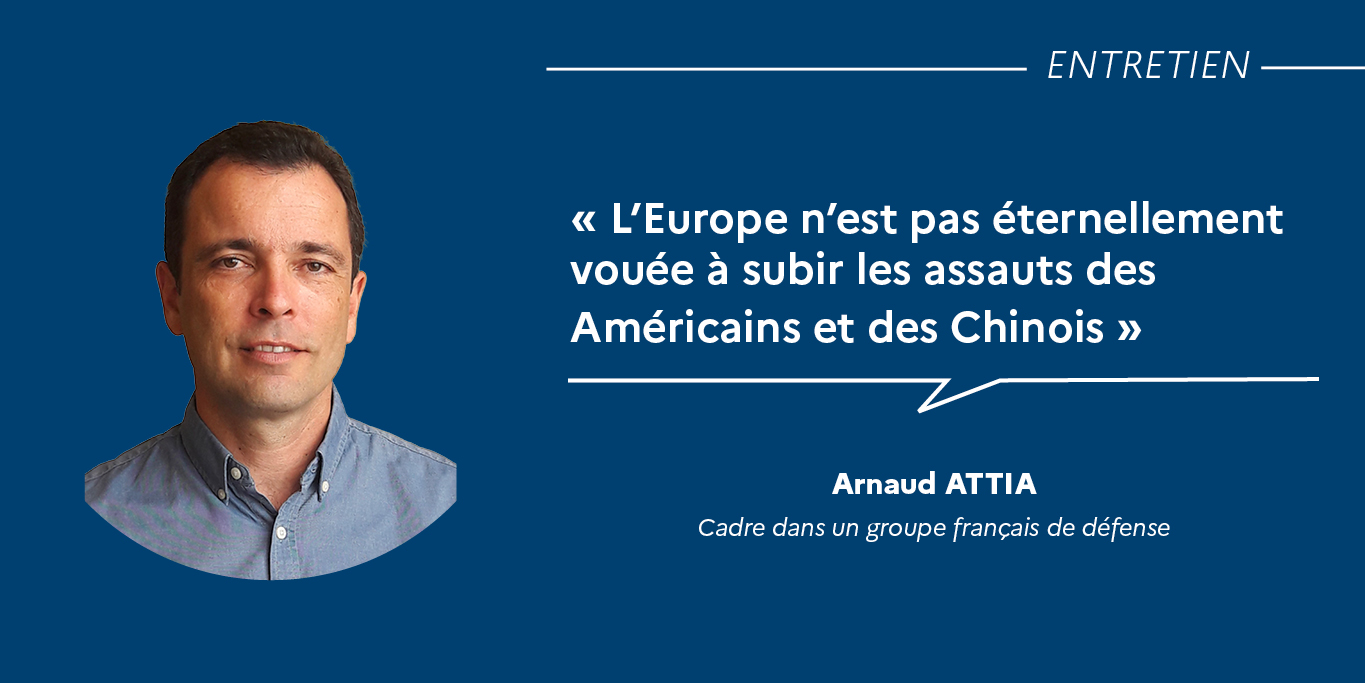
We’re starting to see signs of it. Here and there, I hear Greeks, French and Dutch people beginning to talk in terms of power. We are not destined to endure the Americans’ political and military assaults and the Chinese’s technological and commercial assaults for ever.
We can stand on our own two feet. Let us hope that a new generation of European leaders will embody a European ambition rooted in our peoples, our history and our shared values, and in what we wish to contribute to the world.
This continent has endured centuries of war, but today there is something above us that unites us, and we must ensure it endures.
To what extent is this book the result of your experience as a trainee at the IHEDN?
It is entirely the result of this experience. I would like to thank the IHEDN and my employer for giving me this opportunity.
What I found most fascinating was the diversity of perspectives. In particular, it was the insight into the military world – given that I do not come from that background – and the discussions with fascinating people. Throughout my year at IHEDN, I was struck by the dedication, commitment and clarity of analysis shown by the people around me: lecturers, students and sponsors (MEDEF, etc.). Month after month, a process of crystallisation took place, which provided me with the keys to analysis.
I had my own background and life experience, but my time as an auditor gave it structure and provided me with a method. This forward-looking approach, which is specific to the military and strategic spheres and which IHEDN taught me to master, set my skills in motion, structuring and deepening them. I believe that the «defence mindset», which is the very DNA of the IHEDN, requires a long-term commitment. Thinking is all well and good, but acting is better. This truly reflects the IHEDN’s motto: «Understand in order to act; understand one another in order to act together.»
Writing is my way of contributing to this spirit of defence. I am very pleased that the IHEDN has served as both the catalyst and the driving force behind this realisation, which is fully reflected in this book.
 French
 English