
IHEDN Mondays are now available in audio format!
Click below to listen:
Decision-making, responsiveness, coordination, resource management, strategy… the qualities that have been essential for millennia to be a good soldier are also, since the 20the century, those required to excel at video games.
Long dismissed as mere entertainment for teenagers – whether actual or immature – video games have gradually established themselves as the world’s leading cultural industry, far outstripping the film industry in terms of turnover and audience figures. Beyond financial considerations and popular enthusiasm, this digital medium is forging an increasingly deep relationship with the military world.
The military’s interest in games did not begin with the advent of microprocessors. Long before the first cathode-ray tube screens, strategic thinking had already been using games as spaces for experimentation without any direct risk to human life. As early as the 3rde In China in the 1st century BC, the game of Go was used to train the political and military elite in encirclement tactics and strategic planning.
A technological foundation with military origins
Closer to home, the Prussian General Staff of the 19th centurye century has formalised the use of wargames or map-based board games to model troop movements, a rigorous method that was quickly adopted by the US Navy and all the major Western armed forces. When modern computing emerged in the mid-20the In the 20th century, it emerged from the needs of military research during the Cold War, funded to calculate the ballistic trajectories of missiles and rockets.
It was precisely on this technological foundation of military origin, thanks to the PDP-1 computer developed by Digital Equipment Corporation, that the Massachusetts Institute of Technology was founded in 1962 Spacewar!, one of the very first video games in history, pitting two spaceships against each other around a black hole. The very origins of video games are thus directly linked to public procurement and defence budgets. Later, in the 1980s, the US military asked the publisher ATARI to «customise» its game Battlezone for training soldiers.
Over the decades and through technological leaps, the link between the armed forces and gaming has been embodied in iconic productions that have left their mark on the collective imagination whilst redefining society’s relationship with military matters. At the turn of the 2000s, the US military took this approach to its extreme by developing its own first-person shooter, America’s Army. Distributed free of charge, this publication was specifically designed to promote the institution’s values, inspire vocations and recruit young people by giving them a taste of barracks life and the tactical procedures of a soldier.
At the same time, in the private sector, huge business sagas such as Call of Duty or Battlefield have taken visual, audio and tactical realism to unprecedented levels. By working closely with military advisers, intelligence experts and arms manufacturers, the studios behind these blockbusters transform contemporary theatres of operations into ultra-realistic interactive spectacles. Studios thus benefit from exclusive access to cutting-edge expertise to enhance the credibility of their productions, whilst helping to convey to the general public a positive and technologically advanced portrayal of armed operations.
The studios’ substantial budgets benefit the armed forces
Conversely, graphics engines and virtual reality technology derived from the video game industry make it possible to develop immersive combat simulators at a lower cost. «Some companies invest considerable sums in developing their games,» says Stanislas Dewavrin, a participant on the 2026–2027 IHEDN national course specialising in Digital Sovereignty and Cybersecurity (SNC):
«The figures are not official, but for the last GTA 6, the figure would be close to two billion dollars. For Call of Duty, »It’s no doubt well over 400 million dollars. It’s certainly not the sort of thing a government would spend a billion on to develop a video game!"
The tactical shooter series, which has been running since 2001, ARMA is renowned for its realism. «When you’re heading to an operation site, you literally spend 30 to 45 minutes sitting in the back of a lorry,» says Stanislas Dewavrin with a laugh. «And if you get shot as you’re getting out of the lorry, you’re dead and you have to start all over again.»
A self-taught developer, Stanislas Dewavrin joined the French mobile games publisher Gameloft at the age of 18, where, in 2004, he created the car racing game Asphalt, which has now reached 1.7 billion paid downloads worldwide. At the helm of his own studio, Oh BiBi, since 2012, he has published other highly popular games such as Frag Pro Shooter (300 million players) and is currently developing the next mobile version of’Angry Birds.
Understanding three-dimensional geometry, hand-eye coordination, quick decision-making…
For this gamer, who has been playing since childhood, military simulators and video games are «part of the same continuum». Both can be very useful for developing human acuity. From an operational and cognitive perspective, regular practice of shooting or strategy games develops skills that can be transferred to the battlefield: an understanding of three-dimensional geometry, hand-eye coordination, rapid decision-making under high levels of stress, and concise communication within a team. Stanislas Dewavrin gives an example:
«In South Korea in the early 2010s, the best players in StarCraft 2, a real-time strategy game, were able to make 300 decisions a minute during the fast-paced stages, with both hands on their keyboards, whilst looking at their screens.»
Video games are also of interest to military institutions for another reason: they are a powerful tool for raising their profile, building loyalty and modernising their image amongst younger generations.
In France, the Ministry of the Armed Forces has taken up this issue at the instigation of the Cinema and Creative Industries Mission, notably through the LNX portal aimed at gamers, established in 2022. Initiatives are also emerging at a local level, such as at the Army Intelligence School (ERAT) in Saumur, which launched in early 2026 Call of Intel, dedicated to exploring careers in intelligence.
A joint forces team of soldiers who train in their spare time
This momentum has led to the formation of genuine internal esports communities, initially on a voluntary basis, with over 1,200 players in the Air and Space Force and several hundred in the Army. The armed forces now field their own teams of service personnel, who train in their spare time, at major events such as the Gamers Assembly. The Arkhè Joint Task Force, founded in March 2024, is making a name for itself in competitions in League of Legends, one of the most popular games at the moment. By streaming content on Twitch or engaging with the community on Discord, the organisation strengthens internal cohesion and maintains a direct, close link with civil society.
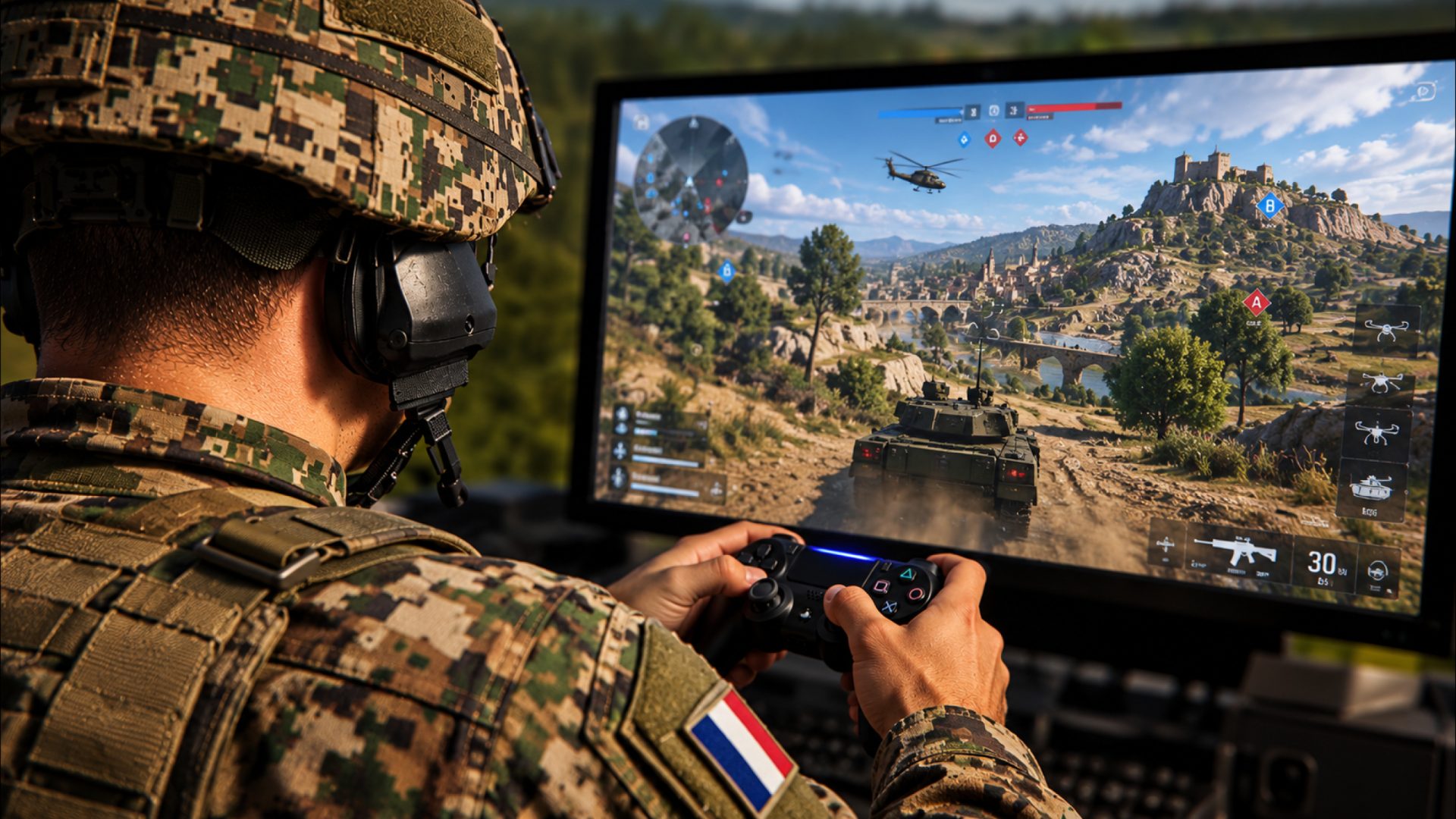
The ergonomics of consumer-grade console controllers are directly adapted for the remote operation of reconnaissance drones, remotely piloted ground vehicles or armoured turrets, making use of the young recruit’s muscle memory.
In the current conflict in Ukraine, the importance of drones is also reflected in a growing comparison with video games. Ukrainian officer Robert Brovdi, known as «Magyar», commander of the famous combat drone unit «Magyar’s Birds», has introduced a points system for his soldiers based on the significance of the Russian equipment destroyed, explains Stanislas Dewavrin:
«They have a league table of the best-performing squads, and it’s not just about being number one – the budget allocations for these squads depend on their ranking. The more effective you are, the larger the budget you have access to for better equipment.”.
In video games, there’s this dynamic known as positive reinforcement: the best players get even better, and those who are lagging behind but who really want to succeed are ten times more motivated to try and catch up; their determination can take them to new heights. That’s another aspect of video games: it’s not just about learning, it’s also about motivation.»
Gaming codes are now making their way into the IHEDN: in just a few hours, and thanks to AI, Stanislas Dewavrin created a simulation game for his SNC major committee, aggregating thousands of data points to develop various scenarios in a region of the world currently in conflict: political decisions, military operations across all environments, energy flows, population, weather…
 French
 English