
IHEDN Mondays are now available in audio format!
Click below to listen:
Since ancient times, armies have used animals for a wide variety of purposes, including combat, transport, reconnaissance and the delivery of messages.
War elephants are one of the most spectacular examples of this. They were used in India until the end of the 18the century, but also in the Persian Empire, in China and in Vietnam, right up to the colonial conquests of the 19the century, they also left their mark on European military history following the conquests of Alexander the Great.
In 218 BC, the Carthaginian general Hannibal thus crossed the Alps with elephants during the Second Punic War. To combat these imposing «tanks», the Romans are said to have used pigs doused in a flammable substance.
Dolphins, too, have been used for military purposes. The US Navy, with its Navy Marine Mammal Programme (NMMP), established in 1960 and disbanded in 2017, trained dolphins to detect mines, protect ships and search for objects, particularly during the Vietnam War and the Iraq War.
Although long relegated to the background in military accounts, animals have nevertheless played vital roles alongside soldiers. Their roles have evolved alongside changes in warfare and technological advances, but some continue to provide specific capabilities to the armed forces to this day. We take a closer look on this World Animal Day. Even today, animals are still present within the French armed forces.
The horse: the cornerstone of military power and logistics
Used for military purposes for over 5,000 years, the horse has long been one of the armed forces« main assets. Initially harnessed to war chariots, it gradually became an essential component of the cavalry. In Europe, it enabled armies to increase their mobility, charge the enemy and transport men, weapons and supplies. For centuries, military power thus relied in part on this »warhorse par excellence’, which proved decisive on the battlefield.
In the modern era, the horse’s role became more diverse. In addition to cavalry horses, there were those used for artillery and transport, making the horse much more than just a weapon: a genuine mobile logistical infrastructure. Under Napoleon Ier, the cavalry is thus organised into heavy and light units, tasked with both charging and carrying out reconnaissance and raids.
The First World War, however, marked the first major upheaval. Despite the rise of modern weaponry and motorisation, the armed forces remained heavily reliant on horses. Nearly 11 million horses, mules and donkeys were thus conscripted into the European armed forces. In France, 1.9 million horses – 520,000 of which were requisitioned in just seventeen days – were mobilised during the conflict, and more than a million perished. Indeed, in 1914, the French army still had only 170 motor vehicles at its disposal: the horse therefore remained indispensable to the army’s day-to-day operations.
The interwar period, however, accelerated this transformation, which was already underway. Advances in motorisation, armoured vehicles and aviation gradually undermined the role of traditional cavalry. The Second World War cemented this turning point: whilst horses were still widely used for transport and logistics, particularly by European armies, mechanised warfare confirmed the superiority of motorised vehicles for mobility and combat. The horse thus gradually ceased to be a central element of military manoeuvre. The Army Museum points out, however, that horses remained in use throughout the Second World War, a conflict during which the largest number of horses were ever deployed.
Today, therefore, horses are no longer used as a conventional means of combat by the French armed forces; nevertheless, they retain an operational role in certain units. The Republican Guard’s cavalry regiment, the French army’s last mounted unit (and the largest in Europe), has around 460 horses and carries out missions including surveillance, search and rescue, providing security at large gatherings and patrolling, as well as providing escorts and taking part in official ceremonies. This unit is also the last to train in and practise charging with sabres and firearms.
However, the horse has never been the only equine animal to serve in the armed forces. Although less prestigious but particularly valuable for logistics, mules and donkeys have long been used to transport troops, provisions and equipment across difficult terrain, particularly in mountainous areas. Their ability to navigate steep terrain still makes them particularly useful when vehicles cannot access certain areas.
Carrier pigeons: the army’s first drones
Used as messengers since ancient times by the Egyptians, Greeks and Romans, carrier pigeons gradually established themselves as a means of communication particularly well-suited to wartime situations. In France, its military use really took shape in 1870, during the siege of Paris, with the creation of the first pigeon service. The pigeons were then used to maintain communications with the besieged capital.
The First World War marked the peak of their military use. Faced with the vulnerability of telephone and telegraph lines and the difficulties encountered by couriers, the French army mobilised between 40,000 and 60,000 pigeons. Dovecotes, some of which were mobile, were set up as close as possible to the front line to enable the birds to transmit information from forward positions. Capable of travelling several tens of kilometres in difficult conditions thanks to their respiratory capacity and their inner ear, which gives them a highly developed sense of direction, these birds can fly at speeds of up to 70 km/h, making them a discreet means of communication that is difficult to intercept.
Among them, Vaillant, registration number 787-15, became the symbol of military pigeon racing. On 4 June 1916, whilst Fort Vaux was under siege to the north-east of Verdun, Commander Sylvain Raynal sent his last pigeon carrying a distress message. Despite gunfire and gas attacks, Vaillant managed to reach Verdun after several hours’ flight. Although the attempt to relieve the fort failed, Vaillant was mentioned in the Order of the Nation.
Their role continued during the Second World War, particularly in covert and intelligence operations. Thousands of pigeons were parachuted by the British over occupied territories to enable resistance networks to transmit intelligence to London. Thanks to microphotography, which enabled aerial photography, a single bird could carry up to 3,000 miniaturised messages. Pigeons thus became a particularly valuable means of communication for intelligence purposes when other channels of transmission were under surveillance or cut off.
With the development of radio, telecommunications and, subsequently, digital technologies, the operational use of carrier pigeons gradually declined. The last operational French military loft was finally disbanded in 1961. However, a traditional loft was preserved and established at Mont-Valérien, near Paris, in 1981, where it became a memorial dedicated to military pigeon racing.
Indeed, today, Mont-Valérien is still home to Europe’s last active military dovecote. The nearly 200 pigeons are no longer trained for operational military missions, but their breeding and training help to preserve this tradition. It is Sergeant Sylvain of the 8the the signals regiment which runs this military dovecote.
- To find out more about Corporal Sylvain and his pigeons: Carrier pigeons: the wings of war | Ministry of the Armed Forces and Veterans Affairs
Dogs, man’s best friend… and a soldier’s best friend
Used for military purposes since ancient times, dogs were for a long time employed primarily for guarding and surveillance. Over the centuries, their roles gradually diversified, but their military use remained largely unstructured for a long time.
It was at the end of the 19the It was not until the 19th century that European armies began to take a more systematic interest in the capabilities of dogs. In France, the first Medical Dog Society was founded in 1908 and, as early as 1911, the Ministry of War officially recognised the usefulness of medical dogs in searching for the wounded and began training them. During the First World War, their roles expanded to include liaison dogs, patrol dogs, sentries and, as ever, medical dogs. They were also used to carry messages, ammunition or equipment. By the end of the war, more than 3,200 dogs were serving in the French armed forces.
The Second World War confirmed this trend towards more specialised roles. Dogs were no longer merely guard animals or companions to soldiers: their sensory abilities and mobility made them genuine military auxiliaries. Within the armed forces, they were used in particular for surveillance, communications, search and detection.
After 1945, technological advances and changes to the battlefield gradually reduced the dog’s traditional roles. But unlike the horse or the carrier pigeon, the dog did not disappear from the armed forces: on the contrary, its natural abilities became its main asset. Its sense of smell, its tracking ability, its mobility and its capacity to navigate complex environments remain difficult to replicate entirely through technological means.
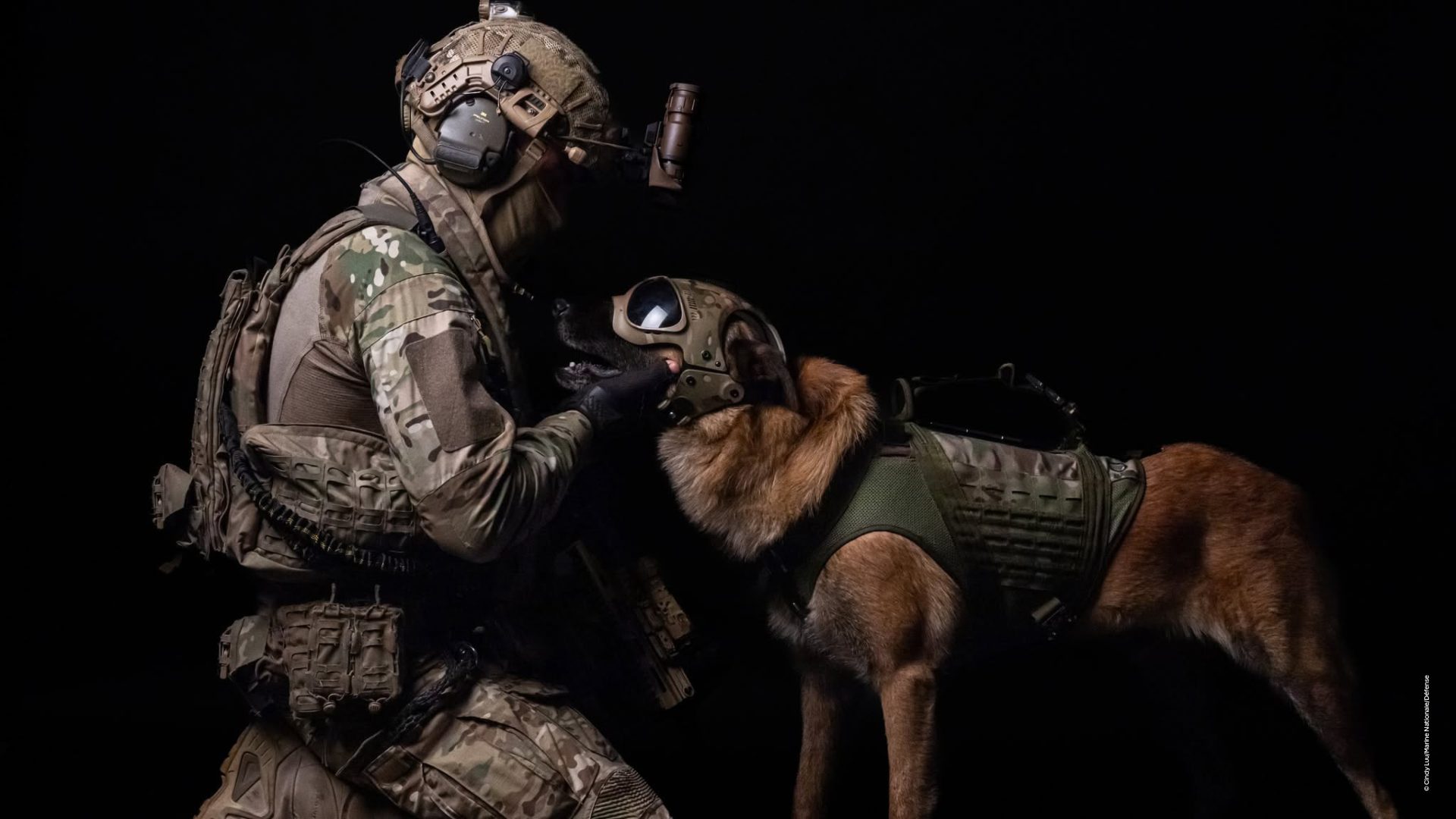
Today, the military dog has thus become a specialised operational partner. The 132nde The K-9 Infantry Regiment is responsible, in particular, for the training and deployment of the Army’s dogs for the detection and neutralisation of adversaries, as well as for the detection of explosives, hazardous substances and ammunition. Within the French Army, there are approximately 2,800 dogs in service, supported by more than 300 dog handlers.
This trend is also evident within the National Gendarmerie, where all dog-handling teams are trained at the Gendarmerie’s National Dog Training Centre (CNICG) in Gramat, in the Lot department. For example, the GIGN has dogs specialised in assault, tracking and explosive detection, some of which can even be guided remotely by their handlers using radio or laser devices. The dog thus becomes a true extension of the soldier’s capabilities, within a human-animal partnership whose effectiveness relies as much on training as on the complementary nature of their skills.
- To find out more about the role of dogs in the armed forces: My Dog, That Soldier (#JDEF)
From animals to machines: replicating the capabilities of living organisms
The gradual replacement of certain animals with machines is a response to a number of developments. Fatigue, dietary requirements, care needs, injuries and the constraints associated with transport and long distances limit an animal’s operational capabilities. Added to these constraints are changing ethical considerations and society’s evolving attitude towards the use of animals in combat. As the Ministry of the Armed Forces points out, their use is now increasingly being questioned from a philosophical and ethical perspective.
But technology does not merely seek to replace animals; it also seeks to replicate some of their capabilities. The approach has thus gradually shifted from the animal itself to its function, and then from its function to its technological equivalent: horses and mules for transport, replaced by vehicles and logistics robots; pigeons for communication, superseded by radio communications, drones and satellites; and dogs for detection or reconnaissance, for which drones and robots can now provide alternatives. Biomimetic robotics goes even further by drawing direct inspiration from an animal’s morphology.
The quadruped robot is one of the most visible examples of this. In France, the Defence Innovation Agency (AID) has acquired two VISION 60 robots from Ghost Robotics in order to trial their tactical use by the three armed forces and the GIGN. These trials focus in particular on the potential for deploying a machine rather than a soldier or an animal in certain environments.
However, French and international military robotics is still largely in a phase of experimentation and development, rather than one of widespread replacement of soldiers or animals. The AID, the Directorate General of Armaments (DGA) and the Army are stepping up trials through initiatives such as CoHoMa (human-machine cooperation), which puts robots and drones through their paces in realistic tactical scenarios, or the Mobilex challenge, which focuses on autonomous mobility across complex terrain. The Pendragon project, meanwhile, is designed to test a robotic combat unit combining several ground and air platforms.
These machines can therefore take over certain tasks previously carried out by animals, whilst offering further advantages: they do not suffer from biological fatigue, can be sent into dangerous areas and are capable of collecting and transmitting data. However, they do have their own vulnerabilities: energy self-sufficiency, maintenance, and dependence on networks and sensors.
However, this development does not mean that animals will disappear from the armed forces. The dog is precisely one area where technology still struggles to replicate all its capabilities. Its sense of smell, mobility, adaptability and, above all, the complementary relationship with its handler make it an aid that is difficult to replace entirely. The Ministry of the Armed Forces describes the human-dog partnership as an «inseparable» team; this is why it purchases around 350 dogs each year for the three branches of the armed forces.
Moreover, innovation is not solely aimed at replacing them: it also serves to protect them more effectively, as demonstrated by research into equipment designed to improve their protection and well-being whilst on operations.
The future therefore seems less about pitting animals against robots and more about their capabilities coexisting. Robots can take on certain dangerous or repetitive tasks, whilst dogs retain biological abilities that are still difficult to replicate artificially.
From the horse to the four-legged robot, history thus illustrates not so much the gradual disappearance of the animal as the transformation of its functions.
 French
  English