
IHEDN Mondays are now available in audio format!
Click below to listen:
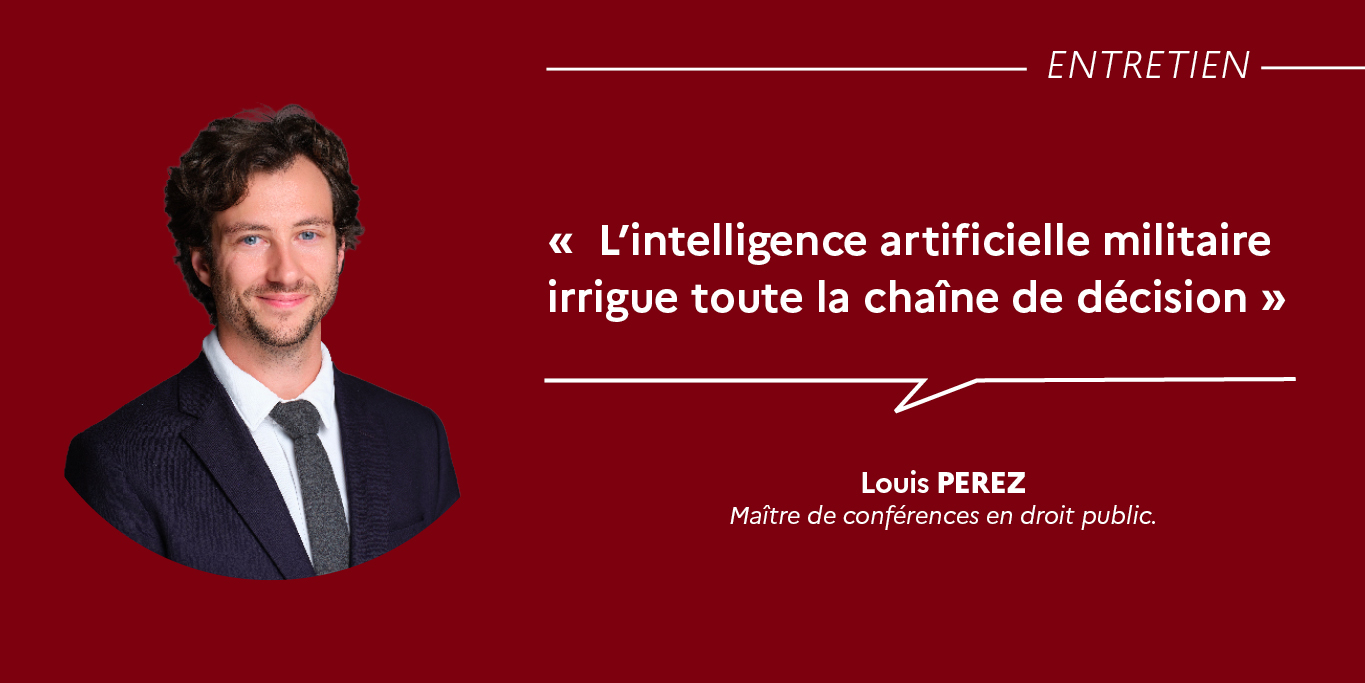
Winner last June Louis Perez, who was awarded a special prize by the IHEDN for his thesis «The international legal regulation of military artificial intelligence», holds a PhD in public law from the University of Paris-Panthéon-Assas. His thesis, funded by a research grant from the Directorate-General for International Relations and Strategy (DGRIS) of the Ministry of the Armed Forces, is the result of work carried out at the Institute for Strategic Research at the École Militaire (IRSEM).
He is currently pursuing his research as a postdoctoral fellow at the Chair in Strategic Studies at the Thucydides Centre at Panthéon-Assas, where he is leading a project on military artificial intelligence and strategic technologies. His work focuses on international humanitarian law, lethal autonomous weapons systems (LAWS), the regulation of GAFAM and the lawfare.
You point out that «killer robots» (SALA) are merely the tip of the iceberg. In your view, which current applications of military artificial intelligence (MAI) are most underestimated by the general public?
SALA systems attract a great deal of attention because they embody a science-fiction trope: that of the «killer robot». As the former Minister for the Armed Forces, Florence Parly, said in her speech on military AI, «The Terminator won’t be marching in the 14 July parade». Yet military AI is a versatile technology that is finding its way into almost every aspect of the armed forces. The most fundamental applications are also the least visible, such as intelligence gathering and decision support.
An AI system can play a role in military decision-making in various ways. It can produce an analysis, make a recommendation or implement the decision itself. Public debate generally focuses on the third scenario. However, the line between these three scenarios is much blurrier than it appears.
Under time pressure, and faced with a system they do not fully understand, operators often find themselves faced with a binary choice: to trust or not to trust. If the recommendation is accepted without critical scrutiny, the decision-support system effectively becomes an autonomous system. A system presented as a simple support tool may therefore, in practice, have effects comparable to those of an autonomous weapon. Yet it is largely excluded from the debate on SALA.
Other applications are sometimes overlooked, such as the use of AI in cyber or intelligence operations. AI should therefore not be viewed as an isolated entity, but as a layer that permeates the entire decision-making process. This is where the key issues – particularly the legal ones – come into play.
You contrast humanism with cybernetics. In what way do the cybernetic paradigm and its computational tools directly threaten the traditional conception of international law and politics?
Modern international law is rooted in a humanist tradition. It is shaped by and for humankind – rational and political beings – and is underpinned by the institution of the sovereign state, which creates and implements it. On a completely different level, cybernetics – a discipline founded by the mathematician Norbert Wiener in the aftermath of the Second World War – is the foundation of AI. Whilst this technical field may, at first glance, have little to do with law, or more broadly with the social sciences, cybernetics in fact embodies a different vision of society and humankind, which it conceives as systems governed by the same laws.
According to its principles, machines, humans and societies are information systems that regulate themselves through feedback. It thus ties in with what the legal scholar Alain Supiot calls «governance by numbers». We are moving from government to governance, from legislation to programming. Legitimacy no longer derives from the law, but from the effectiveness of calculations.
In international law, this tension manifests itself on two levels. The first is that of interpretation. Can a machine apply the law of armed conflict? Assessing the proportionality of an attack or taking the necessary precautions requires contextual judgement, or even an internal debate. The humanist perspective refuses to delegate this judgement to a machine and to reduce human beings to mere data.
The cybernetic approach, on the other hand, holds that the law – and, more broadly, the reality to which it applies – can be digitally codified right from the design stage of systems (by design). A sufficiently effective system could thus apply the law, perhaps even better than a human being. The second level concerns the sources of law. Traditional law is being bypassed in favour of regulation that is shifting towards flexible, technical or ethical standards, often of private origin.
On a more political level, the threat stems from the project that was already being pursued in the 19the In the 19th century, the philosopher Henri de Saint-Simon called for the replacement of the ’government of men« with the »administration of things’. This line of thinking is reflected in what the legal scholar Antoinette Rouvroy and the philosopher Thomas Berns now refer to as algorithmic governmentality.
The development of IAM relies heavily on civilian technology giants (such as GAFAM). How does this dependence on private-sector technology redefine the sovereignty and sovereign powers of states?
This represents a genuine historical reversal. AI originated from US military funding. At that time, technology flowed from the military to the civilian sector. Today, the trend has reversed. It is a handful of major digital companies that hold the expertise, the data, the computing power and the talent. The armed forces, accustomed to dealing with traditional defence companies, are inevitably turning to these new digital players.
This dependence goes far beyond a simple supplier relationship. An AI system is complex and ever-evolving. The company therefore does not deliver a turnkey product. It generally remains necessary for the company to evaluate the system over time, update it, and even use it in real-world conditions, as can be seen with Palantir in Ukraine.
The state thus becomes dependent on the private sector even in its most sovereign functions. These companies have, moreover, acquired attributes of power akin to those of a state. They have public affairs departments which, in practice, carry out quasi-diplomatic missions. They play a decisive normative role, whether through their lobbying on the drafting of legal rules or through their expertise in the development of technical, ethical or political standards. Finally, they obviously wield disproportionate economic clout, greater than that of many states. The state would thus be entering a postmodern form, astutely described by the legal scholar Jacques Chevallier, who demonstrates that this political entity is now facing competition and has been demystified.
However, we must not write off the state too quickly. It remains the sole sovereign. If companies have acquired this power, it is thanks to the state rather than in spite of it. What it has indirectly granted, it can take back. The recent standoff between the Pentagon and Anthropic illustrates this point well. The Pentagon officially designated the company as a «supply chain risk» after it refused to lift its restrictions on mass surveillance and autonomous weapons. Faced with a company seeking to impose limits on it, the state is therefore able to reaffirm its sovereignty. On the other hand, when confronted with a foreign company backed by its home government, the balance of power may prove less favourable.
With regard to the development phase and the legality assessment, do states really have the technical capacity to audit and understand the «black box» nature of these algorithms before deploying them?
They can do so to a limited extent, and in a highly uneven manner. Article 36 of Additional Protocol I to the Geneva Conventions requires an assessment of the lawfulness of new weapons and new means and methods of warfare. In theory, therefore, states must ensure that AI systems operate in accordance with international law. In practice, this leads to confusion between technical certification and legal certification. If the system functions properly from a technical point of view, it is considered lawful.
It is therefore crucial to be able to verify that these systems are functioning correctly. However, this is no easy task, particularly because some AI systems produce their results in a way that is not transparent. Whilst we know the input data, we do not really know how the system arrives at its results. The paradox is that these systems are used precisely because of their speed. Even if it were possible to trace their reasoning, this would negate the time saved – which is precisely the reason for using them. The field of explainable AI (explainable AI (or XAI) is therefore expanding rapidly in order to help us understand how these systems achieve their results, without losing the benefits of their speed and accuracy.
Beyond these purely technical difficulties, the capabilities of states in this area vary considerably. On the one hand, there are the states and companies that develop these systems and possess the relevant expertise; on the other, the purchasing states, which are forced to rely on assessments carried out by others. Some states are resisting this trend, such as France, which points out, for example, that the responsibility for assessment lies with the state and cannot be delegated to an industrial firm.
Some large technology companies are now setting up their own internal structures to assess the compliance of their tools. Are we witnessing a gradual «privatisation» of legal and ethical oversight of these tools?
Article 36, referred to above, imposes an obligation on States Parties to the Protocol. Companies have no specific obligation in this regard. In practice, however, it is in their interests to develop effective systems, and they therefore tend to carry out their own compliance reviews in-house. Palantir, for example, has set up a multidisciplinary team (Privacy and Civil Liberties Engineering), comprising lawyers, philosophers and engineers, which issues specific guidelines to engineers and draws on the advice of an advisory board of independent experts.
At the same time, consultancy firms are even offering their services to governments to help them carry out their legality assessments. The risk, however, is that governments may end up relieving themselves of the responsibility of conducting this assessment themselves, even though the obligation rests primarily with them.
At a time when armed forces are seeking to automate decision-making processes in order to achieve «information superiority», is there not a risk that the proliferation of IAM could lead to an uncontrollable escalation that international law would be unable to curb?
The risk is real. Armed forces are seeking to speed up the «observe, orient, decide, act» cycle in order to gain information superiority. Taken to the extreme, this acceleration has been theorised in the United States under the term ’hyper-war«. Furthermore, the use of AI by non-state actors is becoming an increasingly real threat. When all belligerents rely on automated systems, the speed of operations can outpace human capabilities, leading to a loss of control and, consequently, unintended escalation.
Two factors exacerbate this risk. The first is a climate of competition reminiscent of that in the nuclear sphere. Yet lines of code are far less visible than nuclear warheads. The perception of an adversary’s capabilities matters just as much as their actual capabilities, which fuels a security dilemma. The second factor is the diffuse and dual nature of AI, reinforced by the culture of’open source, which renders traditional non-proliferation regimes largely ineffective.
The law of armed conflict does not set a «maximum speed» for operations, but the precautionary principle requires that all practicable measures be taken in good time to spare civilians.
There could therefore be a conflict between the escalation of hostilities and the time required to apply the law. The only solution would then be to delegate these legal assessments to machines as well, which would apply them at a speed that precludes any human intervention.
Who is responsible when a military AI system makes a mistake?
All stakeholders claim to be committed to «responsible AI», but determining who is liable in the event of a system error is precisely where things get tricky.
The responsibility of individuals, particularly military personnel, is the first thing that springs to mind, but it is also the most difficult to establish. Most violations committed using these systems will not be intentional, but will result from malfunctions, errors or accidents. Yet international criminal law is designed to deal with crimes committed intentionally. The material element often takes the form of an omission, such as failing to verify a recommendation. The mental element often amounts to negligence, which does not, for example, fall within the jurisdiction of the International Criminal Court.
The most promising approach is that of line manager accountability. It operates as a duty of care and fits well with the risk management framework specific to these systems. Its implementation, however, remains largely in the hands of the Member States themselves.
State liability constitutes a parallel approach, which also faces the difficulty of linking a system’s actions to the State. An emerging avenue is that of liability for lawful acts, which obviates the need to establish the existence of an unlawful act. This regime already exists in international law for certain hazardous activities (nuclear, space, etc.). Whilst it would encourage armed forces to test their systems more thoroughly and to restrict their use, it would need to be enshrined in an international instrument, which is not yet the case.
That leaves companies, which are nevertheless central to the development of these systems. They do not have international legal personality. Their liability can therefore only be sought on a residual basis, before national courts or indirectly through that of their directors.
What is the current state of international negotiations? Is a treaty feasible in the short term?
The issue has been under discussion for more than ten years within the framework of the Convention on Certain Conventional Weapons (CCW), in a group of government experts dedicated to SALA. This forum has long been seen as a symbol of deadlock. It operates on the basis of consensus, which allows a handful of states – often those that develop these systems – to block the wishes of a large majority.
The year 2026 marks a milestone, however. On 5 September, the group of experts adopted by consensus a report bringing its 2024–2026 mandate to a close. This report sets out a characterisation of SALA and adopts a two-tier approach aimed at banning systems incompatible with the law of armed conflict and regulating the others. The next steps will be decided at the CCAC Review Conference, from 16 to 20 November. At the conference, States will decide whether to launch full-scale negotiations, an option supported by many States.
In light of the uncertainties surrounding the CCAC, the United Nations General Assembly has, in parallel, taken up the issue. Since 2023, it has adopted an annual resolution on SALA. The Secretary-General has also urged States to adopt a legally binding instrument. These initiatives led States to meet in New York in 2025 for consultations on the issue. The December 2025 resolution on SALA was adopted by 164 votes in favour and 6 against (Belarus, Burundi, North Korea, Israel, Russia, United States).
Above all, the Assembly has begun to broaden the scope of the issue beyond SALA. In 2024 and 2025, it adopted more general resolutions on AI in the military sphere, as well as a resolution in 2025 on the risks associated with the integration of AI into nuclear weapons. These resolutions also prompted international discussions and a report by the Secretary-General on the matter.
To find out more:
 French
 English