
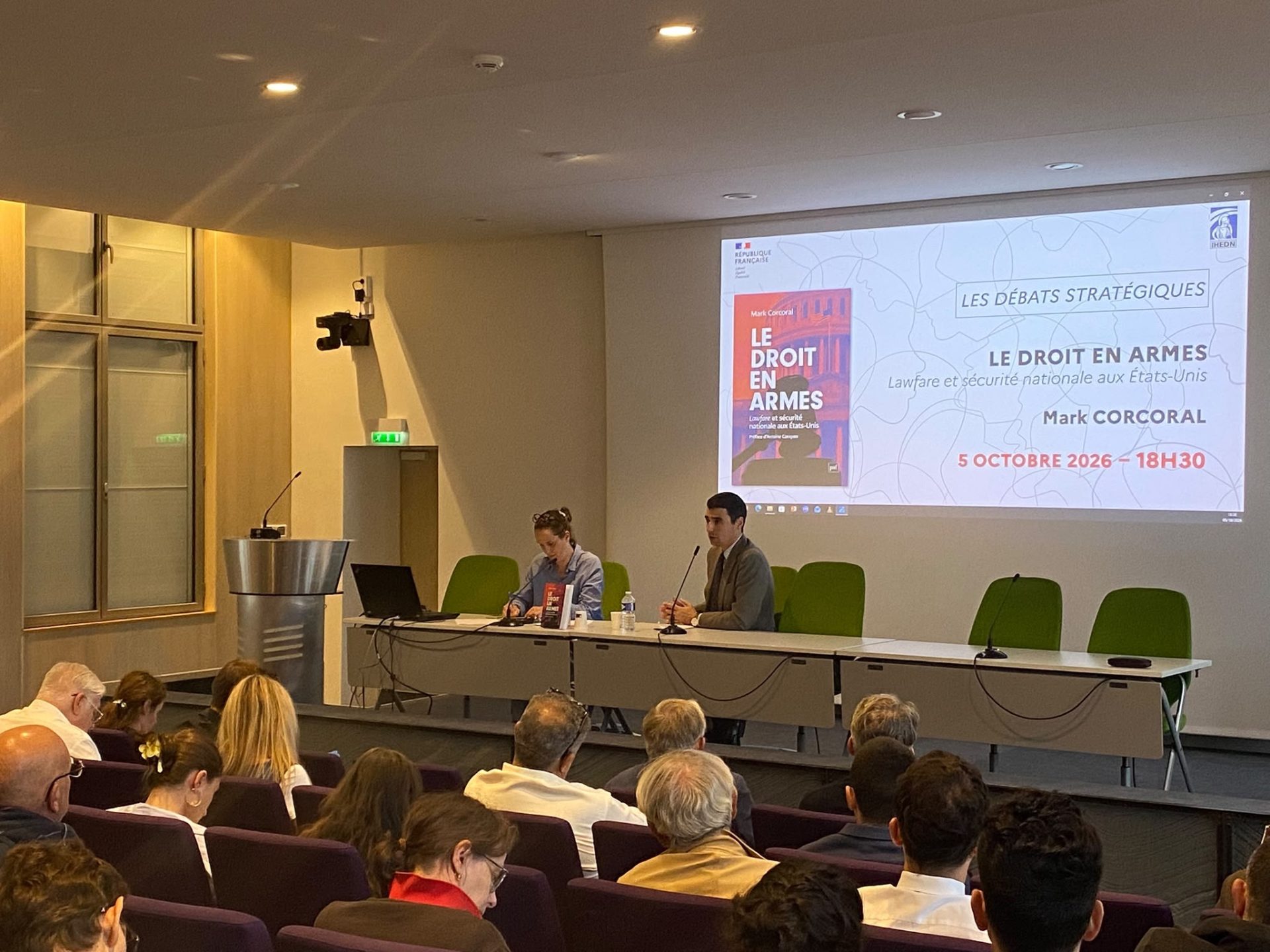
The discussion began with a simple observation: the instrumentalisation of the law is often associated solely with authoritarian regimes, whereas democracies, too, use it as a strategic tool.
What is lawfare? Mark Corcoral defines lawfare as the strategic use of the law to strengthen the security of one party or to undermine that of an adversary. An ordinary legal practice becomes lawfare when three conditions are met: legal ingenuity that derives an unexpected advantage from the law, a fundamental political antagonism, and a security objective. It is this last condition that influences the ethical conduct of legal professionals; the US prosecutors interviewed by the author acknowledged that they had been more creative, or even more aggressive, whenever a matter of national security was at stake. Lawfare is defensive when it reduces the legal risks facing the executive’s actions, and offensive when it hinders an opponent or enlists private actors.
Why the United States? Two factors predispose the United States to lawfare: a legal culture that reveres the law whilst recognising its malleability, in a country where the law predated the state, and a strategic culture that takes a broad view of national security. The Department of Justice (DoJ) is the prime observatory for this, with the Attorney General, who heads the DoJ, serving concurrently as legal adviser to the executive, Attorney General and counsel to the federal government.
Prudence, accommodation, abuse. Mark Corcoral identifies three ways of reconciling the law and national security. A cautious legal policy involves exceeding legal requirements and staying well clear of the boundaries of legality; it therefore does not constitute ‘lawfare’. Accommodating legal policy seeks to bend the law and have this validated by the checks and balances – first the judiciary, then the legislature. Abusive legal policy, the most aggressive form, cloaks an illegal act in a veneer of legality and involves keeping these checks and balances at bay. In a state governed by the rule of law, this latter approach remains precarious.
Turning points, from Watergate to 11 September. Following the Watergate scandal (1973) and the revelations in the 1976 Church Report, intelligence activities have been subject to strict regulatory oversight. It is this regulatory framework that makes legal creativity essential, as it is no longer possible to openly disregard the law in the name of reasons of state. Another turning point was the post-11 September era: Mr Corcoral revisits the definition of torture, interpreted narrowly (the concept of severe pain being derived from a US health insurance law, far removed from considerations of national security), in order to legally authorise the use of «enhanced interrogation techniques». The courts put a stop to this. This was followed by a period of accommodation: mass surveillance was consolidated through a broad reinterpretation of the Foreign Intelligence Surveillance Act, followed by legislative reforms designed to secure the cooperation of private telecommunications operators.
Restricting individuals, regulating businesses. When it comes to terrorism, security takes precedence over justice, and the aim is to criminalise behaviour before it results in an act. This approach has led to a judicial extension of the definition of «material support» for a terrorist organisation, as illustrated by the conviction of John Walker Lindh. With regard to businesses, the aim is not to secure a criminal conviction following a trial, but to ensure compliance and active cooperation. To achieve this, Washington applies the extraterritorial reach of its law, using the US dollar as a criterion for jurisdiction over any transaction passing through a correspondent bank located in the United States.
 French
  English