
This week, General Jacques Langlade de Montgros, Chief of the General Staff of the Army (CEMAT), welcomed the students to the Foch lecture theatre at the École Militaire for the presentation on the Army’s capabilities (PAT).
In his address, he outlined the Army’s main priorities for the year, as well as the progress made in the transformation process undertaken in recent years to adapt the Army’s capabilities to the new strategic environment and developments on the battlefield.
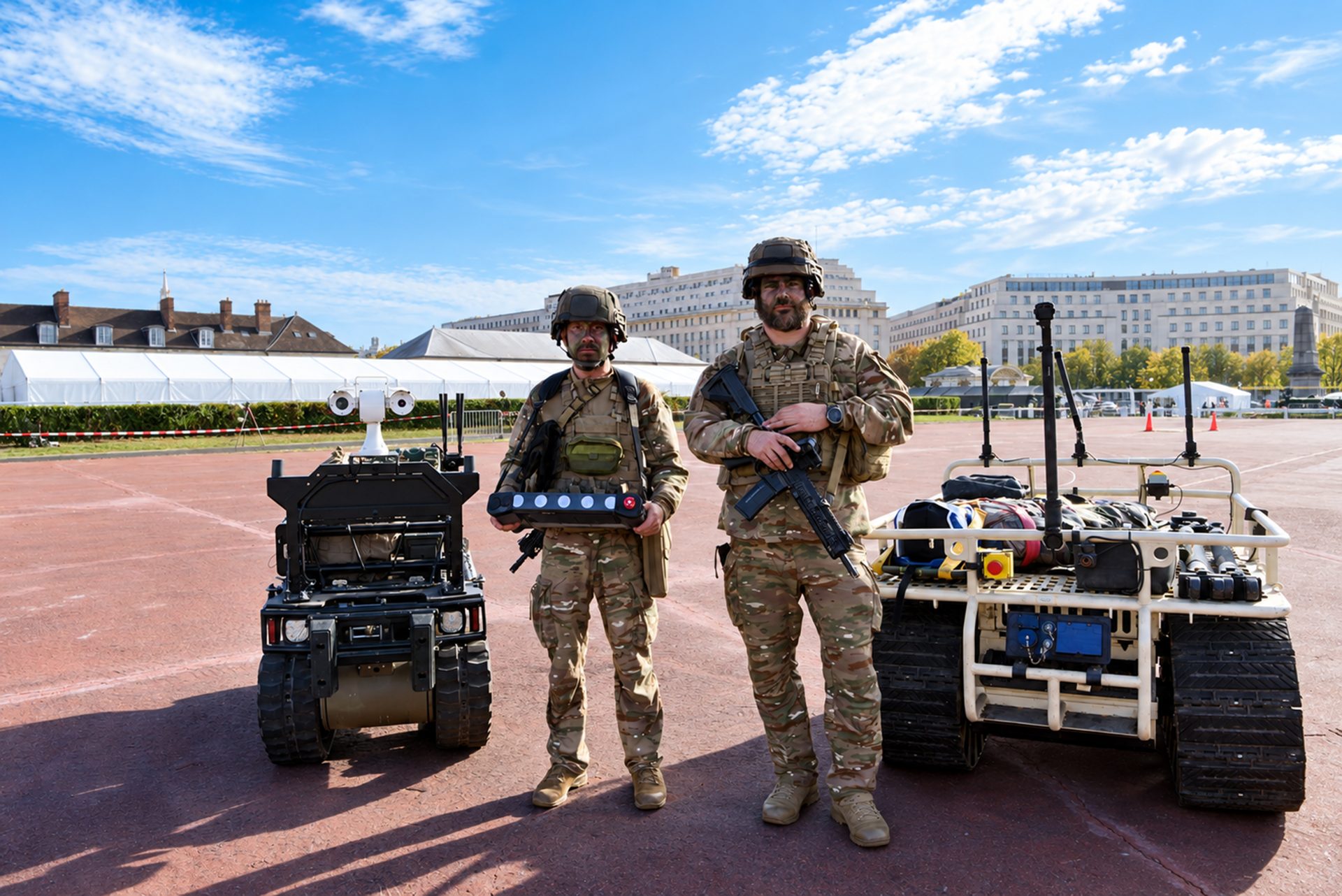
The attendees were then able to watch dynamic and static demonstrations held in the courtyard of the École Militaire. They were thus able to see various pieces of equipment and speak directly with the military personnel involved in operating them.
This provides an opportunity to take stock of the VULCAIN section, which forms part of this process of transforming the Army.
What is the VULCAIN section?
Launched in 2021, the VULCAIN project aims to gradually build a comprehensive air-to-ground robotic capability, the operational and tactical use of which is to be fully mastered by 2040.
The VULCAIN section was set up to test the various possible uses of robots and robotic units. Working in conjunction with the Army’s innovation bodies, it assesses their operational and tactical benefits, as well as their limitations.
It is therefore not simply a matter of «replacing soldiers with robots». The challenge lies in determining how humans and machines can work together within the same operation.
Indeed, the changing nature of conflicts and the widespread emergence of drones, autonomous systems and artificial intelligence are gradually transforming the battlefield. For the Army, robotisation can, in particular, help to reduce the direct exposure of combatants, increase the number of personnel available on the ground, expand the range of sensors and capabilities, and address certain constraints associated with high-intensity conflict. VULCAIN therefore aims to anticipate this transformation rather than simply endure it.
The project aims to answer some very practical questions:
- Which robotic systems should be used?
- For what roles?
- How can they be integrated into combat units?
- How much independence should we give them?
- How can we ensure that humans remain in control?
- What operational benefits can they actually deliver?
In recent years, the CoHoMa (Human-Machine Collaboration) challenge – organised by the Battle Lab Terre and accredited by the Defence Innovation Agency (AID), and forming part of the VULCAIN project – has put this approach into practice. Each year, an exercise is organised simulating a realistic scenario inspired by combat situations. The human-machine teams, comprising the VULCAIN Task Force and organisations from industry, research and higher education, must overcome every trap and obstacle. This enables the study of the synergy between humans and machines, the assessment of the state of the art in robotic air-to-ground combat, and the practical exploration of the conditions for integrating automated systems into units and manoeuvres.
How does VULCAIN fit into the modernisation of the Army?
VULCAIN is a specific initiative dedicated to robotisation, but it complements the Army’s other major transformation projects.
SCORPION : the transformation of close-quarters and collaborative combat, centred on connectivity, information exploitation and new platforms. The programme already includes robotics and drones amongst the technologies likely to shape future capabilities.
TITAN : an extension of the SCORPION programme through to 2040, with an expanded focus on collaborative air-ground combat and the renewal of the heavy-class segment.
MGCS : a Franco-German project designed to form the future land combat system and intended to replace the Leclerc tank as part of this transformation.
In short, with VULCAIN, the challenge is not simply a matter of acquiring new robots. It is about thinking today about how soldiers, vehicles, drones, robots and artificial intelligence systems will be able to work together on the battlefield in the future.
A transformation that forms part of a long-term strategy: experimenting, learning, integrating, then rolling out on a large scale, in order to maintain operational superiority by 2040 and beyond.
What will VULCAIN be like in 2026?
When the VULCAIN contract was signed in February 2021, the Army set itself a timeframe of nearly twenty years to build up its robotic capability. The objective set at that time was clear: to experiment first, gradually integrate robotics into units, and then achieve a fully-fledged air-land robotic capability, with equipment, deployment and tactics all fully mastered. The roadmap thus envisaged an experimental section from 2021, pilot units in 2025, and then operational robotic units from 2030 onwards.
However, the strategic and technological landscape has changed profoundly since that first roadmap. In particular, the Russian invasion of Ukraine in February 2022 marked a turning point. The conflict brought drones, robotic systems, artificial intelligence and data processing to the fore, whilst demonstrating the importance of scale and the ability to produce and rapidly replace equipment. This development has also altered the pace at which the armed forces must innovate. It is no longer simply a matter of defining today the equipment that will be in service in fifteen years’ time, but of being able to experiment rapidly, incorporate feedback and adapt capabilities in line with technological progress and operational requirements.
Today, in 2026, this transformation is entering a new phase. The Army is no longer simply seeking to determine whether robots can be used in combat, but how they can be integrated in practice into a unit and into tactical manoeuvres.
The Pendragon project illustrates this development. Led jointly by the Future Combat Command (CCF) and the Ministerial Agency for Defence Artificial Intelligence (AMIAD), it aims to trial a robotised combat unit enhanced by artificial intelligence, comprising around twenty ground and air platforms capable of cooperating autonomously. An initial operational demonstration is scheduled for 2026, ahead of an initial deployment in 2027.
In parallel and in a complementary manner, the CoHoMa challenge continues to explore the fundamentals of air-land tactical robotics.
The Army is therefore now carrying out several projects, each providing different insights into cooperation between combatants, drones, robots and artificial intelligence systems.
The original timetable has thus gradually evolved, shaped by operational realities and technological developments, but the ultimate goal remains the same: to be operational by 2040.
 French
  English