

This fact sheet is also available in audio format
Click below to listen:
Summary
- Since the 1960s, Europe has been developing a space strategy combining cooperation and independence, marked by the creation of the European Space Agency (ESA) in 1975 and the success of the Ariane launchers, which provide autonomous access to space while promoting scientific and technological partnerships.
- Faced with the «new space race», the European Union has adopted the Space Act in order to harmonise regulations, secure its infrastructures, strengthen the competitiveness of its industry and promote a responsible approach, in particular through space traffic management and consideration of the environmental footprint.
- This document marks the EU's desire to unify its space policies around strategic issues, but in some areas this ambition is coming up against the reluctance of Member States and competition from the European Union. New Space.
Context - A European space strategy between cooperation and independence
Faced with the space exploits of the two blocs during the Cold War, Europeans and their companies quickly sought to cooperate with the United States as well as with the USSR/Russia, while developing their own capabilities. The first step in this direction was the creation of the European Space Research Organization (ESRO) in 1962, with the aim of building scientific satellites. It brought together ten European countries, including France, West Germany and the UK. In the same year, six of these countries decided to join forces in the European Launcher Development Organization (ELDO) to develop a European launcher called Europa. The two organisations became operational in 1964. The emergence of satellite telecommunications also led to the creation of the European Telecommunications Satellite Conference (CETS) in 1963.
Science and launchers have therefore been the pillars of European space from the very beginning of the European space adventure. ESRO successfully developed its first satellite in 1968 to study cosmic rays and solar X-rays. ELDO, on the other hand, abandoned its Europa launcher project in 1972. In fact, the priorities of the various member countries often diverged. To remedy this, and in order to centralise and relaunch European space, France, Germany and the United Kingdom joined forces to provide funding for the main programmes expected by the various member countries: the L3S (Ariane) launcher requested by France, under the prime contractorship of the Centre national d'études spatiales (CNES), the Spacelab research module requested by Germany and the MAROTS maritime telecommunications satellite requested by the United Kingdom. These three programmes form the basis of the European Space Agency (ESA). When it was created in 1975, eleven European Member States signed the European Space Agency Convention. The Agency's establishments are spread across Europe: its headquarters are in Paris, the European Space Technology Centre is in the Netherlands, and the European Space Operations Centre and the European Astronaut Centre are in Germany. The European Space Research Institute is based in Italy, the European Centre for Space Astronomy in Spain and the Centre for Applications and Telecommunications in the UK.
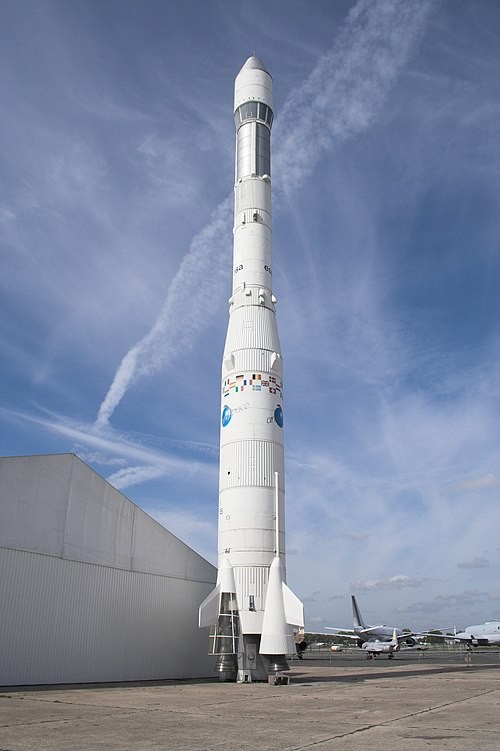
The first generation of ESA projects, pursuing the initial ambition of independent access to space, focused on the development of Ariane launchers. The first flight of Ariane 1 took place in 1979. But it was with Ariane 4 (developed between 1988 and 2003) that Europe became the leader in the commercial launch market in the 1990s (113 successful launches between 1988 and 2003). ESA also carries out research programmes, such as the Giotto mission (1986), which studied Halley's comet and was a major scientific breakthrough. Its researchers are also developing programmes in cooperation with NASA, in particular the aforementioned Spacelab, a modular space laboratory designed in Europe and carried in the payload bay of the American space shuttles between 1983 and 1998. It enables astronauts to carry out scientific experiments in orbit. In the 2000s, Europeans became involved in other major space projects, contributing in particular to the International Space Station (ISS), a large scientific laboratory in low Earth orbit, occupied to this day by an international crew.
As an independent agency, ESA is not integrated into the institutions of the European Union. However, ESA and the EU share funding and have been working together since the 1990s, in particular on major projects guaranteeing the independence of European space activities, such as Galileo, the geolocation instrument, and Copernicus, the Earth observation programme. The first joint meeting between ESA and the EU took place in 2007. Following this meeting, the Agency adopted a resolution on European space policy to provide a framework for institutional cooperation. The main objectives of this resolution are: the coordination of civil space programmes between ESA, the EU and the Member States; the development and exploitation of European space applications and satellite communication applications; the preservation of autonomous access to space; synergy between defence and civil space programmes and technologies, including the interoperability of civil and military systems; and the coherence of space policy with the EU's external relations.
On the European Union side, space activities have been grouped together since 2021 within the European Union Agency for the Space Programme (EUSPA). To date, the various components of space activities managed by the European Union include satellites, launchers, the space surveillance and monitoring support framework (SST), the European Geostationary Navigation Overlay Service (EGNOS), the commitment to the ISS, the development of science and technology and space surveillance.
Analysis - A security-oriented space strategy
In recent years, the European Union has adopted a number of space-related texts aimed at defining a common policy on the safety and management of space traffic. Published last June, the Space Act is part of this ongoing process. This document, which is due to come into force on 1er The European Space Strategy for 2030 is the first proposal for a European regulation specifically dedicated to the harmonised management of civil space activities. It is based on six pillars: harmonising regulations; securing orbits; protecting space systems; securing space services; building a more sustainable space economy; and broadening future horizons.
The concerns about protecting space systems and securing space services set out in the Space Act echo the European Commission's efforts to enhance Europe's strategic autonomy in space. The deployment of a secure European connectivity constellation, IRIS2, is the most recent step in this process. It is a multi-orbital constellation of 290 satellites combining medium and low earth orbit. Planned for 2030, it is intended to provide secure connectivity services for the EU and its Member States, as well as broadband connectivity for government authorities, private companies and European citizens, while guaranteeing high-speed internet access to compensate for areas not covered by traditional operators. This system will make Europe less dependent on other players for its strategic or governmental needs. It is an extension of the Copernicus and Galileo programmes, which were already designed to achieve greater autonomy on a European scale. IRIS2 goes even further, as it is a proprietary infrastructure.
Another objective of the Space Act is to overcome the current fragmentation of national space regulations. Faced with the growing power of the United States and China in this new «space race», the desire for a more agile space ecosystem on the European side is palpable. To this end, the text sets out a number of simplification measures and the establishment of a «single space market». Indeed, around 40% of the European space industry's turnover comes from the commercial sector, a much higher figure than in the United States. To make the sector more agile, the new regulations propose easier access to the market, as well as lighter administrative procedures for companies.
However, with this text, the European Union is also seeking to distinguish itself from other powers by asserting a reasoned and responsible approach to the space environment. The text aims to establish «common standards for space traffic management» in response to the growing number of satellites in orbit, which increases the risk of collisions and space debris. Taking account of the environmental footprint is another major advance in the text. Until now, there has been no standardised method for assessing the environmental impact of launches and in-orbit operations. The Space Act announces the introduction of a European methodology to measure and better control this footprint.
Prospects - Is Europe still too timid in the face of the «new space race»?
In conclusion Space Act is devoted to developing a common framework for analysis and defining a shared space strategy. It aims to harmonise the various existing space policies within the Union by proposing a regulatory framework and setting clear priorities, such as security and environmental protection. However, the EU, as a space player, comes up against institutional limits. For example, Member States« concern for sovereignty, particularly as regards information sharing, is holding back progress in pooling Earth observation capabilities for military purposes. However, changes in the international context are forcing the EU to move towards a more »strategic space". The war in Ukraine, in particular, has acted as a catalyst in legitimising the strengthening of European space capabilities, whether for defence or dual use. Europeans are now embracing the strategic dimension of space, working on notions of vulnerability, protection and attribution of attacks. Space is thus going beyond its purely technological role. However, divergences persist between Member States, particularly in the field of launchers, where Europe is facing increased competition from the United States. New Space.
Bibliography
This This fact sheet is based on information from the following sources:
- European Space Agency, «ESA: facts and figures», accessed on 24 September 2025.
- Autret, Florence, «Quelle organisation pour l'Europe spatiale?, Foreign policy, 2007.
- Chaaban, Florian, «Space Act: towards a unified and sustainable space policy for the European Union», All of Europe, 25 June 2025.
- Cité de l'espace, «NASA's budget under pressure», published on 7 May 2025.
- European Commission, «IRIS²: the new EU Secure Satellite Constellation, Infrastructure for Resilience, Interconnectivity and Security by Satellite», EU Space, 16 December 2024.
- European Commission, EU Space Act, 25 June 2025.
- Dagorn, Gary, « La réduction du budget de la NASA menace d'annulation 44 missions spatiales dès 2026, selon le décompte du ‘Monde’», Le Monde, 17 June 2025.
- Darnis, Jean-Pierre, «Sécurité et défense spatiale de l'Union européenne», in: L'Année de défense nationale 2025, La documentation française, October 2024.
- Diris, Jean-Pierre, «IRIS2: everything you need to know about this new European constellation», Polytechnique Insights, 11 March 2025.
- Heurteaux, Stéphane, L'Union européenne et le fait aérien et spatial : histoire et perspectives, National Defence Review, 2019.
- Jacqué, Philippe, L'Union européenne se dote d'une stratégie spatiale pour la défense, Le Monde, 16 March 2023.
- Ministry of Higher Education and Research, «Actors in European Space Policy», 27 June 2023.
- Palacin, Hugo, «What is the European Space Agency?, All of Europe, November 2, 2023.
- Pinaud, Olivier, «Despite Ariane's renaissance, Europe's space challenge remains immense», Le Monde, 1 September 2025.
- Posaner, Joshua, The European Space Agency plans to increase its defence budget considerably, Euractiv, 18 April 2025.
- Sartorius, Emmanuel: «Une ambition spatiale pour l'Europe, vision française à l'horizon 2030», Centre for Analysis and Forecasting, 2011.
- Tumanyan, Albert, «EU Space Act: deciphering the draft European Space Regulation», Space Law, 13 July 2025.
- Vie publique, «Space», accessed on 24 September 2025.
- Voulkovski, Helena, «Europe in the rivalries of Space», Conflits magazine, 31 July 2024.
This file is automatically translated
 French
  English