

This fact sheet is also available in audio format
Click below to listen:
Summary
- Russia's interventionism, revisionism and imperialism on the international stage are the main source of concern for Estonia, Latvia and Lithuania.
- The Baltic States' defence policies are based on a comprehensive approach, combining increased attention to national defence capabilities, the central role assigned to collective defence, and strengthening the preparedness and resilience of the population as a whole.
Members of the North Atlantic Treaty Organisation (NATO) and the European Union (EU) since 2004, Estonia, Latvia and Lithuania re-established their independence in the early 1990s, after half a century of Soviet occupation. As soon as they regained their independence, these three states designed their foreign and defence policies with a resolutely Euro-Atlantic outlook. The challenge was to secure the free and sovereign existence of their countries in the face of a Russia perceived, at best, as an uncooperative and contemptuous neighbour, and at worst, as a threat.
Context - Estonia, Latvia and Lithuania face Russia
Relations with Russia are an essential element in understanding the positioning and actions of Estonia, Latvia and Lithuania on the international stage, as well as the more specific orientations that these three states give to their defence policies. Specialists on the region often refer first and foremost to the weight of the past to explain the tensions that characterise these relations. Russia has never explicitly acknowledged the USSR's occupation of the Baltic States in 1940, and in 2014 Vladimir Putin even rehabilitated the Molotov-Ribbentrop Pact of 1939, whose secret protocols established German and Soviet spheres of influence in Eastern Europe. A certain arrogance in Russian diplomacy and policy towards its neighbours, widely documented by researchers, also illustrates Moscow's staging of its superiority, and more broadly its refusal to consider the Baltic States as interlocutors in their own right. Finally, Russia's resolutely interventionist, revisionist and imperialist approach on the international stage is a major source of concern for Estonia, Latvia and Lithuania.
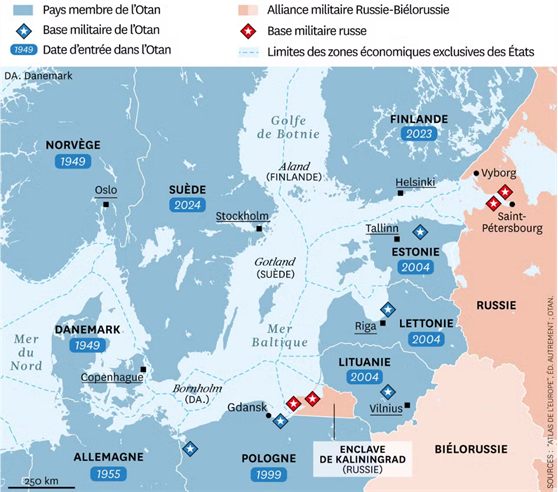
On the eve of the dissolution of the USSR, while the three Baltic States were already engaged in the process of re-establishing their independence, Latvia and Lithuania were attacked by Soviet forces in 1991, resulting in a number of civilian casualties. Moscow then proved particularly difficult during negotiations on the withdrawal of Russian troops from the Baltic States. Russia was already using the issue of the rights of Russian-speaking populations to slow the process down. The Soviet occupation significantly altered the demographic composition of Estonia and Latvia and, to a lesser extent, Lithuania. The proportion of the Russian-speaking population in Estonia and Latvia rose from around 10 % in 1940 to over 30 % in 1991. Following tough negotiations, Russian troops finally evacuated Lithuania in August 1993, followed by Estonia and Latvia in August 1994.
However, during the 1990s and 2000s, Russia did not hesitate to use various means of pressure against the Baltic States, ranging from sanctions on agri-food products to cuts in energy supplies. With varying degrees of radicalism depending on the period, Moscow also opposed the three Baltic States« aspiration to join NATO. Although the integration of Estonia, Latvia and Lithuania into NATO and the EU took place against a backdrop of relative calm in 2004, relations with Russia soon returned to their usual state, described by a Lithuanian researcher as »constantly bad to non-existent".»[1].
In 2007, Estonia was hit by a vast campaign of computer attacks targeting its political, administrative and economic institutions, as well as its media. The attacks came against a backdrop of diplomatic crisis between Moscow and Tallinn following the Estonian authorities' decision to move a monument commemorating Soviet soldiers in the Second World War. These cyber attacks were a real wake-up call, marking a turning point in awareness of the importance of cyber for national defence and security. Estonia, already well advanced in the digital field, is gradually establishing itself as a real leader in cyber security. Since 2008, it has hosted NATO's Cooperative Cyber Defence Centre of Excellence (CCDCOE).
The war between Georgia and Russia in 2008, which resulted in Moscow recognising the independence of the Georgian separatist territories of South Ossetia and Abkhazia, is seen by Baltic elites and civil society as further proof of Russia's hegemonic behaviour and the threat it poses to European security. The Balts denounce an act of interference that could be repeated in other territories that Russia might consider to be part of its «sphere of influence». Andrius Kubilius, former Prime Minister of Lithuania, leader of the conservative party then in opposition at the time of the Russo-Georgian war, and European Commissioner for Defence and Space since 2024, declared at the time: «The next one may be Ukraine, and then it may be our turn».»[2]. As well as mobilising in support of Georgia, the Baltic states are sounding the alarm and looking for ways to consolidate their own defence. Against a backdrop of major national economic difficulties resulting from the global financial crisis of 2007, they are nevertheless having to contend with the limited national resources available for their defence. They are insisting on the need to prepare dedicated defence plans within NATO. Despite initial reluctance on the part of some of their allies, these regional defence plans - initially intended for Poland - were extended to the Baltic states and were officially announced at the Nato summit in Lisbon in 2010.
Russia's illegal annexation of Crimea in 2014 and its intervention in Ukraine's Donbass region mark a point of no return in relations between the Baltic States and Russia. Tallinn, Riga and Vilnius strongly condemned the Russian aggression, asserted themselves as fervent defenders of the Ukrainian cause and actively mobilised to prevent and counter the expansion of the Russian threat. They are therefore investing massively in their defence and negotiating additional deterrence and defence measures with their allies. Against this backdrop, NATO launched its Response Plan (Readiness Action Plan, (RAP) at the summit in Wales in 2014. This plan includes strengthening the air policing of Baltic airspace. At the Warsaw summit in 2016, the Allies also established a reinforced forward presence (enhanced Forward Presence, (eFP), resulting in the deployment of multinational battlegroups (the equivalent of a battalion) in the Baltic States and Poland.
Analysis - Defence and resilience at the heart of the Baltic States' concerns since 2014
The defence policies of the Baltic States are based on a global approach combining, in addition to collective defence, national military capabilities with the resilience of all citizens.
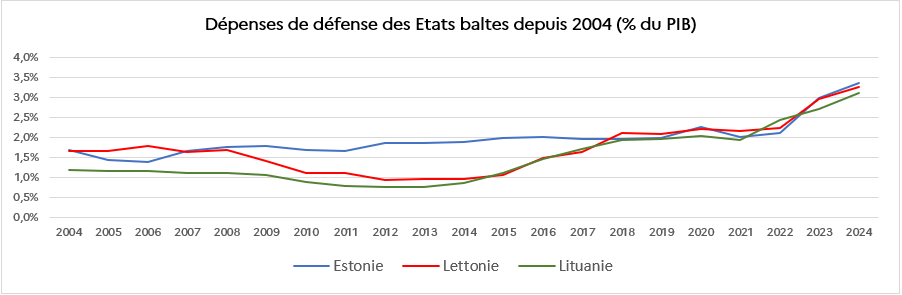
As far as the national armed forces are concerned, all three countries have compulsory military service in common. Estonia has organised its defence forces on a dual model without interruption since the 1990s. It has a modest active army backed up by a reserve army made up mainly of reservists who have completed their compulsory military service. In all, almost 20 % of the Estonian population is currently on the mobilisation register. Latvia and Lithuania are taking a slightly different approach. After embarking on the professionalisation of their armed forces in the 2000s, both countries are reintroducing conscription - Lithuania in 2015, Latvia in 2023 - against a backdrop of a deteriorating security environment.
This has also led to a significant increase in defence budgets. Today, their defence effort exceeds 3 % of GDP, with an upward trend to 6 % of GDP by 2030. This rearmament translates directly into the modernisation and acquisition of new equipment. The most significant contracts include the purchase of the German IRIS-T air defence system by Estonia and Latvia, M142 HIMARS artillery systems from the United States by the three Baltic states, German Leopard 2A8 tanks by Lithuania, ASCOD combat vehicles from Spain by Latvia, and French CAESAr guns by Estonia and Lithuania.
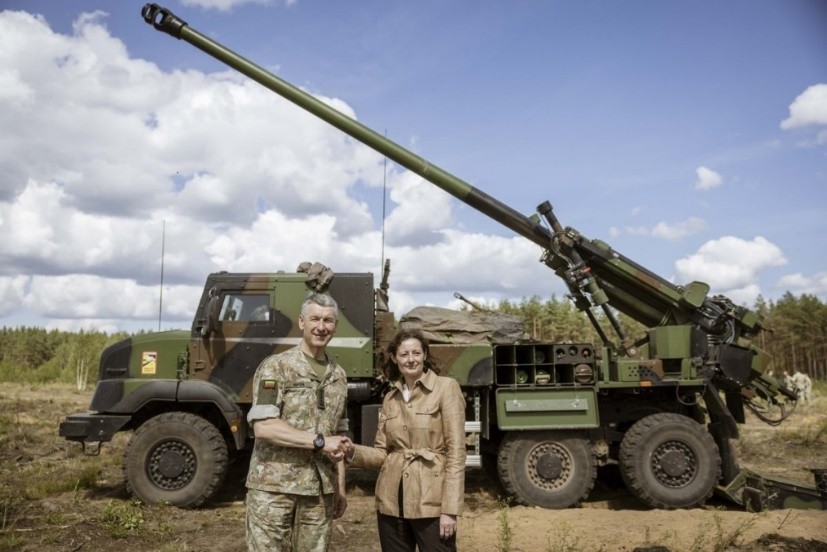
Tallinn, Riga and Vilnius are also undertaking other significant initiatives to strengthen their deterrence and defence capabilities. Following the example of Poland, which is reinforcing its eastern border with the «Eastern Shield», the three Baltic states are launching a similar defence line project in 2024. This involved building a network of bunkers, installing counter-mobility equipment, roadblocks and placing explosive charges under bridges. In March 2025, Lithuania withdrew from the Oslo Convention banning cluster munitions. At the same time, the three Baltic States, along with Poland, announced their withdrawal from the Ottawa Convention banning anti-personnel mines.
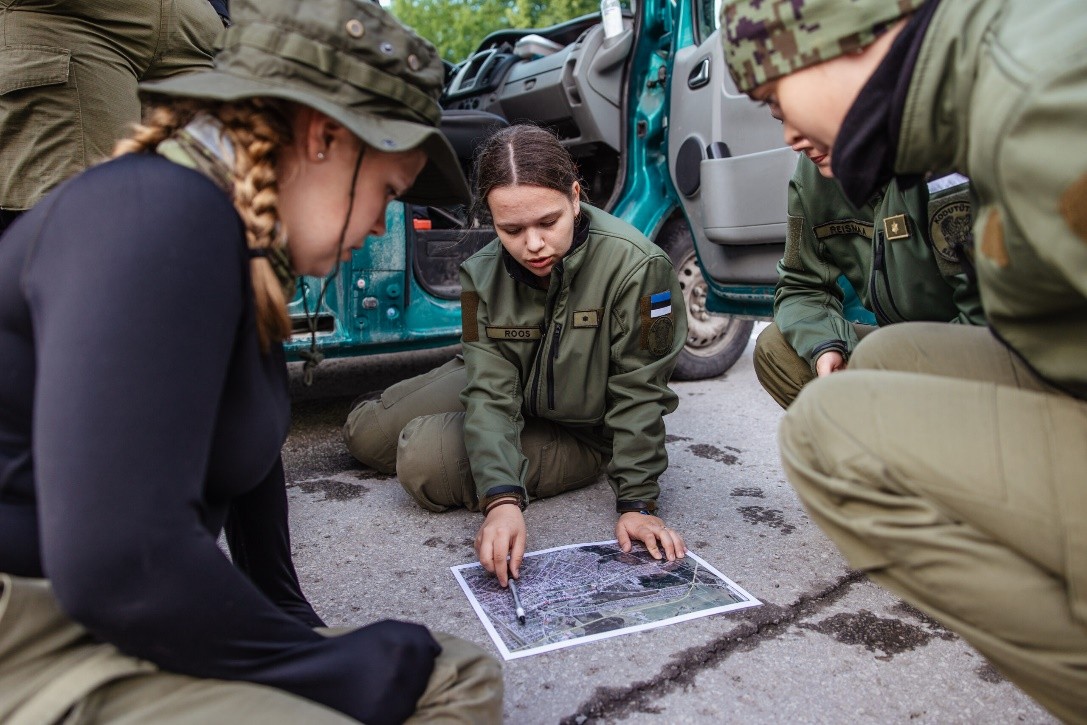
Defence preparedness also relies on actions aimed at strengthening people's resilience. Supported by both the public authorities and civil society, various initiatives are developing people's ability to deal with a variety of threats, to react appropriately in crisis situations and, where necessary, to resist and take part in defending the country in times of war. This takes the form of numerous information and awareness campaigns, such as the production of «survival manuals» and training modules open to all on subjects such as mobilisation, civil resistance and support for the host country when allied armed forces arrive.
Since the start of the war in Ukraine, Baltic citizens have also become massively involved in defence organisations bringing together civilian volunteers, such as the Estonian Defence League and the Lithuanian Union of Gunmen. Enjoying a high degree of autonomy, while being supported and supervised by the State, these structures aim to strengthen the capacity of the population to resist and defend their country. According to the latest available data, they have around 29,000 members in Estonia and 17,000 in Lithuania. These figures include members of youth organisations open to citizens from the age of 7 in Estonia and 11 in Lithuania.
Outlook - The Baltics on Europe's eastern security flank
With Europe's centre of gravity shifting eastwards in the wake of Russia's war in Ukraine, the three Baltic States occupy a special place. The allocation of the post of EU High Representative for Foreign Affairs and Security Policy to Estonia's Kaja Kallas, and that of Commissioner for Defence and Space to Lithuania's Andrius Kubilius in 2024, demonstrates that these countries' strategic views are being taken into greater account at European level.
Faced with the Russian threat, identified years ago by Tallinn, Riga and Vilnius and whose potential for the future is taken very seriously, the Baltic States are getting organised and preparing themselves. Since they consider the outcome of the war in Ukraine to be decisive for their own security and that of Europe as a whole, they are asserting themselves as one of the main supporters of the Ukrainian cause and are positioning themselves as leaders, in terms of share of GDP, in the aid given to Kyiv. At the same time, they are steadily strengthening their national defence capabilities. The Lithuanian Defence Minister's much-publicised statement, made during her visit to Washington in March 2025, to the effect that the only way to negotiate with Russia is to put «arms on the table», is an example of this.»[3], illustrates the Baltic approach to Russia.
Finally, the Baltic States are very attached to the principle of collective defence and are aware of their limited capacity to deal with the Russian threat on their own in the long term, so they are particularly keen to maintain close links with their allies. Estonia, Latvia and Lithuania have always sought to assert themselves as good and reliable partners and then allies, for example by providing military support in Afghanistan or Africa, such as Estonia's contribution to Task Force Takuba in Mali. In addition to the United States, the Baltic States are now counting on their European allies to strengthen the defence of the eastern flank of NATO and the EU. The inauguration of a German military brigade in Lithuania in May 2025 - Germany's first permanent military deployment abroad since the end of the Second World War - illustrates this dynamic.
[1] Dovilė JAKNIUNAITE, «Nuo stabiliai blogų prie jokių: Lietuvos ir Rusijos santykiai 2004-2021 metais», in Dovilė Jakniūnaitė, Česlovas Vytautas Stankevičius, Vilenas Vadapalas, Gediminas Vitkus, Dainius Žalimas, Lietuvos ir Rusijos sutartis dėl tarpvalstybinių santykių pagrindų, Vilnius, Mykolo Romerio universitetas, 2021, pp. 163-179
[2] Marielle Vitureau's private archives cited in Katerina KESA, Countries receiving foreign aid and donor countries: the place and role of the Baltic States between the Nordic countries and the post-Soviet States through the prism of sponsorship (1985-2013), Doctoral thesis, INALCO, 2015, p. 225
[3] Lucas Y. TOMLISON, «Lithuanian defence minister: Only way to negotiate with Russia is with a ‘gun on the table’», FoxNews, 10 March 2025
To find out more
Bibliography
This This fact sheet is based on information from the following sources:
- AFP, Russian manoeuvres: NATO on the lookout to gauge the show of force, France 24, 2017
- Estonian Defence League, About the Estonian Defence League, Kaitseliit
- Eitvydas BAJARūNAS, The Baltics Adapt to Trump, Center for European Policy Analysis, 2024
- Elie GUIDI, Cluster munitions: why Lithuania is withdrawing from the Oslo Convention, La Croix, 2025
- Chloé HOORMAN, Lithuania, at the forefront of the defence of Europe, Le Monde, 2025
- IISS, Military Balance Plus, International Institute for Strategic Studies
Dovilė JAKNIŪNAITĖ, Česlovas Vytautas Stankevičius, Vilenas Vadapalas, Gediminas Vitkus, Dainius Žalimas, Lietuvos ir Rusijos sutartis dėl tarpvalstybinių santykių pagrindų, Vilnius, Mykolo Romerio universitetas, 2021.
Živilė KALIBATAITĖ, International recognition through the projection of armed force: the case of Lithuania's foreign military intervention policy (1994-2019), PhD thesis, Université de Namur, Université Paris-Est, 2020
- Kauno Diena, Lietuvai prisieks beveik 700 naujų Lietuvos šaulių sąjungos narių, Kauno Diena, 2023
Katerina KESA, Countries receiving foreign aid and donor countries: the place and role of the Baltic States between the Nordic countries and the post-Soviet States through the prism of sponsorship (1985-2013), PhD thesis, INALCO, 2015
- Łukasz KULESA, «Central and Eastern Europe: new centre of gravity or troublemaker?», Foreign policy, 241(1), 2024, translated from English Cadenza Academic Translations, pp. 37-49
- Laurent LAGNEAU, Estonia and Latvia to pool their purchases of German IRIS-T SLM air defence systems, Military Zone, 2023
- Laurent LAGNEAU, Lithuania has officially ordered 44 Leopard 2A8 tanks from Germany, Military Zone, 2024
- Laurent LAGNEAU, The French Army forges an unprecedented partnership with the Estonian Defence League, Military Zone, 2023
- Augustė Lyberytė, Ūla Klimaševska, Austėja Paulauskaitė, ELTA, Vilniuje pasirašytame memorandume įtvirtintas siekis gynybai skirti bent 5 proc. BVP, LRT, 2025
- Estonian Ministry of Defence, Defence Forces, MIL.ee
- Vilius NARKUNAS, ELTA, LRT.lt, Prezidentas : įsipareigojame gynybai skirti nuo 5 iki 6 proc. BVP, LRT, 2025
- SIPRI, SIPRI Military Expenditure Database, SIPRI
- Charles SZUMSKI, Germany deploys its first permanent brigade abroad since the Second World War, Euractiv, 2024
- Amélie Zima, «NATO's enhanced forward presence (eFP) in the Baltic States and Poland. Apports et limites de la dissuasion conventionnelle multilatérale», Research note, n°131, IRSEM, 2022
- Amélie Zima, «Fortifying Poland? The Eastern Shield Project», Ifri Briefings, Ifri, 2024
This file is automatically translated
 French
  English