
IHEDN Mondays are now available in audio format!
Click below to listen:
Two and a half centuries ago, when the United States of America declared its independence from Great Britain on 4 July 1776, victory was far from assured. The balance of power lay firmly with the kingdom of George III, the world’s leading military and naval power at the time. Faced with a seasoned professional army, backed by an all-powerful navy and mercenaries from German principalities, the American insurgents had only a makeshift militia, sorely lacking in weapons, ammunition, formal military training and stable funding.
However, the Americans enjoyed strategic advantages: they were fighting on their own territory – vast and difficult to control – for an existential cause that rallied a large section of the population, whilst the British had to contend with extremely vulnerable transatlantic supply lines and colossal logistical costs.
The Kingdom of France, Great Britain’s great rival, ceded a third of the North American continent – «New France» – to it following its defeat in the Seven Years’ War in 1763. Since then, Versailles has kept a close watch on the upheavals affecting its enemy across the Atlantic: as early as 1764, the Duke of Choiseul, Louis XV’s chief minister, sent agents there.
The War of Independence began in 1775, with the French already fighting alongside the insurgents. «Through private initiatives, young officers, engineers and cartographers who needed to advance their careers travelled to America and contributed their expertise,» states Iris de Rode, an expert on French involvement in the American War of Independence.
Around 20,000 French people fought in the various theatres of this conflict
This Dutch historian, who is currently Thomas Jay McCahill III Fellow at the’American Revolution Institute of the Society of the Cincinnati, in Washington, completed his studies at the University of Paris 8 a thesis about one of these officers, François-Jean de Chastellux (the book (the work based on it was awarded the Guizot Prize by the Académie française).
At the start of the uprising, Louis XVI, who had succeeded his grandfather in 1774, was determined not to involve France openly. His country’s involvement became official in 1778 and, until the signing of the Treaty of Paris – which confirmed Britain’s defeat on 3 September 1783 – some 20,000 Frenchmen had fought across the various theatres of this conflict. This support was largely decisive, according to Iris de Rode:
«Without the alliance with France, the Americans would probably not have been able to defeat the British in the 1780s. They might eventually have achieved independence, but much later and under very different circumstances.»
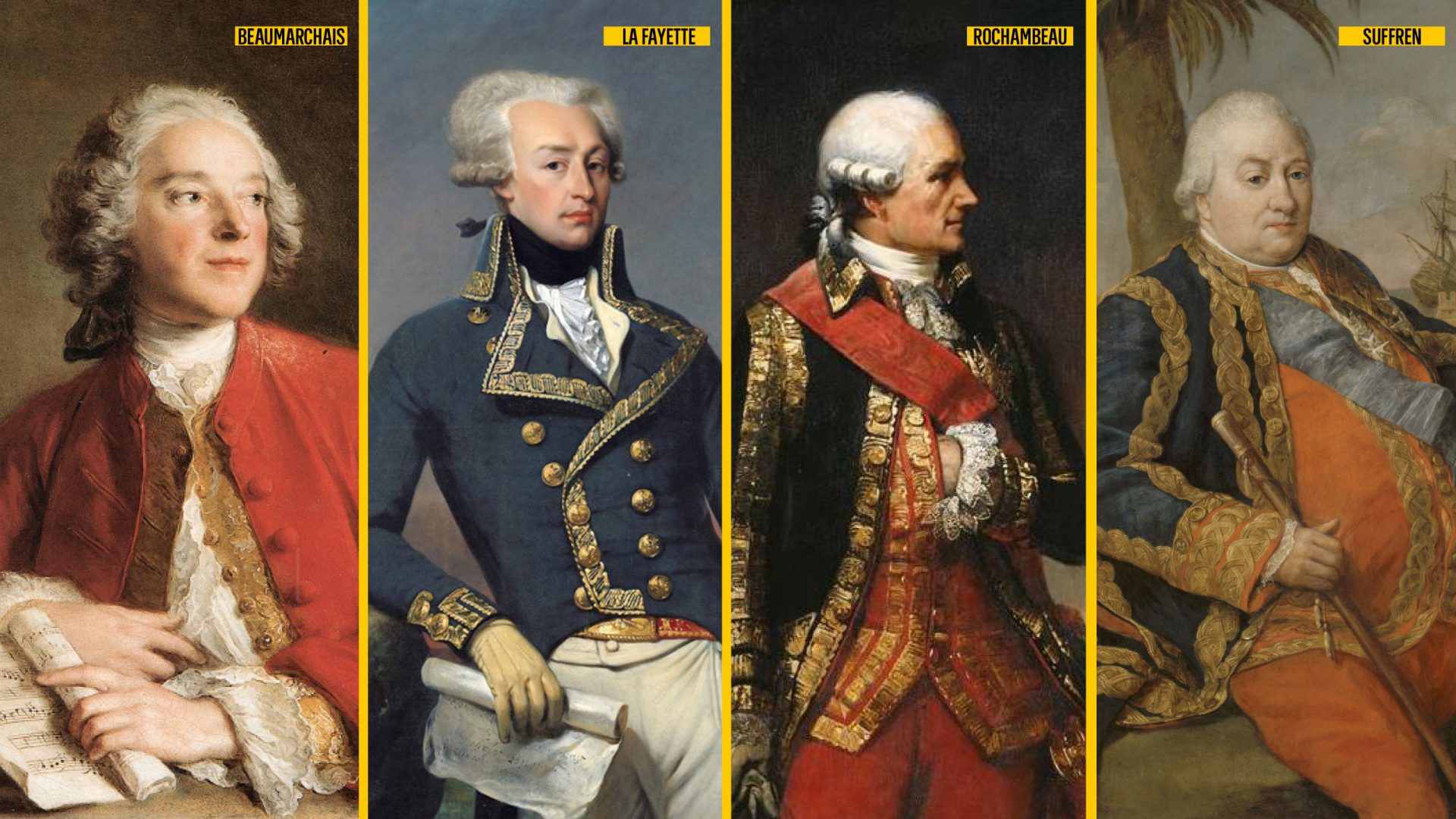
Among the first Frenchmen to be secretly involved at the start of the conflict was a man who is far better known as a playwright: Beaumarchais.
Beaumarchais, the arms dealer
From 1776 onwards, Pierre-Augustin Caron de Beaumarchais (1732–1799) acted as a secret intermediary between France and the American rebels by setting up a fictitious company, Roderigue Hortalez et Cie. Thanks to funds secretly advanced by France and Spain (1 million pounds from each kingdom, amounting to approximately 20 million euros in today’s money), he managed to arm and supply George Washington’s Continental Army on a massive scale. «The British were, of course, aware of this, but they did not want an open conflict that would also open up a front with France,» says Iris de Rode.
According to the historian, Figaro’s father played a crucial role:
«Beaumarchais is the a leading figure in these shipments of arms and ammunition. He brought greater organisation to the process, dispatching dozens of ships across the Atlantic, either directly to America or via the French West Indies. Without this, the insurgents would not have been able to fight their early battles, such as their decisive victory at Saratoga in 1777.»
In the holds of these merchant ships, Beaumarchais transported tens of thousands of rifles, cannons, ammunition, uniforms and military equipment essential to the Americans.
Beyond his logistical support, Beaumarchais played a major political role. «Together with the Count of Vergennes, Louis XVI’s Secretary of State for Foreign Affairs, he was instrumental in persuading the king to back the insurgents, notably by writing a detailed report,» explains Iris de Rode. The playwright’s significant role was officially recognised with a tribute from the US Congress, but his heirs were only able to recover a small fraction of the sums he had invested in this cause.
Beaumarchais thus played a direct part in transforming a local rebellion into a genuine threat to British power. This was all the more so as the Enlightenment writer was also one of the key figures behind the recruitment of European volunteers to fight alongside the insurgents at the start of the war. It was he who facilitated the departure of leading figures for the New World, starting with the young Marquis de La Fayette, whom he helped to equip and make the crossing of the Atlantic.
La Fayette, the go-between
Gilbert du Motier, Marquis de La Fayette (1757–1834), is remembered in France for his actions as an enlightened aristocrat during two revolutions: those of 1789 and 1830. In the United States, the «hero of two worlds» remains the foremost foreign figure associated with the country’s independence.
Orphaned at an early age and in charge of an immense fortune from the age of 12, he married Adrienne de Noailles at the age of 16; she came from an even wealthier family and, above all, one that was highly favoured at court in Versailles. These qualities, along with his enthusiasm for the cause of the insurgents, did not escape the attention of the American agent in Europe, Silas Deane, whom he met in Paris in late 1776, as Iris de Rode recounts:
«La Fayette has money and connections, and what’s more, he refuses to be paid for his service in the American army. Deane promises him the rank of Major General ; Congress would grant it to him after his arrival in America, when he was just 19 years old.»
The reckless teenager arrived in America in June 1777, but despite a letter of recommendation from Benjamin Franklin, another American diplomat posted in Paris, Congress was exasperated by the influx of foreign officers to whom Deane had promised high ranks. His meeting with the commander-in-chief of the Continental Army, George Washington, proved decisive, according to Iris de Rode:
«Washington quickly recognised his potential. As soon as La Fayette began to fight, he demonstrated his bravery and skill. A deep bond of affection and trust developed between the two men.»
The young French general, who learnt English very quickly, commanded American troops for two years. Following the Franco-American defeat at Newport in 1778, La Fayette was granted leave and returned to France in early 1779 to champion the American cause at Versailles. Towards the end of the year, his wife gave birth to their only son, whom they named Georges Washington.
In the United States, there are hundreds of roads, towns and counties named Lafayette
The Marquis returned to the United States in 1780, fighting further battles and spending a great deal of money to fund his troops. His military actions were daring; he became popular with the Americans and narrowly escaped capture on the orders of one of the leading British generals, Charles Cornwallis. And during the Siege of Yorktown, he played a key role alongside Washington in securing the victory on 19 October 1781.
In 1784–85 and again in the 1820s, he undertook triumphant tours across the country, where hundreds of roads, towns and counties now bear his name, as well as submarines and warships (always «Lafayette» as a single word). Why such enduring fame across the Atlantic? In addition to his diplomatic and military achievements, Iris de Rode points out that Lafayette excelled at «self-promotion»:
«La Fayette was remarkably gifted at communicating and maintaining his public image on both sides of the Atlantic. But this popularity was also based on very real achievements: his bravery in battle, the considerable sums he devoted to the American cause, his military and diplomatic role, and his exceptional closeness to George Washington all contributed to making him the Frenchman most enduringly associated with American independence.»
Another French hero, a more brilliant military commander than La Fayette, is also widely celebrated in America, whilst he is all but forgotten in France today: Marshal de Rochambeau.
Rochambeau, the strategist
Following the Franco-American alliance of 1778, the principal French naval commander sent to American waters was Vice-Admiral Charles-Henri d’Estaing. But his military failures and the tensions caused in particular by the Newport expedition began to undermine the alliance and fuel American discontent. «What’s more, George Washington could not give orders to d’Estaing,» explains Iris de Rode. «La Fayette therefore suggested to him that they needed a Frenchman – a competent military officer, capable of understanding the Americans, and of a modest character.»
Louis XVI chose Jean-Baptiste-Donatien de Vimeur, Count of Rochambeau (1725–1807). An excellent commander and a keen expert on the technical aspects of warfare, he landed at Newport on 11 July 1780, with «32 transport ships escorted by seven ships of the line, 2 frigates and 2 smaller warships, carrying between 5,500 and 5,800 soldiers», explains Iris de Rode.
His arrival proved decisive: «With Rochambeau, who had been ordered to serve under Washington’s command whilst retaining command of the French army, the two armies gradually learnt to operate together,» the historian continues. The American commander-in-chief quickly recognised the expertise of the French general, who had distinguished himself on European battlefields since 1742.
Iris de Rode: «Without Rochambeau, I don’t know if the Americans would have been able to win»
Thus, Rochambeau persuaded Washington to abandon a manoeuvre that could have proved disastrous for the insurgents, the historian recounts:
«He went to great diplomatic lengths to persuade Washington not to attack New York. At that time, Manhattan was a formidable British stronghold, protected by an extensive system of fortifications and a large garrison.»
When Admiral de Grasse, at the head of a large French squadron, announced that he would lead his fleet into Chesapeake Bay, Rochambeau played a decisive role in persuading Washington to abandon New York and lead the Allied army to Virginia, where Cornwallis had just established a fortified base at Yorktown.
Lord Cornwallis surrendered on 19 October 1781. «Without Rochambeau, I don’t know if the Americans could have won,» comments Iris de Rode. «The French general and his officers» considerable experience of European siege warfare proved decisive against the British.”
That is why Rochambeau, who was appointed Marshal of France in 1791, continues to be honoured in the United States, notably through warships, a major bridge in Washington and a 1,000-kilometre commemorative route named Washington–Rochambeau Revolutionary Route. His statue stands, not far from that of La Fayette, in Lafayette Square, a park opposite the White House. In France, for the general public today, the name Rochambeau is mainly associated with a brand of grocery products.
After Yorktown, Britain was «terribly humiliated», according to Iris de Rode:
«Their great general, Lord Cornwallis, has been defeated. And politically, the British are realising that the risk of losing their other colonies is growing ever greater, firstly because of the ’Bourbon Alliance« of 1779 between France and Spain, and now because of this disastrous defeat.»
For French involvement in this war of independence was not confined to the American continent: battles also took place in the Caribbean, off the coast of Africa and in India, where the Bailli de Suffren distinguished himself in particular.
Suffren, the sailor of two oceans
Behind the mediocre Admiral d’Estaing, many French naval officers distinguished themselves during the American War of Independence, in this sub-conflict which historians refer to as the Franco-British Naval War (1778–1783).
The most celebrated of them all, Admiral de Grasse, emerged victorious the decisive battle of the Chesapeake in September 1781, before falling from favour following his heavy defeat at Les Saintes, in Guadeloupe, in April 1782. We should also mention Admirals de Guichen, de Vaudreuil, de Ternay, de Latouche-Tréville and La Motte-Picquet, as well as the future explorers La Pérouse, Tromelin and d’Entrecasteaux.
Among these brilliant naval officers, Pierre André de Suffren de Saint-Tropez (1729–1788), a vice-admiral better known as «the Bailiff of Suffren», distinguished himself by successfully extending the conflict to overseas theatres of operations. According to Iris de Rode, «Suffren embodies the «global war» aspect of this conflict, this long naval war between the British Empire and the French Empire, alongside its allies, the Spanish and the Dutch».
To the English, Suffren is «Admiral Satan»
Suffren first served from 1778 to 1780 in America and the Caribbean under d’Estaing, whom he did not hesitate to criticise. In 1781, he was appointed commander of the French squadron sent to counter the Royal Navy in the Indian Ocean. On 16 April, he engaged in a battle off Porto Praya, in Cape Verde, which was tactically inconclusive but enabled him to gain a significant strategic advantage in his advance towards the Indian Ocean. Upon reaching India, he went on to distinguish himself through a series of daring and fierce engagements, notably five epic battles against the British admiral Edward Hughes between 1782 and 1783.
Through this aggressive campaign, Suffren succeeded in neutralising British naval supremacy in the Indian Ocean, protecting France’s interests and allies in the region (the United Provinces – now the Netherlands – and the Sultanate of Mysore) and to tie down considerable enemy forces far from the North American theatre.
By diverting British war efforts and maintaining the pressure right up until the final months of the conflict, Suffren’s campaign had an impact on the overall balance of power at the time of the peace negotiations. This prompted the following comment from Iris de Rode:
«It was not Rochambeau who won the last major battle of the American War of Independence at Yorktown; it was Suffren, in India, with his strategic victory at the Third Battle of Gondelour on 20 June 1783.»
Unlike De Grasse, whose record in this conflict was undoubtedly more impressive, Suffren emerged undefeated from the American War of Independence. On the British side, he has gone down in history under a dreadful nickname: ‘Admiral Satan’.
 French
  English