
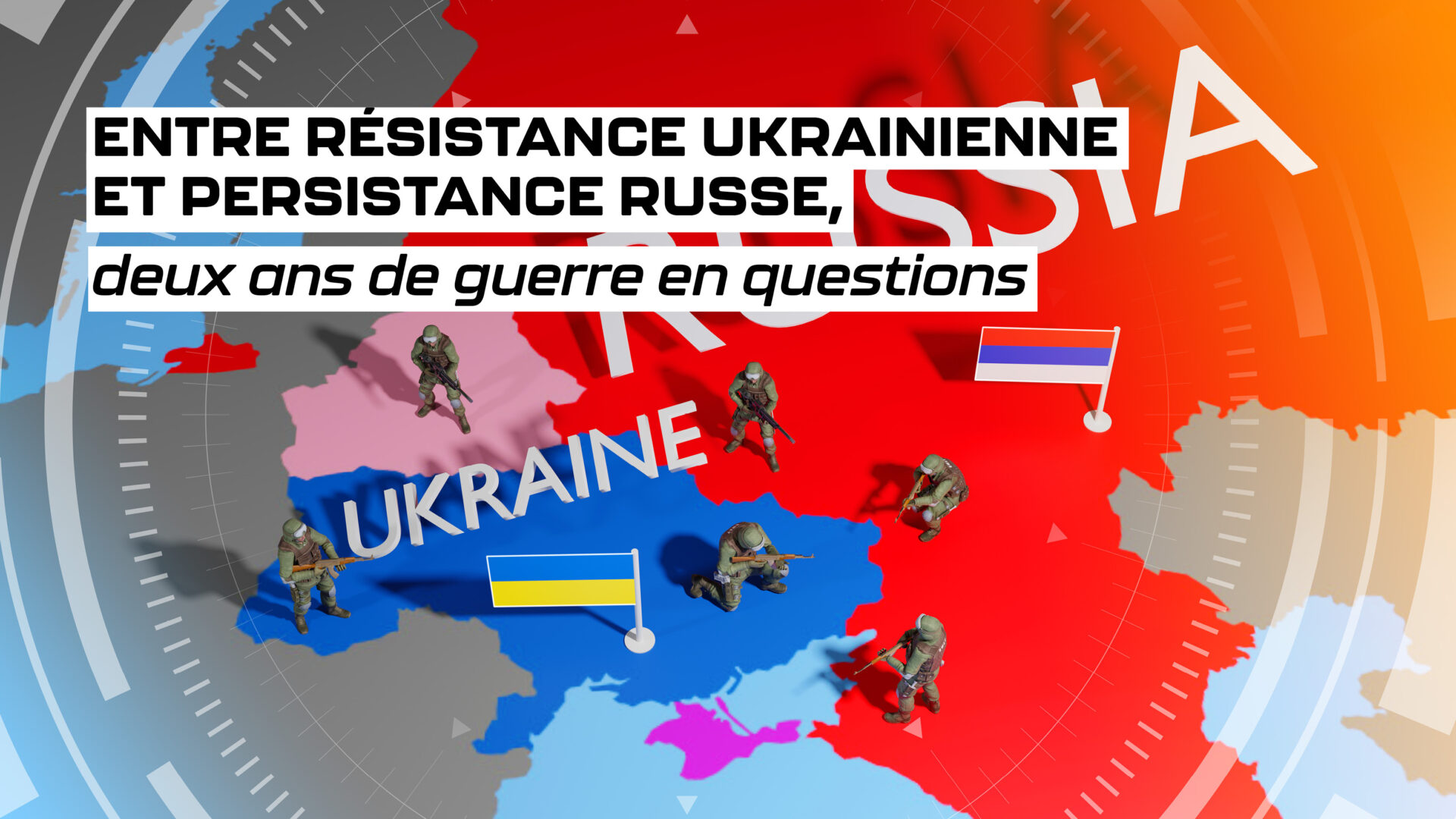
It is now two years since Europe turned its back on the famous "peace dividend" reaped since the end of the Cold War. The conflict unleashed by Russia in Ukraine is having a major impact on a number of fronts, including The Great Continentmagazine published by the Geopolitical Studies Grouphas taken the opportunity to explore a conference on Tuesday 20 February at the École normale supérieure in Paris.
In his speech, the Minister for the Armed Forces, Sébastien Lecornu, evoked this period before 24 February 2022: in terms of armaments, "for 20 years, innovation dominated all battles, and the question of stocks and the capacity to produce ammunition did not arise". It is now crucial, and "for the past two years, we have been trying to have a defence industry that 'rebrands' itself", he summarised, acknowledging that "we had lost our independence in terms of the production of certain munitions".
Pointing out that France has "increased its production of Caesar guns by a factor of 2.5", the Minister announced: "In the coming weeks, the artificial intelligence incremented in a Caesar gun will make it possible to almost halve the amount of ammunition consumed", by increasing the accuracy of shots.
"HALF THE AID TO UKRAINE, WHICH WAS AMERICAN, HAS DISAPPEARED".
This is all the more important given that, as researcher François Heisbourg points out, "for the last two months, not a single American munition has arrived in Ukraine", because the aid plan has been blocked by Congress. As a result, "half of the aid to Ukraine, which was American, has disappeared".
"In France, we have yet to demonstrate that we know how to make our defence industry work," says François Heisbourg, special adviser to the International Institute for Strategic Studies and the Fondation pour la Recherche Stratégique. "We are now producing 3,000 shells a month, having tripled our production. Meanwhile, in Germany, Rheinmetall has produced 700,000 by 2023. For him, this is necessary: "we will have to continue to increase military appropriations and go to 3% of GDP, whereas we have just reached the 2% decided in 2014: Poland is already at 3.9%, Greece at 3%".
Jean-Dominique Merchet, diplomatic and defence correspondent for the daily L'Opinion, believes that "we need to pull out all the stops in industry: it's the heart of the matter. The material aspect is essential. It's us that Putin sees as the enemy". The journalist therefore advocates a "common defence architecture" as well as "a military Schengen": "It makes no sense that military equipment cannot easily cross the borders of the EU or NATO", he believes, advocating "the free movement of soldiers and military equipment".
Pointing out that France is the only EU member with a nuclear deterrent, Jean-Dominique Merchet believes it is essential to "revise our nuclear doctrine, which is 60 years old": "We should propose to our European partners that they share our nuclear weapons, by putting double-key weapons on their territory, as the Americans are doing in Germany, Poland and Belgium".
It is for this reason that the recent isolationist comments of putative candidate and former US President Donald Trump have had an "infinitely greater media resonance in Germany than in France", points out François Heisbourg. Even if Trump is elected in November, Jean-Dominique Merchet is optimistic, noting that "two-thirds of American aid to Ukraine goes directly to American manufacturers", who therefore have a commercial interest in supporting the country.
"ALMOST A HUNDRED AGGRESSIVE INTERACTIONS" BETWEEN RUSSIA AND FRANCE IN 2023
This rich symposium also addressed Russia, its domestic policy and its strategy. Opening the conference, the French Minister for the Armed Forces emphasised that Russia "no longer behaves towards us, France, as it did in 2022". He spoke of "much more military interaction between our two armies" in the Eastern Mediterranean, the Baltic Sea and the Strait of Hormuz. With "almost a hundred aggressive interactions in 2023", the Russians are "close to the threshold to see how we behave".
Listing in turn the arms race, the militarisation of space, threats to submarine cables and critical infrastructure, the "pursuit of blackmail" in agriculture and oil, the war waged through "proxies" and information warfare, Sébastien Lecornu believes that "it is because Russia is encountering difficulties on the conventional front that it is becoming more aggressive on hybrid threats". The most worrying of these, in his view, is "cyber": "Threats that used to be criminal are also becoming state-based".
In short, various threats that were "epiphenomena two years ago have now become systemic". Reminding us of France's firm stance in this power struggle, the Minister warned: "Maintaining a balance of power does not mean escalation.
"THIS WAR IS THE PERSONAL PROPERTY OF VLADIMIR PUTIN".
Guillaume Lancereau, a Max Weber Fellow at the European University Institute in Florence, says: "Putin's sole aim in waging this war is to extend his power and increase his wealth. This specialist in the Russian President's speeches even believes that "this war is Vladimir Putin's personal property".
Referring to the recent death of opposition figure Alexeï Navalny, the academic points out that the Russian regime is more heterogeneous than you might think: "A truly arbitrary power would have taken it upon itself to kill an opponent, without imposing on his family and the whole world a macabre suspense about the whereabouts of his corpse". According to all the researchers present on Tuesday, there is no doubt: Navalny was "assassinated", or at least "probably".
For Juliette Cadiot, Director of Studies at the Ecole des Hautes Etudes en Sciences Sociales (EHESS-CERCEC), there are still "forms of resistance" in Russia: associations continue to collect information on the war, and even help Ukrainians to leave Russia. But opposing the war is increasingly dangerous, because "the criminal arsenal has been redeployed and radicalised, and the length of sentences increased. Prison in Russia is dangerous, as the example of Navalny has shown: people are tortured, their personalities are degraded, and they can die or be murdered".
"WE CAN EXPECT THE WAR TO CONTINUE, AND EVEN TO SPREAD".
Céline Marangé, a researcher at the Institut de recherche stratégique de l'École militaire (IRSEM), points out that Alexeï Navalny's death was announced on the day that the Munich Security Conference began, and that Ukraine was signing security treaties with France and Germany: "I see this as a clear political signal". In her view, "we can expect the war to continue, and even expand, over the next few years". Even if, in two years, it has caused 300,000 deaths and injuries on the Russian side and 200,000 on the Ukrainian side, figures that she compares with the 11,000 Soviet deaths during the war in Afghanistan (1979-1989).
This war is of course having "very destabilising effects on Russian society", with the estimated departure of a million Russians, "most of them educated", adds Céline Marangé. But as well as "indoctrinating the population" with "unbridled propaganda", this war "creates economic opportunities and rents in Russia", to the extent that the country emerged from recession in April 2023. "The war offers symbolic and pecuniary rewards to poor men who previously had no prospects", she analyses. "50,000 $ for a dead soldier is a fortune" for his family in some remote regions.
As a result, Russia is experiencing a "construction boom", and "wealth disparities between regions are tending to narrow". For the IRSEM researcher, ending the war would therefore have "a significant economic and political cost for the Kremlin, which would suffer shocks in return". The war in Ukraine has therefore become indispensable to Vladimir Putin, for reasons of "internal stability".
"IT IS SIGNIFICANT THAT THE UKRAINIAN STATE HAS NOT COLLAPSED".
Marlène Laruelle, professor of international affairs and political science at George Washington University (USA), agrees: "In Russia, war is a social springboard, an element of prestige, recognition and financial success, and it opens up professional prospects". In her view, "the so-called civilisational war with the West has become the key element of Russian identity". She sums this up with a reference to the Communist period: "Today, going to the front is the new party card.
The successive sessions of the symposium naturally addressed Ukraine's resilience and adaptability - one of the round tables was entitled "How to rebuild Ukraine". For Muriel Lacoue-Labarthe, Deputy Director General of the French Treasury and Head of the Bilateral Affairs and Business Internationalisation Department (SABINE), "it is significant that the Ukrainian state has not collapsed". It has also been able to react quickly and think ahead: "Very quickly, the authorities decided to replace traditional light bulbs with LED bulbs", which has drastically reduced the country's electricity consumption at a time when Russia was attacking its critical infrastructure.
Jean-Dominique Merchet considers some of the successes of the attacked country to be "very impressive", in particular "what the Ukrainians are capable of doing in the Black Sea": "A country without a navy capable of challenging Russian supremacy in this sea is for me one of the great strategic surprises of this conflict. They are driving the Russian fleet out of Sebastopol! They shot down an AWACS [Airborne Warning and Command System], although France has 4 and Russia 5 or 6... That's precious!
 French
  English