
The launch of the Defence Academy at the École Militaire (ACADEM) by the Minister for the Armed Forces, Sébastien Lecornu, on Thursday 26 October, was followed by a series of meetings and debates on various themes. The long-planned workshop entitled "Geopolitical recomposition in the Middle East: the next strategic surprise" was thrust into the spotlight by the outbreak of hostilities between Hamas and Israel. Ongoing since 7 October, this is the fifth conflict between the two parties in fifteen years.
Moderated by Vice-Admiral (2S) Pascal Ausseur, Director General of the Fondation méditerranéenne d'études stratégiques (FMES), the debate brought together a number of specialists on the region in the Foch amphitheatre at the École militaire: French-Lebanese researcher Karim Emile Bitar, former head of the Middle East programme at IRIS, lecturer at the École normale supérieure in Lyon and at the Institut national du service public (ex-ENA); Jean-Paul Chagnollaud, President of the Institut de Recherche et d'études Méditerranée Moyen-Orient (iReMMO); Fatiha Dazi-Héni, researcher at the Institut de recherche stratégique de l'École militaire (IRSEM); Théo Nencini, specialist in China in the Middle East and Iran, doctoral researcher at the Institut catholique de Paris and the Université de Grenoble-Alpes; and Pierre Razoux, Academic Director of the FMES.
"REFUSAL OF PEACE, REFUSAL OF THE INTERNATIONAL COMMUNITY TO GET INVOLVED...".
Jean-Paul Chagnollaud, an expert on Palestine, began by explaining that the situation that has prevailed since 7 October is the result of a "triple refusal": "a refusal to accept peace, a refusal by the international community to get involved, and a failure to understand that the status quo there is untenable". A refusal to accept peace: after they were signed in 1993, the Oslo Accords were "a source of hope for everyone", Israelis and Palestinians alike. Except that on both sides, "there were forces that didn't want peace, that didn't want compromise": "on the Palestinian side it was clearly Hamas"; and on the Israeli side, "the main player was Benyamin Netanyahu", already Prime Minister from 1996 to 1999.
Secondly, a refusal by the international community to get involved, which begins just after the UN Security Council's "fundamental" resolution of 23 December 2016. In January 2017, the arrival of Donald Trump as US President marked the start of a period in which the Palestinian situation was being "managed", while at the same time pushing for a "normalisation" of relations between Israel and the Arab countries. And finally, a refusal to understand that "the status quo is not viable", as the UN resolution put it at the end of 2016: "Moreover, there is no status quo, because the situation is deteriorating every day", says Jean-Paul Chagnollaud. For the Palestinians, " the confinement of 2.3 million people in Gaza since 2007 is impossible to maintain", particularly for young people, "sons or grandsons of the 1948 refugees, whose fates are truly tragic and utterly hopeless". This lack of a status quo is also reflected in "an even greater acceleration of settlement" in the West Bank and East Jerusalem.
THIS WAR IS "TEARING APART ALL THE COUNTRIES OF THE MIDDLE EAST".
An expert on Israel, Pierre Razoux listed the "dilemmas" facing the coalition government led by Benyamin Netanyahu. Firstly, "they sold the Israeli population on the fact that the existential threat was Iran", and that "the Palestinians are under control". This has just been proven wrong. Netanyahu is therefore "torn between what he has been saying for a long time and what is happening on the ground". The second dilemma is that the government is also torn between "its own population, which is demanding that it apply the law of Talion and eradicate the military wing of Hamas, and the United States and Europeans, who are calling for restraint". Finally, "the third dilemma is the possible extension of the conflict" towards the north and the axis formed by the Lebanese Hezbollah and Iran.
More broadly, in his view, the war between Israel and Hamas "is tearing apart all the countries in the Middle East, including those that used to have close relations with Israel: Egypt, Jordan, Turkey and the Gulf monarchies". While they "had good reasons to get along with Israel, they find themselves confronted with their own public opinions, and the mantras they have been repeating for decades". All in all, Pierre Razoux believes that we are "more than ever at the heart of the confrontation and power rivalry between China and the United States".
"THE PERSISTENCE, CENTRALITY AND UNIVERSALITY OF THE PALESTINIAN QUESTION".
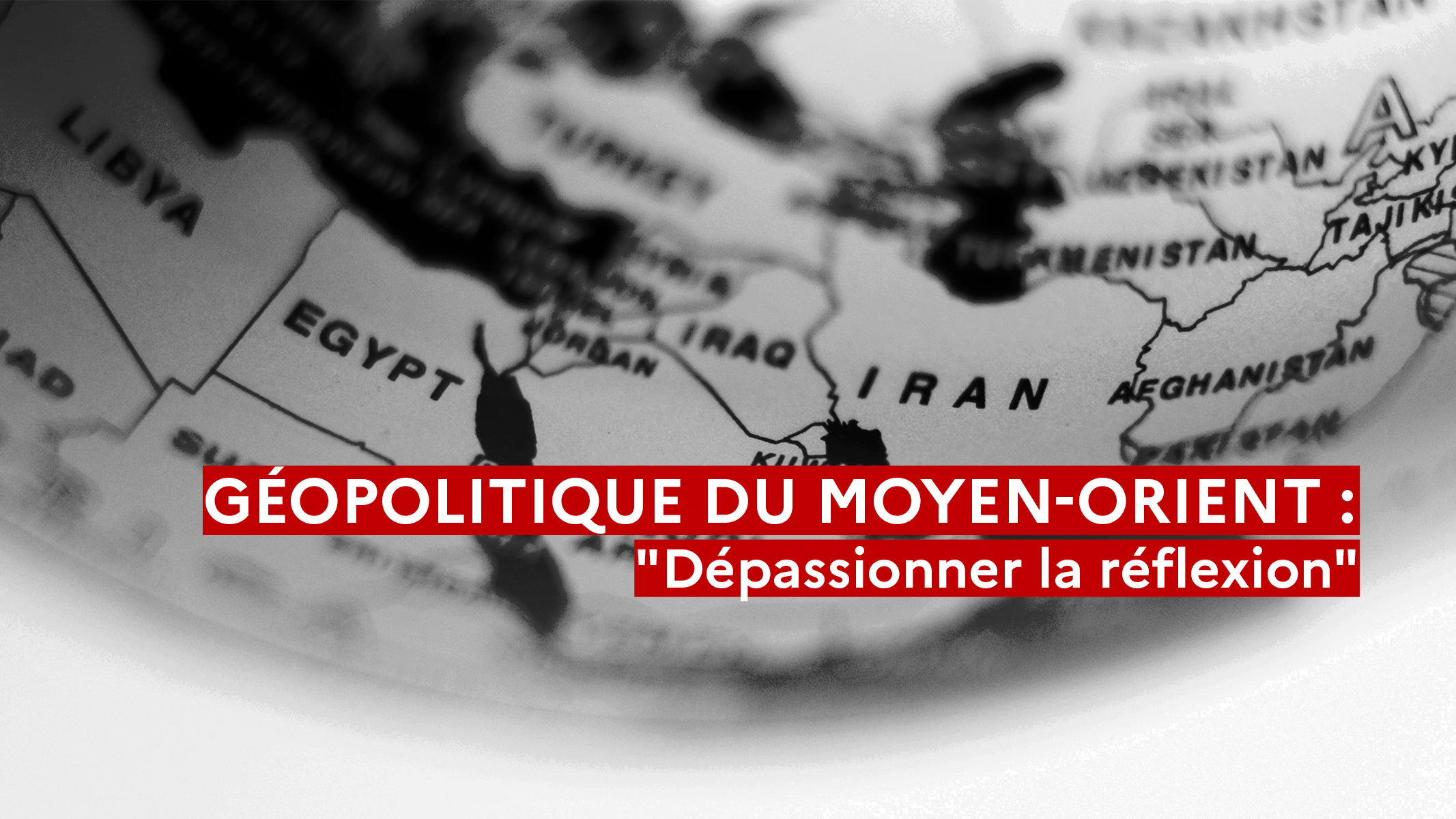
For Karim Émile Bitar, "there is a growing need for dispassionate reflection on these issues", since "we are witnessing a certain return of tribalism in international relations. We have the feeling that emotions are winning out". In his view, "we are witnessing two radically different discourses, two visions that may seem irreconcilable". When we look at "the television channels of the 'global South' and those of the West", we get the feeling that "there is an inability to break down these blinkers, to consider the suffering of the other side, and sometimes even to humanise that other side".
For twenty years or so, "everyone knew that a whole series of international resolutions were being violated on a daily basis, and people wanted to forget about the Israeli-Palestinian conflict", as if it had become "a minor, low-intensity conflict". However, "the appalling carnage of 7 October has reminded us of the persistence, centrality and universality of the Palestinian question". In his view, the possibility of the opening of a second front on the Lebanese border should not be overlooked, nor even that of a third front on the West Bank.
A "STAGGERING GAP" BETWEEN WESTERN AND ARAB POSITIONS
Fatiha Dazi-Héni, a specialist in Arab-Muslim governments and societies, observes that there is an "ever-increasing gap between Westerners' understanding of the world and that of the countries of the Middle East, particularly those closest to the West", such as the Gulf monarchies, Egypt and Jordan: Today, they are "unanimous" in their view that "the main Western states with responsibility for managing the conflict" - the United States, the United Kingdom and France - "are out of step" with the positions of the Arab states.
"Struck by China's very neutral stance", she calls for us to "really bear in mind that even among the West's closest allies, these states are now looking more towards the BRICS". Not least because they can see that "Westerners are not seeing things the same way when it comes to the Russian invasion of Ukraine or the daily siege and bombardment in Gaza": "There is no denying the impression of dehumanisation when it comes to Palestinian victims compared with Israeli victims. This feeling is extremely strong". From the perspective of the Arab states, the BRICS could therefore put pressure on the West to find a political solution to the Israeli-Palestinian conflict.
"IRAN FEELS IT IS THE BIG WINNER IN THIS AFFAIR".
On the Iranian position, Théo Nencini explains that "Iran feels it is the big winner in this affair", and believes that, "objectively, it can be proved right": "The simple reactivation of the Israeli-Palestinian conflict was a strategic objective for Iran", and enables it to obtain "positive repercussions from a political, diplomatic and strategic point of view". In domestic politics first of all, since support for the Palestinian cause is "one of the founding dogmas of the Islamic Republic": the regime can therefore say to its population "we are on the right side, don't overthrow us". A strategic victory, since many organisations linked to Iran (Lebanese Hezbollah, Yemeni Houthis, etc.) "are back on the warpath".
Iran's biggest success has been diplomatic, firstly by putting the Abraham agreements between Israel and Arab countries on hold, and secondly by speeding up the "Asianisation" of its foreign policy, as a means of establishing "an alternative regional geopolitical order" to that desired by the Americans. "But the real diplomatic (and symbolic) victory for Iran is the isolation of the West. The episode underway since 7 October "makes it clear to the world that the geopolitical "West" (the West plus Japan and South Korea) "finds itself diplomatically isolated": "Isolated for forty years, the Islamic Republic of Iran is taking its revenge, that's the feeling in Tehran".
The moderator of the debate, Admiral Ausseur, made clear the need to balance the analysis: "This situation is a good illustration of the new world we are in, a world that is fracturing", he noted, pointing in particular to "the ideological and emotional aspect, which is based on resentment and humiliation", and widening the differences between countries and communities. Finally, he warned that social networks, the Internet and artificial intelligence "are new bombs for the fragmentation of society, and for fragmentation between States and between communities".
Relive the debate:
 French
  English