
IHEDN Mondays are now available as audio files!
Click below to listen:
A graduate of ESCP and Sciences Po, and a former student of ENA, Pierre Lévy served in the French Foreign Service for 41 years, particularly in the European, economic and politico-military fields. A former director of the Centre for Analysis and Forecasting (CAP) and director for the European Union at the Quai d’Orsay, he also served as ambassador to the Czech Republic (2010–2013) and to Poland (2016–2019).
He was subsequently appointed Ambassador to Russia from 2020 to 2024, during a period marked by a profound deterioration in bilateral relations and the invasion of Ukraine; he has drawn on this exceptional experience to write the account «In the Heart of Russia at War», published in late 2025 by Tallandier.
Pierre Lévy, who was appointed French Ambassador in 2022, has been named, by decree of the President of the Republic, Chairman of the Board of Directors of the Institute of Higher National Defence Studies with effect from 24 January 2026.
In your book, you refer to a «self-radicalisation» of Vladimir Putin’s regime: starting from a «legitimate pride» in being Russian, this gives rise to «toxic resentment», «total revisionism» and «uninhibited aggression». How so?
Every head of state wants their country to be respected, to have its voice heard, and to live in safety. This aspiration is entirely legitimate. It is simply that, in Russia’s case, there are some very specific factors at play.
Firstly, because national ideology is underpinned by the view that the West has harboured a centuries-old hostility towards Russia, with the aim of weakening or destroying it. This idea is extremely prevalent. Secondly, in order to restore Russia to its former power, Vladimir Putin had the following option.
It could have opted for constructive engagement. A country is respected because it contributes to world peace and stability: it contributes to development, to crisis resolution, to the fight against climate change… Russia had many assets that would have enabled it, in a sense, to do good. As a permanent member of the United Nations Security Council, it has certain responsibilities, particularly in the fight against proliferation. Russia, which has been very active in certain regional crises, such as the one in Syria, had the means to influence events. It could also have worked with us to build an area of stability and prosperity between itself and the European Union, encompassing the countries that Moscow referred to as its «near abroad».
But there is a second way to be a respected country: to instil fear. That is the choice Vladimir Putin has made. He wants a Russia that is strong and respected, not because it is a responsible stakeholder in the international system, but because it inspires fear – fear of a nuclear power, fear of an empire that is being rebuilt.
During my stay in Russia, I believe I have «unravelled» the Russian President’s strategic thought process. The Ukrainian issue is a long-standing one; it had been on his mind for a long time. The constitutional reform of July 2020, which allows him to stand for two further terms and, in theory, to remain President of the Federation until 2036, acted as a catalyst.
With his resentment towards the West and his desire to settle the Ukrainian question once and for all, perhaps he said to himself at that moment, «Right then, I have plenty of time ahead of me; I now want to work for posterity, leave my legacy, and inscribe my name in history alongside Peter the Great, Catherine II and Stalin».
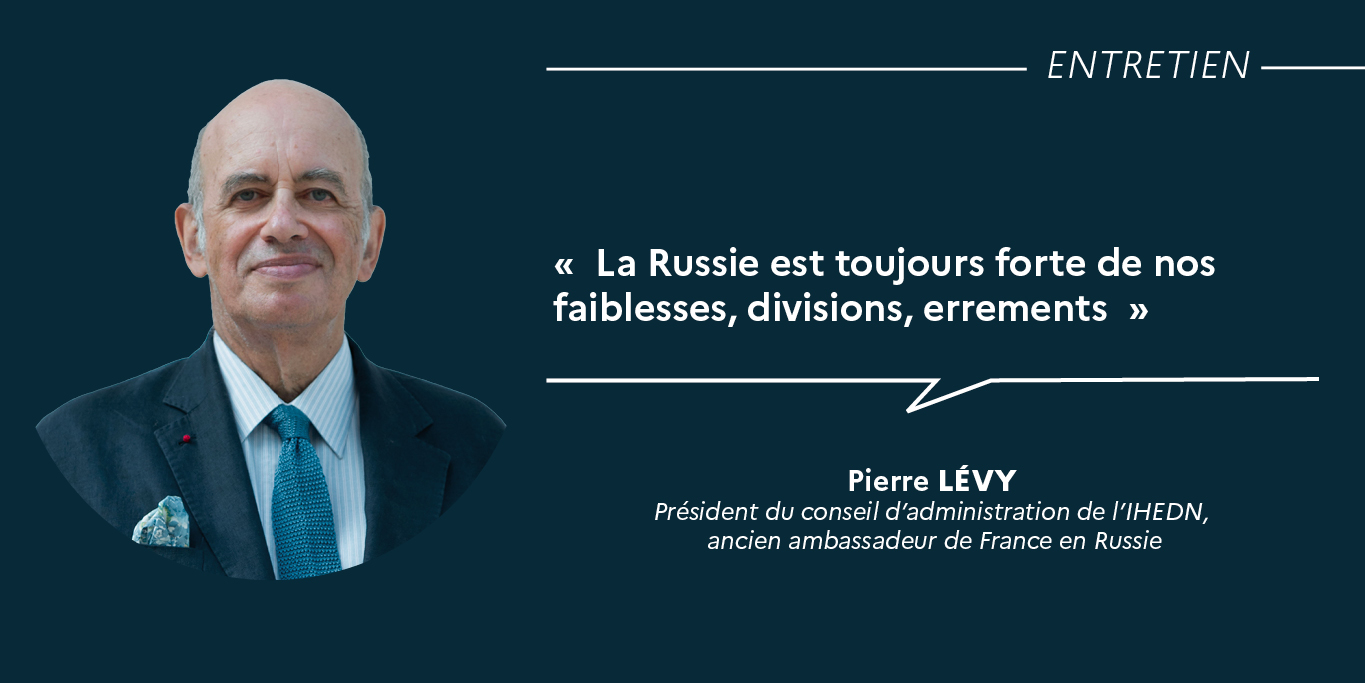
«Russia continues to draw strength from our weaknesses, divisions and missteps, which it seeks to exploit»
He then assessed the situation, that is to say, he evaluated the balance of power. I published an article this summer in *Le Grand Continent* an article on the profiling of Russia as an aggressor. He analyses various acts of aggression by Russia, in order to identify a pattern, a behavioural profile, just as the police would draw up for a serial killer.
We must bear in mind the developments of 2021: first, in the United States, the Capitol riots on 6 January, which highlighted a certain decline in American democracy. Then came the disastrous withdrawal from Afghanistan. At European level, the Minsk process, launched in 2015 to enforce the ceasefire in the Donbas and find a political solution, is stalling, whilst European Union member states are divided over whether or not to engage with Putin… All of this has been closely monitored by the Kremlin. Vladimir Putin therefore decided that perhaps the time had come to intervene.
That is exactly what happened in Georgia. In April 2008, the NATO summit in Bucharest had resulted in a shaky and ambiguous compromise on relations between Ukraine and NATO; and by August, Russia had launched its war against Georgia.
Looking further back, the same pattern was seen during the Suez Crisis in October 1956, with the results we are all familiar with regarding the Franco-British operation. A few weeks later, in November, the operation against Budapest capitalised on a very deep transatlantic rift between the United States, France and the United Kingdom.
We can therefore describe Russia as a serial aggressor, and we can indeed draw up a typology that offers valuable lessons for the future. The key point to bear in mind is that Russia always draws strength from our weaknesses, divisions and missteps, which it seeks to exploit by taking action.
With regard to the role of the intelligence services within the Russian regime, you speak of a ‘state nobility’ within the power structure…
Yes. It is, in a sense, the backbone of power. Firstly because, of course, these services play a major role in internal and external security within this «Fortress Russia».
Secondly, because they act as a breeding ground for officials who subsequently permeate the state apparatus and even the economic sphere. The prime example is, of course, Vladimir Putin himself. But we also see many of these people going on to hold senior positions at major banks or at Rostec, the technology holding company, particularly in the defence sector.
The security services even control the ideological apparatus. For instance, Sergei Naryshkin, the director of the SVR, the foreign intelligence service, is also president of the Russian Historical Society. Former Defence Minister Sergei Shoigu is president of the Russian Geographical Society.
The bulk of the FSB’s workforce – the domestic intelligence service – consists of border guards. When you arrive at the airport, it is FSB officers who check your passport.
The military intelligence service, the GRU, bears little resemblance to our DRM in terms of its methods of operation and its missions. Finally, the Rosgvardia is a sort of Praetorian Guard, headed by a former bodyguard of Vladimir Putin. It was considerably strengthened after taking over Wagner’s heavy weaponry following the death of Yevgeny Prigozhin.
This mechanism is therefore very important, and shows that the regime itself is not monolithic. We must approach it with great humility when analysing it, because it is a very opaque black box.
Within the government, there are currently debates between, on the one hand, those who want to lock down the country, crack down on even the slightest dissent, and, on the other, those who believe that regular disruptions to the internet and popular apps such as Telegram may have adverse political consequences and erode Putin’s popularity – something we have, in fact, been seeing since last June, against a backdrop of a deteriorating economic situation.
We don’t really see these internal debates, but we do catch a few glimpses of them. It is very interesting to follow these developments, even more so as the general election in mid-September approaches.
You write that the war in Ukraine takes precedence over everything else. How is Russia suffering as a result of this strategic choice?
This prioritisation of war can be analysed in terms of both domestic and foreign policy.
Domestically, Russia is, of course, operating under a war economy. Currently, around 40% of the federal budget is reportedly allocated to defence and security, an expenditure that is estimated to account for between 8 and 9% of GDP. It is difficult to obtain reliable figures. This expenditure is undoubtedly underestimated.
The country has reached a point where a very large section of society has a vested interest in the war continuing. For example, the bonuses paid to contract soldiers upon enlistment or in the event of their death represent considerable sums relative to the average wage, as the Russian economist Vladislav Inozemtsev demonstrated in February in a paper for the Ifri, calling it «the economy of death». He demonstrates that in Russia, death is rewarded more than life: the entire economy, the whole of society, is heavily driven by the war machine.
What will happen when these fighters return, when the war ends? It is clear that this creates enormous social – and even psychological – imbalances. I think all of this will have an impact. Historically, Russia has fared very badly in post-war periods. In the years 1945–50, Stalin treated veterans very badly; he was deeply suspicious of them. The same was true later on for veterans of the war in Afghanistan (1979–89). For example, the Russians do not pay the same attention as we do to the treatment of post-traumatic stress and reintegration into civilian life. This is a major issue for Russia’s future, a future that this war is profoundly transforming.
And what about externally?
Russia’s position on the international stage has been greatly weakened, precisely because of the priority it has placed on the war. Firstly, it is dependent on Iran and North Korea, countries that are seeking or already possess nuclear weapons. In this regard, Russia has abdicated its international responsibilities, given that sanctions were in place against North Korea’s ballistic missile programme. In March 2024, Russia vetoed the extension of the sanctions monitoring committee in the Security Council.
Look at what is happening in its immediate neighbourhood: Georgia and Azerbaijan are breaking free, with the latter at war with Armenia. Armenia is now looking towards Europe, which is causing real fury in Moscow: they were very unhappy about the major European meetings that took place last May in Yerevan and Prime Minister Nikol Pashinyan’s inclination towards Europe.
Finally, look at how Putin’s friends in Russia have been brought down without Russia lifting a finger. Bashar al-Assad, of course, who is now holed up in Moscow. Nicolás Maduro is in prison in the United States. Perhaps Cuba will be next. The Russians haven’t done much for Iran either. But they are helping it discreetly, particularly in the field of ballistic missiles.
How has France been affected by being classified as an «unfriendly state» by Russia?
Indeed, in March 2022, Russia introduced the category of ’unfriendly state« – a concept that did not previously exist in international relations – for all European and G7 countries. This has certain consequences, such as restrictions on dialogue and contacts.
Tensions rose very quickly following statements by persona non grata. From spring 2022 onwards, there was a major wave of expulsions across European countries of Russian officials who were diplomats in name only and were, in reality, carrying out espionage. France expelled around forty Russians, six of whom were caught red-handed by our intelligence services.
And the Russians retaliated. They expelled a number of my colleagues, no doubt carefully selected by the FSB to cause us as much harm as possible: officials from the Quai d’Orsay and other government departments who spoke Russian, the three senior officers – from the army, air force and navy – who were deputies to the defence attaché, and the head of the security detachment, a gendarme.
And – this is very interesting – they expelled all my staff in charge of communications – what used to be known in embassies as the «finance department» – as well as the accounts officer: if you no longer have an accounts officer, you can no longer authorise expenditure or receive funds. What they wanted was to bring the embassy to a standstill. That period was very difficult to manage, both organisationally and emotionally, but we held our ground.
How do you explain the appeal of Russia’s justification for the war in Ukraine – that it is defending itself against NATO aggression – amongst a section of the French population, who readily echo this view?
Firstly, there is a very long history between France and Russia, and between France and the Soviet Union, which must not be forgotten, and which also reflects a kind of mutual interest, even mutual passion, in the cultural sphere. History has brought France and Russia much closer together.
I am, of course, thinking of the alliance with the Russian Empire, which was concluded in 1892 and lasted until the 1917 Revolution and then throughout the Second World War. The history of the Normandie-Niemen Fighter Regiment is emblematic of these relations. Then there was the entire period of General de Gaulle and his policy of navigating between the two blocs.
There is, therefore, a shared heritage. Building on this, we can see two trends. Firstly, the Russians make great use of this common ground, including through flattery for manipulative purposes, by recalling the great Franco-Russian friendship and General de Gaulle’s policies, and by lamenting that France’s current policy is so far removed from that golden age. When I was in Moscow, this was a line of argument I often heard.
On the French side, you have the enthusiasts, who are great admirers of this history and deeply imbued with this Franco-Russian relationship. And then there are the useful idiots. You also have people who have a genuine ideological affinity with Putin’s Russia, which often goes hand in hand with rabid anti-Americanism and an anti-European stance, not to mention certain political parties.
There is a whole spectrum of views, ranging from those who say that we have not listened sufficiently to Russia, that it was humiliated following the break-up of the Soviet Union, and that we provoked it, right through to those who regard it as, in a sense, the vanguard of a new, ultra-conservative Europe, upholding the values with which they identify.
The common thread running through these positions is a combination of being pro-Putin’s Russia and being anti-American, anti-NATO and anti-European. This struck me very much when I was ambassador: I experienced it on a daily basis because I obviously had contacts with the French community, with some of its leading figures, and often had difficult and tense discussions.
«I have always been deeply saddened – and that’s putting it mildly – by those French people who criticise their country abroad»
In my various roles, I have always been deeply distressed – and that is putting it mildly – by those French people who criticise their own country whilst abroad. Whilst, of course, we have the right to do so – we are fortunate to live in a democracy – I have always found it deeply shocking when people make critical remarks in front of foreigners. These are situations I have encountered in countries other than Russia.
That said, I don’t think it’s easy these days for certain political forces to declare themselves quite openly pro-Putin. But there is an insidious form of this, which involves invoking a sort of pseudo-realism, you see, with rhetoric along the lines of:
«Of course, the Ukrainians are very brave, but ultimately the fight is very one-sided and we’re just delaying their defeat. People talk about a war against Russia, but that makes no sense – we’re not going to get involved in the Third World War for Ukraine’s sake.»
All this is very dangerous. But we must also look at things from both sides by asking whether Russia has lost us, and not just whether we have lost Russia. Having lived through this entire period in various posts at the Quai d’Orsay since the early 1990s, I can say that we have made a great deal of effort.
The Russians are very good at crafting a sort of overarching narrative of victimhood, based on a twisted logic, portraying their country as acting in self-defence – a «narrative», to use a buzzword. This narrative is disseminated to audiences who are more or less informed or naive.
I think a great deal of work was done to integrate Russia into the international system and create a framework for cooperation with the European Union in the early 2000s. But, with hindsight, I believe that Russia’s unique character was underestimated. It is the largest country in the world. Russia’s political and economic transition is not treated in the same way as that of other former Eastern Bloc countries which were fortunate enough to join the European Union.
Mistakes have left their mark, such as the «shock therapy» applied to the economy in the 1990s under the guidance of the American academic Jeffrey Sachs, from which many oligarchs profited to amass fortunes during a chaotic transition. This explains why there is now genuine mistrust in Russia towards the Western liberal economic model.
You were appointed Chair of the IHEDN Board of Directors at the end of January. What are your priorities for your three-year term?
I must first point out that the IHEDN’s mission is widely recognised as being of great importance: to explain defence and security issues and to strengthen the spirit of defence. The Institute is also renowned for the quality of its courses. I have found a highly capable team under the leadership of General Hervé de Courrèges.
This mission takes on even greater significance in the current international context. I would simply refer to what must be our roadmap, our compass, the National Strategic Review (NSR) published in July 2025. It is based on a scenario centred on the Russian threat and the possibility of an all-out war against the heart of Europe by 2030. It is, moreover, explicitly stated that this would not be a war on national territory.
I am convinced that our mission is to address all these aspects of the RNS across its various dimensions: the defence apparatus, the BITD, societal resilience – which is fundamental – the European dimension and the transatlantic dimension. In this context, there is, of course, the national session with its main events, but I attach great importance to the regional sessions and the youth programmes. I have already had the opportunity to take part in them.
This is a key feature of the IHEDN’s work, and it deserves our utmost attention, as we truly have a mission to educate citizens: to explain the current situation to our fellow citizens with the necessary intellectual rigour, and to instil confidence in them whilst remaining clear-headed.
I believe this crisis will drag on: even if the war ends, the confrontation will continue. We must expect, as Russian troops stall on the ground, for even more significant hybrid operations and destabilising actions aimed at weakening our collective ability to respond, undermining our republican pact, influencing our electoral choices, and testing European and transatlantic solidarity.
«Students have a special responsibility to share and disseminate their knowledge within society»
It is therefore very important to address all these aspects to ensure that our fellow citizens are fully aware of the issues at stake and are well prepared – mentally, militarily and strategically. It is important to strike the right balance, as we are no longer at peace, but we are not yet at war.
When discussing these issues in practical terms, it is always important to distinguish, on the one hand, the hardware and on the other side, the software. The hardware It’s the army, the forces at our disposal, the various branches of the armed forces. And the software, that’s the strategic software we use.
You may have the finest army in the world, but if you lack the operational concepts and, above all, the political will to use it, there is little point. This is all about national strategy, the development of a European strategic culture – which is absolutely fundamental – and societal resilience.
It is crucial to help our fellow citizens understand – as each of us has a responsibility at our own level – the significance of individual and collective commitment. Students have a special role to play in sharing and disseminating their knowledge throughout society.
Whenever I meet former students, they are very enthusiastic; they tell me proudly about their experiences and explain how much everything they learnt at IHEDN has meant to them. This is a reaction that has struck me deeply ever since my appointment. As you can see, I, too, am very proud and committed to doing my bit to contribute to IHEDN’s excellence.
 French
  English