
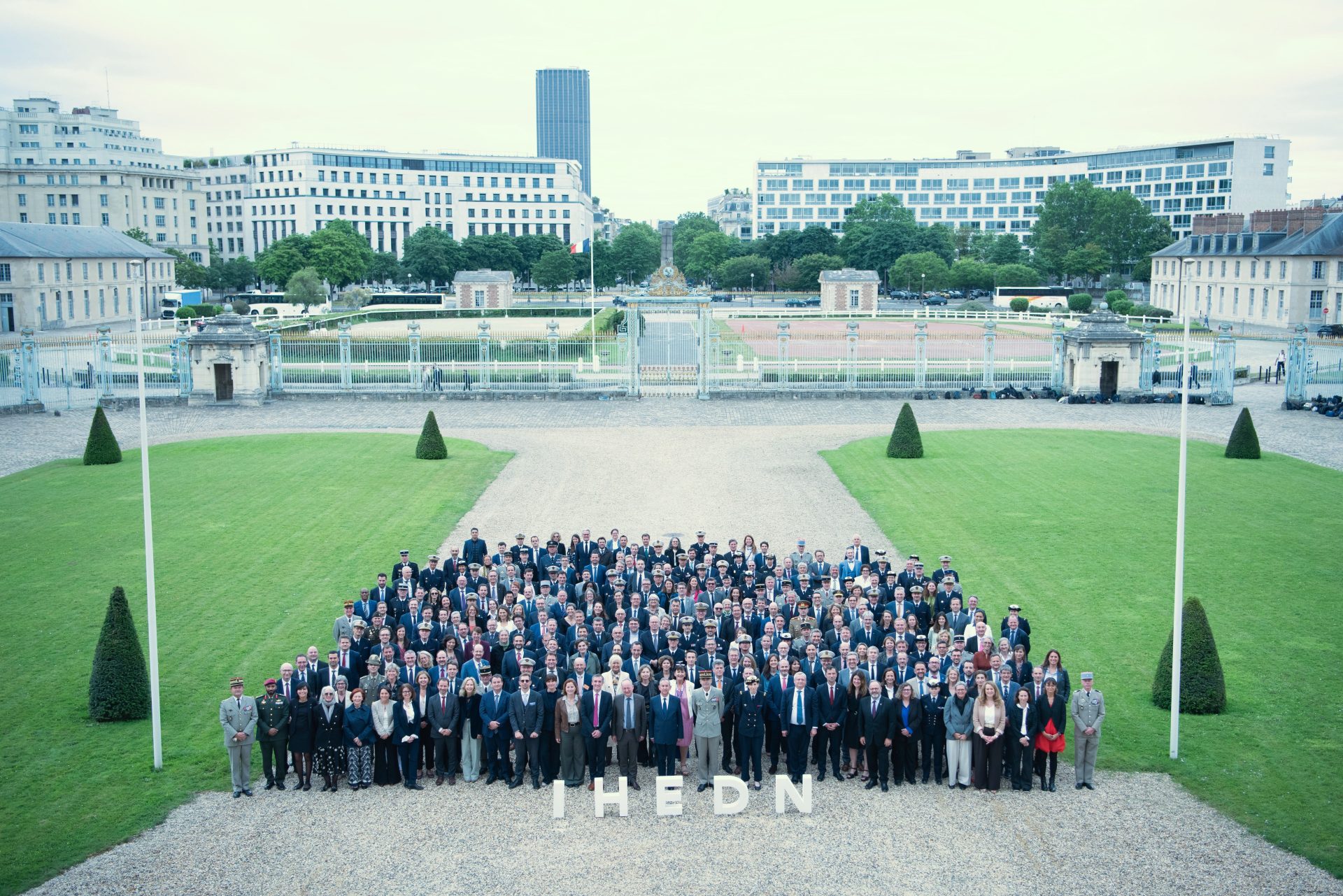
Friday 12 June, listeners to Channel 5e Participants in the IHEDN national session presented a summary of the committee work they had carried out since September 2025 to the authorities and their fellow students. This summary does not claim to be exhaustive, given the diversity of the 23 committee reports arising from the five main themes of the national session, but it highlights how they contribute to and shed light on the central annual theme: «Strategic Opportunities». Each of these committees worked on a strategy and specifically highlighted a key recommendation to address the challenges of the future.
FRAMEWORK FOR THE ANNUAL THEME: IMAGINING THE WORLD OF TOMORROW
Against a backdrop of rapid change, marked by major geopolitical, economic and technological upheavals, France finds itself at a pivotal moment in its history. As challenges mount – escalating international tensions, the waning of multilateralism, global economic vulnerabilities – this period of intense turbulence makes in-depth reflection all the more necessary. Faced with uncertainty and growing complexity, rethinking our national strategies has become an absolute necessity to ensure our country’s security, autonomy and ability to adapt.
Russia’s large-scale invasion of Ukraine in 2022 undoubtedly represents the major strategic turning point of the early 21st centurye century, redefining the international order and calling into question the security architecture in Europe. This shift has been intensified by developments in transatlantic relations since Donald Trump’s second inauguration in January 2025, as well as by major crises in the Middle East (Gaza, Israel, Syria, Iran, Lebanon, etc.). These upheavals have led to a significant increase in defence budgets and have made it necessary to refocus attention on territorial defence and the role of the citizen.
It is precisely at the heart of these upheavals that «strategic opportunities» lie: external circumstances, often unpredictable, which France and its allies must be able to anticipate, bring about and seize in order to capitalise on them.
STRATEGIC PRIORITY NO. 1: ALLIANCES AND PARTNERSHIPS
Faced with the reshaping of the world order, France – a founding member of the UN, NATO and the European Union – must reassess its international ties. To paraphrase Winston Churchill: «There is nothing more dangerous than being alone in the world. » Whilst the interests of certain traditional partners may be changing, these shifts pave the way for essential geopolitical innovation, whether through the emergence of a strengthened European approach in the Indo-Pacific or via innovative frameworks within Europe (European Political Community, E5 [1] ).
Five committees have proposed redefining the scope of these alliances:
1. Advanced deterrence and the European security architecture
Committee 1 of the Armaments and Defence Economics (AED) major: What strategy should France adopt with regard to deterrence at European level?
The first committee tackled the paradox of combining deterrence – a quintessentially sovereign concept – with the notion of partnership. Building on the concept of «advanced deterrence» introduced in the President of the Republic’s speech at Île Longue last March, the committee’s work outlines a model of «multibilateralism» in which French deterrence becomes the non-negotiable foundation of collective European security. Without competing with NATO, this approach relies on education and strategic acculturation to extend the perception of our vital interests across the continent.
2. Strategic economic autonomy and trade renewal
Committee 1 of the Economic Defence and Security (DSE) major : Alliances and partnerships: what new global partnership strategies can France and the EU draw upon to consolidate their economic power and security, as well as that of their partners, over the next ten years?
In light of the risks of coercion, particularly in the economic sphere, this committee proposes the creation of an economic community of middle powers. Based on reciprocity and financial solidarity (via a support fund for partners subjected to economic aggression), this strategy aims to align the EU and existing bilateral agreements towards convergence with the Comprehensive and Progressive Agreement for Trans-Pacific Partnership (CPTPP). The priorities are clear: to secure energy, AI and critical resources, by establishing a common European mandate within two years.
3. Maritime strategy and information sharing in the face of hybrid threats
Committee 3 of the Maritime Issues and Strategies (ESM) degree programme: In order to capitalise on current geopolitical changes and safeguard our sovereignty over maritime areas, how should we adapt our maritime strategy to counter hybrid threats posed by state actors (dark fleet, illegal, unreported and unregulated (IUU) fishing fleet, illicit activities of all kinds, information warfare)?
To counter the hybrid strategies of strategic competitors (IUU fishing fleets, ghost fleets, information warfare and sabotage), the key lies in the sharing and centralisation of maritime data. Whilst information exists across the public and private sectors and within European agencies, it remains compartmentalised due to psychological and administrative barriers. The committee advocates a pragmatic approach to centralisation in order to pool verified information and thereby break down these silos through trust and small-scale collaborative projects.
4. France as a balancing power and sovereignty over critical minerals
Committee 1 of the Defence Policy (POLDEF) major: France claims to be a balancing power and enjoys a special relationship with countries such as Brazil and India. Is France destined to act as a «bridge» between the «West» and the «Global South»? From this perspective, what strategy should be adopted to fulfil this role?
Exclusive reliance on third-party powers (such as China) for rare earths is a critical vulnerability. For France to fully play its role as a balancing power between the West and the Global South, the committee recommends that it become a key player in the physical control of resources. This involves making the most of our overseas territories (particularly French Guiana) by establishing high-purity refining facilities there, designated as «projects of major national interest».
5. Coercive diplomacy and European air and maritime power projection
Committee 2 of the POLDEF major: The displays of power by Israel and the United States in the Middle East in the spring of 2025 can be interpreted as a resurgence of coercive diplomacy, through the use of aerospace military power. France’s capabilities and expertise in this field have been mobilised in the past. What strategy should France adopt to capitalise on these opportunities?
Drawing inspiration from the US-Israeli shows of force in the Middle East in the spring of 2025, this committee has broadened the concept of coercive diplomacy. To amplify France’s impact, the proposed solution is the creation of modular European air and maritime task forces. Centred around inter-allied amphibious helicopter carriers (PHA), these assets offer significant political and operational flexibility (special operations, evacuations) at a lower cost and with a smaller footprint than a conventional aircraft carrier strike group.
6. Technology alliances and sovereignty in defence AI
Committee 1 of the Digital Sovereignty & Cybersecurity (SNC) major: What strategy should France adopt to forge alliances centred on the new technologies that are revolutionising the defence sector?
Artificial intelligence is the new determining factor in military superiority. To break free from American and Chinese monopolies, the committee identifies, amongst several short-term opportunities, the need for a bilateral strategic partnership with Ukraine. Based on the principle of «exchanging operational experience for industrial expertise», this alliance would enable France to train its AI models using real battlefield data, whilst embedding Europe’s leading military force within a community of shared interests.
STRATEGIC PRIORITY NO. 2: INDUSTRIAL AND TECHNOLOGICAL SOVEREIGNTY
Faced with globalisation and the critical concentration of value chains, France must, as a matter of urgency, regain control of its strategic industrial and technological sectors. The objective is clear: to reduce dependence on foreign suppliers for essential goods and services. Whether in the defence industrial and technological base (BITD), agriculture or healthcare, reindustrialisation and the repatriation of production are vital priorities.
The shift towards proactive strategies requires a return to the basics: identifying our strengths, clarifying governance, mobilising talent and, above all, acting within an extremely tight timeframe to stay one step ahead of global developments. To explore these challenges, the committees have structured their reports around a four-stage strategic framework: Europe, France, artificial intelligence and human capital management.
1. The European level and the institutionalisation of the internal market
Committee 2 of the DSE degree programme : Industrial and technological sovereignty: what proactive strategies can the European Union adopt to turn dependencies into assets, with a view to establishing a form of economic deterrence?
To achieve genuine economic deterrence, the EU must stop being naïve or merely reactive in the face of the major powers« extortion strategies. The committee proposes rolling out the »MIGA’ concept: the Internal Market, Guarantor of our Autonomy, by transforming the purchasing power of our 450 million consumers into an offensive geopolitical weapon. Three strong measures are recommended:
- To transform the fledgling European Customs Agency into a genuine «radar» for detecting vulnerabilities.
- Make full use of existing regulatory tools (anti-coercion measures, cyber regulations).
- To provide Europe with an extraterritorial enforcement arm by extending the powers of the European Public Prosecutor’s Office to sanction foreign actors, following the model of the Department of Justice American.
2. Making France and Europe a leader in AI for software development
Committee 2 of the SNC degree programme: What strategy should France adopt to strengthen the resilience of its value chain and accelerate agility in the development of its cyber capabilities?
The auditors emphasised that French and European digital sovereignty is not limited to visible infrastructure – such as the cloud, semiconductors, submarine cables or platforms – but also concerns the ability to produce, maintain, audit and secure software. In this context, artificial intelligence applied to software development is becoming a major strategic issue: it must not be viewed solely as a productivity tool, but as an essential component of the software value chain.
The auditors emphasised the need for France and Europe to retain their ability to choose, assess and control these tools. The issue is not self-sufficiency, but the ability to avoid relying exclusively on non-European solutions to produce and secure the critical software used by public administrations, sensitive infrastructure, industrial players and defence systems.
3. The resilience of the AI value chain and the export of weapons systems
The technological aspect was the subject of two complementary presentations highlighting the central role of artificial intelligence in modern power.
Committee 5 of the POLDEF major: In a context where the power of states is also measured by the innovations that emerge from them – either directly or through a private sector whose creativity they are able to stimulate – what strategy can the French state adopt to consolidate the position of ’Team France« in Europe and around the world?
With the advent of generative agent-based AI, the committee recommends drawing on the European open-source ecosystem and safeguarding the independence of national champions such as Mistral AI in order to rebuild sovereign operating systems. It also advocates the creation of a Digital Sovereignty Foundation to attract the best talent in the face of Big Tech.
Committee 2 of the AED degree programme: What strategy should France adopt regarding the export of weapons systems incorporating AI?
The aim is to position France, by 2030, as the world’s leading partner for the controlled export of AI-enabled weapons systems. The strategy proposes the creation of user groups to centralise feedback from foreign customers and the agile integration of this data by the DGA to train our sovereign algorithms.
4. The war for talent and the increasing proportion of women in science-related fields
Committee 4 of the POLDEF major: The «brain drain» is a cause for economic, social and political concern. What strategy should be adopted to ensure that talented French people are keen to help shape the future?
The committee highlighted a major structural problem: the decline in standards in mathematics and the critical under-representation of women in research (only 30 % at present). Drawing inspiration from the major US education reform following the «Sputnik shock» of 1957, the recommendation aims to rebuild a culture of science from secondary school onwards. The aim is to reach 40 women in the % programme in the preparatory classes for the grandes écoles by 2030, making gender diversity a driver of national strength.
STRATEGIC PRIORITY No. 3: RESOURCES AND ORGANISATIONS
In the face of rapid geopolitical and technological changes, France must fundamentally rethink the organisation and agility of its defence and security apparatus. Whether it be a question of territorial management, adapting regulatory frameworks or integrating disruptive technologies, government action remains the essential cornerstone of this modernisation. This process requires skilful navigation through a Europe of variable geometry, conceived as a space for coalitions of convenience.
To address these operational challenges, six committees have presented their findings with a view to reconciling the ideal of sovereignty with the reality of our interdependence.
1. Mastery of the maritime domain and data fusion using AI
Committee 1 of the ESM degree programme: How can we capitalise on current and future geopolitical upheavals to implement a maritime, industrial and port strategy that, amongst other things, enables the integration and coordination of civilian and military fleets and vessels in order to enhance the strategic autonomy of France and the European Union?
As it is impossible for the State to provide systematic protection for every vessel, the main recommendation is to move towards an understanding of the maritime domain (Maritime Domain Awareness) powered by AI through the expansion of the MICA Centre (Maritime Information Cooperation and Awareness Center). This strategy is based on three key elements: the deployment of a fleet of European maritime drones, the mobilisation of the civilian operational reserve, and the transition to active self-defence by merchant ships in the face of hybrid threats.
2. Sovereign command and control (C2) for missile defence
Committee 3 of the AED degree programme: What strategy should France adopt in the field of missile defence?
To prevent European partners from automatically aligning with US or Israeli technologies, the committee recommends the development of a sovereign and modular C2 system. This major financial investment involves the launch of a national demonstrator before integrating the early warning capabilities of willing partner countries, thereby ensuring complete decision-making autonomy.
3. Building a Cyber BITD through a «coalition of volunteers»
Committee 3 of the POLDEF degree programme: As our societies, our armed forces and our governments move towards ever-greater digitalisation, what strategy should we adopt to ensure that cyber is not merely seen as a vulnerability, but as a driver of resilience and growth?
In view of Europe’s dependence on non-European software, the committee recommends the formation of a coalition ad hoc European countries willing to foster the emergence of industrial leaders in critical technologies (cryptography, quantum computing, AI). Success depends on the imposition of mandatory common standards in public procurement and strict capital controls to prevent foreign takeovers, thereby enabling the development of an industrial and technological base for cybersecurity (BITC).
4. Dual-track robotics and targeted technology partnerships
Committee 3 of the SNC degree programme: What strategy should France adopt to accelerate the digital transformation of its public administration, given the expectations of industry representatives and decision-makers and the changing nature of disputes?
France must implement a proactive strategy centred on dual-use (civilian/military) robotics in order to address the demographic decline in the public sector and meet the needs of the armed forces.
To enhance agility and consolidate a capability base that enables the State to free itself from certain technological dependencies and, furthermore, to be able to take action immediately, the recommendation proposes prioritising alliances with key partners (Belgium, Italy, Spain) and to expand targeted alliances with India or Singapore.
5. Export controls as a tool for offensive intelligence
Committee 3 of the DSE degree programme : Resources and organisation: What strategies can be adopted to equip European economic security policies with more powerful, proactive, operational and effective tools?
The Wassenaar Arrangement[2] With the system currently paralysed, the committee’s radical proposal is to transform the defensive mechanism for controlling dual-use goods into a strategic and offensive intelligence tool. By carefully analysing data from licence applications, the state can map competitors’ supply chains in real time.
6. Safeguarding national cohesion and regulating digital addiction
Committee 7 of the POLDEF major: French public opinion is currently receptive to alternative narratives that could undermine national cohesion. Whilst avoiding the pitfalls of rewriting a ‘national narrative’ or establishing a ‘Ministry of Truth’, what strategy should be adopted to tackle this threat?
Given that foreign interference exploits social media algorithms to destabilise society, the committee is tackling this challenge from a mental health perspective. The flagship solution is the introduction of a «digital Évin law»: a ban on access to social media for those under 15, automatic log-out for minors after 45 minutes, and heavy financial penalties (up to 6 % of global turnover) for platforms that breach the rules.
Furthermore, this French bill is intended to become an instrument of the European Union.
STRATEGIC PRIORITY No. 4: RESILIENCE AND NATIONAL COHESION
The changes we are currently experiencing present an opportunity for France to build its resilience – that is, society’s ability to withstand external shocks, to hold firm and to bounce back. This resilience is already the focus of a national strategy, which is by its very nature inter-ministerial and places demands on both institutions and individuals. From this perspective, strengthening national cohesion and promoting civic engagement contribute to a genuine «moral rearmament», which is essential for collectively facing the uncertainties of the modern world.
Through this annual theme, the IHEDN is continuing the discussions begun two years ago, which examined the restructuring processes currently underway – in particular the consequences of the return of high-intensity warfare and the strategic shifts taking place. Now, faced with these phenomena, which are imposing themselves upon us through their duration and complexity, it seems essential to take some form of initiative once again. In other words, what role can and must France play in harnessing these disruptive phenomena in order to derive the greatest benefit from them?
This theme is available in Year 5e The national session will focus on the following issues: what strategic opportunities do the shifts in the contemporary world present? How can we identify them accurately, and under what conditions can we capitalise on them? With which partners, and with what vision for the future?
To address these issues in a way that is as closely aligned as possible with the realities on the ground and hybrid threats, the committees working on this priority area have structured their findings around the three pillars of public action: concrete civic engagement, the territorial organisation of competences, and the security of the information and digital space.
1. Financing the war economy without budgetary leeway: the choice of strategic efficiency
Committee 4 of the Armaments and Defence Economy (AED) major: What strategy should France adopt to secure funding for an economy preparing for war?
France must fund an economy that is preparing for war without having any budgetary leeway. The committee considers that a «turning point» strategy (modelled on Germany’s ‘Zeitwende’ post-2022), which would involve a massive increase in the defence budget, would pose significant crowding-out problems and might not be socially acceptable. The committee has therefore focused on a strategy aimed at maximising the strategic, industrial and financial returns of the Military Planning Law (LPM) and, more generally, of the state budget, by using levers capable of amplifying its effect without replacing it: capital, exports, European instruments, regulatory adaptation to ease the burden of standards on the defence sector, and the building of sustainable social and financial acceptability. Finally, the committee proposes testing innovative instruments, notably the National Defence Lottery.
2. The Citizen’s Resilience Passport and the «FERMENTS Exercises»
Committees 6 and 2 of the POLDEF and ESM degree programmes: At a time when war is returning, what strategy should be put in place within French society to rally people’s efforts? / With the major challenges taking on a new shape, how can France’s strategy contribute to a better distribution of resources for the benefit of its overseas departments and regions (DROM-COM)?
In light of the lack of visibility surrounding community engagement initiatives and the absence of real-time mapping of skills, these committees are calling for the creation of a single national resilience portal. This one-stop shop would enable citizens, businesses and organisations to register their skills and logistical resources (lorries, buses), which could be mobilised by public decision-makers in the event of a crisis. This citizen pathway would be marked by three compulsory training sessions (at ages 25, 45 and 60), leading to the award of a Citizen’s Resilience Passport. At the same time, the committees are proposing the roll-out of the FERMENTS exercises (Strengthening and Fostering Resilience, Mobilising and Empowering Local Communities) to provide regular training for mayors, prefects and the local business community.
3. Digital sovereignty: regulated pseudonymity and the criminal liability of platforms
Committees 8 and 4 of the POLDEF and DSE degree programmes: Faced with the risks of society becoming increasingly fragmented, what strategy can be put in place to restore the social contract? / Societal resilience: what strategy can be adopted to strengthen the nation’s moral fibre and ensure its resilience under non-European digital domination?
Massive dependence on US and Chinese tech giants exposes the public sphere to algorithms that polarise opinion and amplify disinformation under the guise of anonymity. To address this, the recommendation proposes two key measures: firstly, the introduction of a regulated pseudonym system, requiring any user posting from France to link their pseudonym to their real identity via an independent trusted third party (such as FranceIdentity) without the platform having access to them. Furthermore, legislative measures going beyond the DSA, aimed at holding tech executives personally criminally liable in the event of repeated breaches of moderation standards.
4. Reliability of public data and the establishment of the National Data Authority
Committee 4 of the SNC degree programme: What strategy should France adopt to strengthen the resilience of its democratic institutions in the face of the challenges posed by disinformation and cyber threats?
The erosion of trust in institutional discourse poses an existential threat to democracy. To guarantee the integrity and provenance of public data, the committee proposes bridging the gap between DINUM, ANSSI and the CNIL by establishing a National Public Data Authority. This coordinating body will be tasked with mapping the Republic’s information assets, classifying and certifying information, and validating the security of its storage. The authority will issue a Certified Public Data Label, guaranteeing citizens access to government information that is reliable, inviolable and secure.
CONTEMPORARY GEOPOLITICAL SHIFTS: A UNIQUE CATALYST FOR INNOVATION IN FRANCE
At the end of this 5the At the national session, the work of the IHEDN trainees powerfully demonstrates that contemporary geopolitical upheavals, whilst posing systemic risks, represent a unique catalyst for innovation in France. Whether it is a matter of reinventing our international alliances, safeguarding our industrial sectors through strategies to build up our capabilities, or adapting administrative organisations to disruptive technologies, strategic initiative now requires foresight and bold, proactive action.
Finally, this line of thinking serves as a reminder that a nation’s power is not measured solely by the sophistication of its weapons, but by the strength of its moral fibre. By placing territorial connectivity, local civic engagement and digital sovereignty at the heart of resilience, France is equipping itself with the essential tools to preserve its national cohesion and face the future with confidence and sovereignty.
[1] A group comprising the defence ministers of the continent’s five largest military powers: France, the United Kingdom, Germany, Italy and Poland.
[2] The Wassenaar Arrangement (WA), the first multilateral arrangement on the export control of conventional weapons and sensitive dual-use goods and technologies, was endorsed by the 33 founding countries in July 1996.
 French
  English