
IHEDN Mondays are now available in audio format!
Click below to listen:
Alongside conference-style debates and study visits, committee work forms one of the pillars of the three-pronged educational approach on which IHEDN’s training programme is based, regardless of the session.
Back in 1936, when it was known as the Collège des hautes études de défense nationale, each student submitted an individual report; it was following its re-establishment as the Institut des hautes études de défense nationale in 1948 that Participants work in groups comprising people from a variety of backgrounds (civilians from the public and private sectors, military personnel, members of parliament, etc.)
Since 1936, The best reports produced in this context are intended to inform the deliberations of public authorities. With this in mind, students are invited to draw up a strategy for France in a specific area: They set out a clear strategic objective and carry out a forward-looking analysis that leads to operational recommendations.
They do so from a specific perspective, that of the French State: close attention must be paid to the ways in which the State acts. The topics proposed to the committees are centred on the annual study theme of the 5the IHEDN national session, «Strategic opportunities». Organised into four cross-cutting sub-themes (alliances and partnerships, industrial and technological sovereignty, resources and organisationsand resilience and national cohesion), and then discussed within each committee, they help lay the foundations for an overall strategy.
Strategic thinking is thus placed at the heart of the collaborative work carried out within the committees. Defined by the British historian Lawrence Freedman as «the art of creating power», strategy reflects the relationship between objectives and means with a view to making the most of a complex situation.
The strategy combines three dialectics:
- the temporal nature of the action, between the present and the future; ;
- the clash of wills between the characters; ;
- the use of resources (human, material, financial, etc.).
At the IHEDN, the strategy is defined more precisely as the art of coordinating actions of different kinds over time to achieve a political objective with limited resources in a context of competition or conflict.
By its very nature, strategy is fluid and closely linked to the context in which it is developed. It is neither a mere action plan nor a dogma. In his *Introduction to Strategy*, published in 1963, General André Beaufre states right from the outset that it is a genuine « a way of thinking that enables events to be categorised and prioritised, and then the most effective approaches to be selected ".
A few days after the close of the 5the Following the IHEDN’s national session, we provide below the executive summary of a committee report for each of the five major fields of study and, at the end of the article, a link to more concise summaries of all 23 committee reports from this session.
MAJOR ARMAMENTS AND DEFENCE ECONOMY: ADVANCED NUCLEAR DETERRENCE
Committee 1 of the AED degree programme examined the question: «What strategy should France adopt in the field of deterrence at European level?»
La nuclear deterrence is a cornerstone of national defence and the ultimate guarantee of the protection of the nation’s vital interests. Based on political, technical and operational credibility, French deterrence has historically enabled France to preserve its strategic autonomy whilst contributing to the stability of the European continent. However, the deterioration of the international situation – marked by the return of high-intensity warfare in Europe, the persistent Russian threat, uncertainties surrounding US commitment and the rise in nuclear proliferation – is now leading to to rethink the European dimension of this stance.
Against this background, the committee sought to stimulate discussion on the implementation of the «advanced deterrence» strategy», introduced by the President of the Republic in March 2026. This strategy aims to strengthen France’s contribution to European security by deepening cooperation with its partners on deterrence issues, whilst upholding the inviolable principle of national sovereignty over the use of nuclear weapons.
The committee recommends that to organise bilateral strategic dialogues with European partners in order to develop a common culture of deterrence and strengthen a shared understanding of threats. It also recommends that’gradually open up certain French nuclear exercises to willing allies, with a view to fostering cultural integration, mutual trust and demonstrating credibility to strategic competitors.
It is also proposed that to build a genuine conventional European pillar capable of supporting French deterrence through coordinated investment in the fields of missile defence, intelligence, military mobility, cyber capabilities and deep-strike capabilities. This enhanced cooperation must, however, be conducted with absolute respect for France’s sovereignty over its deterrent force.
At the same time, in the face of an increase in disinformation campaigns and influence operations, The committee recommends safeguarding democratic support for deterrence by developing a shared strategic culture among the public, decision-makers and opinion leaders. The effectiveness of a deterrent posture depends as much on its military capabilities as on its political and societal acceptability.
Finally, the committee proposes to bolster the credibility of the archipelagisation of French strategic forces in Europe. The the controlled deployment of certain military assets within the territory of willing partners would help to reassure our allies, make it more difficult for the enemy to assess the situation, and ensure that the European dimension of France’s vital interests is taken into account more effectively.
MAJOR ECONOMIC DEFENCE AND SECURITY: HARNESSING OUR STRENGTHS
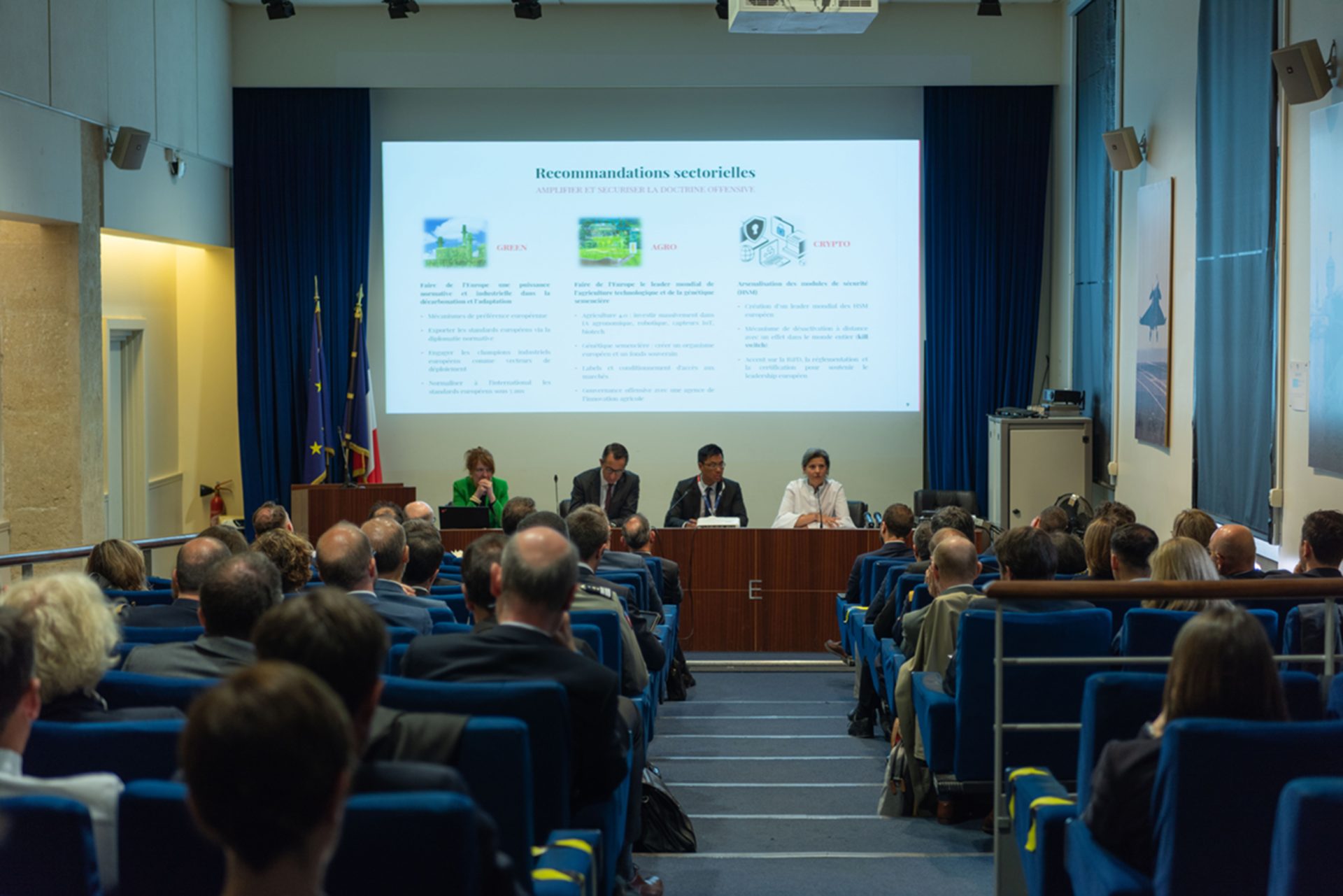
Committee 2 of the DSE major examined the following question: «Industrial and technological sovereignty: what proactive strategies can the European Union deploy to address dependencies and thereby put a form of economic deterrence into practice?»
For too long, Europe believed that interdependence guaranteed peace. The result: it has become economically dependent, handed over its markets and sold off its expertise at rock-bottom prices. China has secured a stranglehold on rare earths. The United States has turned the dollar into a weapon. Russian gas is no longer flowing. As for Europe, it looked the other way. Those days are long gone. The diagnosis is clear-cut. Farrell and Newman set out their theory as early as 2019: In any global network, whoever controls the «choke points» dictates the terms. Washington does so through its extraterritorial laws. Beijing controls 85 % of rare-earth refining and dictates its terms. The GAFAM companies have turned European economies into digital colonies. Europe, for its part, has remained on the defensive.
However, Europe is a force to be reckoned with, though it may not realise it. It has a market of 450 million consumers, who are among the wealthiest in the world. It sets global standards; the «Brussels effect» is effectively imposed on anyone wishing to sell there. It holds a strong position in civil aviation, the nuclear industry, the luxury goods sector and the speciality chemicals sector. Copernicus, its agricultural satellite constellation, is made available as open data to its competitors without any compensation whatsoever. Every year, 300 billion euros of European savings go towards funding its strategic rivals. These imbalances cannot be allowed to continue without being seriously scrutinised. We must turn our strengths into weapons – that is, exploit them to our advantage wherever they can create dependency and thus vulnerability. Asymmetries then become tools of power.
The proposed strategy represents a break with the past, in which France must take the lead in Europe. The aim is to show our neighbours which tools can be used, and to encourage the continent to adopt them. It is also a question of establishing them as standard, flexible instruments for regulating international relations, rather than as measures so dissuasive that they lose their credibility.
We are proposing six proactive measures, with expected outcomes by 2035 :
- MIGA is turning the internal market into a weapon of geopolitical coercion, making access to 450 million consumers conditional, and endowing the EU with an economic war prosecutor.
- CEASE subjects the export of our intangible assets (patents, algorithms, know-how) to a state veto: no more transfers without a geopolitical quid pro quo.
- PASE manufactures asymmetric interdependencies in collaboration with selected partners (Canada, Japan, the Gulf, India) to collectively organise dependencies.
- GREEN is establishing European decarbonisation standards as a global necessity.
- AGRO aims to make Europe what China is to rare earths: a technological and seed monopoly.
- KILL SWITCH is implementing a digital deterrent.
All of these instruments are designed to provide Europe with a credible capability for the development of its own defence capabilities, based on reciprocity and the management of dependencies.
This strategy requires political courage. Pulling these levers means accepting retaliation. It means prolonging deadlines, losing contracts and alienating partners. Within the EU, it also means putting in place compensation mechanisms between Member States to ensure that the unity of the Twenty-Seven holds firm in the face of adversity. No offensive doctrine will be credible without a shared narrative capable of winning over European public opinion. In a brutalised world, weakness attracts predators. Europe must shake off its passivity, show its determination and make it clear that it will respond in kind, by taking on the risk and sharing the cost.
MAJOR MARITIME CHALLENGES AND STRATEGIES: THE «RESSAC» STRATEGY IN THE FACE OF HYBRID MARITIME THREATS
Committee 3 of the ESM degree programme examined the question: «In order to capitalise on current geopolitical changes and safeguard our sovereignty over maritime areas, how should we adapt our maritime strategy to counter hybrid threats posed by state actors (dark fleet, IUU fishing fleets, trafficking of all kinds, information warfare)?»
Protecting France’s maritime areas is a challenge that is as vast as it is complex. With an Exclusive Economic Zone (EEZ) covering 11 million km², 97 % of which lies overseas, France has a fragmented territory that is difficult to monitor. At the same time, the National Strategic Review identifies a proliferation of «hybrid» threats» and multifaceted, primarily targeting the maritime sector. These attacks are carried out across five key areas: cyber, information manipulation, the weaponisation of the law, the economy, and military and space operations and infrastructure.
The definition of France’s strategy is based on the identification of two critical variables:
- The Russia–China axis: Their increasing hybrid activities, whether coordinated or not, directly undermine French maritime sovereignty as well as its democratic and economic foundations.
- The erosion of the international order: International law is giving way to the law of force, and traditional alliances are revealing their limitations. This reality means that France must urgently strengthen its strategic autonomy.
In light of the critical situation facing the overseas territories, The overriding policy objective is to safeguard the integrity of maritime areas. From a strategic perspective, France aims, within twenty years, to be in a position to detect, attribute, prevent and counter any hybrid threat affecting its trade flows, infrastructure and interests on the high seas.
To achieve this, the committee proposes to introduce the strategy «RESSAC». Symbolising the forceful rebound of a wave against an obstacle, it aims to repel attacks and impose a deterrent cost on adversaries.
It centres on Six recommendations for implementing a «total defence» strategy» :
- Gaining a better understanding: strengthening the management, sharing and use of France’s maritime data
- Faster decision-making: strengthening governance of the State’s maritime operations (AEM)
- Working to strengthen the country’s economic resilience: expanding and «maritimising» the OIV network to establish an operational maritime cluster
- Raising national awareness: refocusing some of the government’s communication campaigns to foster a spirit of defence and a seafaring spirit
- To impose a deterrent cost on the offender by denying them access to French and European public procurement markets
- To apply this comprehensive defence strategy to the overseas archipelago.
Although it is a long-term strategy, the RESSAC strategy is expected to deliver tangible results as early as 2027/2028, subject to immediate decisions.
Designed within a tight budgetary framework, the plan sets out reasonable financial trade-offs to ensure it remains sustainable. Finally, The effectiveness of this response depends on a cultural shift: re-establishing a strong bond between the land, the sea and the public in order to foster a genuine awareness of France’s maritime identity. The year 2026, marking the 400th anniversary of the Navy, has been identified as the right time to begin this transition.
MAJOR DEFENCE POLICY: COERCIVE DIPLOMACY
Committee 2 of the POLDEF major worked on the question: «The displays of power by Israel and the United States in the Middle East in the spring of 2025 can be interpreted as a resurgence of coercive diplomacy through the use of aerospace military power. France’s capabilities and expertise in this field have been mobilised in the past. What strategy should France adopt to capitalise on these opportunities?”
In an environment characterised by the escalation of power struggles, the normalisation of actions falling short of armed conflict, and the weakening of multilateral frameworks, Committee 2 has focused on to define the strategy France should adopt in the face of competitors who have fully incorporated coercion into their standard modes of operation.
Coercive diplomacy – the coordinated use of diplomatic, economic, military, informational and legal means of pressure to achieve a lasting political outcome without a full-scale armed conflict – is now practised by all the major powers. Russia combines acts of sabotage, disinformation and energy blackmail; China exploits economic and technological dependencies whilst stepping up its military pressure in the Indo-Pacific; and the United States, even towards its allies, exercises an unapologetic global capacity for coercion across all domains.
The committee carried out a SWOT analysis from The French position: real strengths – nuclear deterrence, a permanent seat on the Security Council, a world-class defence industrial and technological base (BITD), a global diplomatic network – but serious vulnerabilities : technological and energy dependencies; conventional capabilities under strain; domestic political polarisation that can be exploited by foreign actors.
Two strategies were assessed against two scenarios looking ahead to 2035. The committee ruled out «containing the effects of coercion» – a defensive approach deemed insufficient in the face of aggressive competitors – and opted for «fighting on the ground of coercion»: a measured firmness that makes it possible to impose costs on competitors and regain the initiative in grey areas.
Five operational recommendations set out this ambition:
- In diplomatic terms, to develop a doctrine of selective and transactional alliances centred on key countries in Europe and the Middle East, transforming our partners into active channels of influence.
- From an economic perspective, introducing a European preference in public procurement for critical sectors: cloud computing, energy, healthcare and semiconductors.
- In military terms, to establish, under French leadership, modular European air and maritime groups centred on an inter-allied, drone-equipped amphibious helicopter carrier.
- On the social front, national crisis preparedness days and the introduction, from secondary school onwards, of a culture of defence and geostrategy.
- In terms of information, developing the capacity for public attribution and proportionate responses to make hostile campaigns costly.
Coercion is not the enemy of diplomacy: in a world of enduring conflict, it is now a prerequisite for diplomacy’s credibility.
DIGITAL SOVEREIGNTY AND CYBERSECURITY: TOWARDS STRATEGIC DIGITAL AUTONOMY FOR THE STATE
Committee 3 of the SNC degree programme examined the question: «What strategy should France adopt to accelerate the digital transformation of its public administration in response to the expectations of industry and citizens, and in light of changing patterns of conflict?»
Since the early 2000s, the French government has introduced a series of reforms aimed at modernising its administration through digital technology. Based on the digitisation of administrative procedures and the simplification of public services, these policies have led to numerous IT projects and organisational changes. Despite real progress, the results remain mixed. A succession of reforms with shifting priorities, instability in governance models and budgetary constraints have often hampered the coherence of public policy on digital matters.
Committee 3’s report analyses this situation in the light of a profoundly changed international context. Since the war in Ukraine, geopolitical tensions have intensified and digital technology has become a key issue for sovereignty. The United States and China hold a strategic advantage in key areas such as artificial intelligence, cloud computing, quantum computing, robotics and electronic components. At the same time, public administrations have become prime targets for influence operations, espionage and destabilisation.
To address these challenges, The authors of this report carried out a forward-looking exercise based on two variables: the evolution of geopolitical threats and the pace of technological disruption. Two scenarios have been examined. The first envisages a return to a more stable environment following a period of severe turbulence. The second, by contrast, anticipates a sustained escalation of tensions, leading to a strategic weakening of Europe and increased dependence on foreign powers.
Based on this analysis, The report proposes a long-term strategy aimed at strengthening France’s strategic digital autonomy. The aim is to ensure that essential public services are secure and resilient, whilst reducing their dependence on non-European technologies. This ambition is underpinned by strengthened governance, capable of channelling resources towards priority projects and disruptive technologies.
The report also highlights the need to involve all the nation’s stakeholders in this transformation. Citizens, public authorities, businesses and the research community are called upon to contribute to the emergence of a French «core of digital trust» based on proven and independent solutions.
And finally.., This strategy is based on five recommendations:
- strengthen the government’s digital governance; ;
- to involve citizens more closely in the design of public services; ;
- to strengthen national technological capabilities; ;
- to incorporate the robotics revolution into the transformation of the civil service; ;
- and develop national and European partnerships with a view to fostering the emergence of trustworthy, competitive and independently controlled digital solutions.
 French
  English