
Athena at the Beach – 2026 Edition:
The Strategic Tour de France

For the fourth year running, IHEDN is delighted to keep you company during your holidays with the launch of our summer feature: «Athena at the beach» !
For 2026, we’re breaking the mould and offering you a brand-new experience with the launch of our very own Tour de France. The big start will take place tomorrow from Barcelona for an intellectual and geopolitical race which, after a memorable journey, will reach the legendary finish line on 26 July in the Cour d’honneur of the École militaire.
Visit 21 steps With these unmissable highlights, we’ll be exploring the region from a completely new perspective. On the itinerary for this grand loop:
- On high-level strategy: an analysis of the key issues in international cooperation and partnerships.
- On military geography: an analysis of the topographical challenges, borders and terrain that shape defence, both past and future.
- On human history: an in-depth look at key historical sites and a focus on illustrious figures who have shaped our shared history.
As summer is also a time for relaxation, we have designed this trail to be interactive. All along the route, you will find interactive content, little-known historical anecdotes and weekly quizzes to test your knowledge.
Whether you’re by the sea, in the mountains or at the office, pack your bags: it’s time to set off!
The challenges will be unlocked one after the other on the morning of each stage.
Have a great summer and enjoy your strategic journey with «Athena at the Beach»!
Step 1 – Pheasant Island: The world’s smallest block of flats
Today, Athéna is making her first stop at a place that is as secluded as it is exceptional: Île des Faisans.
Situated on the River Bidasoa, on the natural border between France and Spain, this small island has a legal and political status that is unique in Europe: it is jointly administered by the two countries under the principle of condominium. In practice, sovereignty over the island alternates every six months: it comes under French authority from 1er August to 31 January, then under Spanish authority from 1 February to 31 July.
The Theatre of High Diplomacy in the 17th Centurye century
This piece of land became famous in the mid-17the century, during the negotiations for the Treaty of the Pyrenees, signed in 1659. This historic agreement brought an end to more than two decades of fierce warfare between the two great European powers, which were then locked in a major political, military and territorial rivalry.
The Île des Faisans thus became a highly strategic diplomatic venue. A neutral territory par excellence, it was here that crucial talks took place between the French minister, Cardinal Mazarin, and the Spanish representative, Don Luis de Haro, with a view to drawing the new border and negotiating the terms of peace.
The site is also associated with a magnificent event in European history: the marriage by proxy of Louis XIV to the Infanta of Spain, Marie-Thérèse, a dynastic union intended specifically to seal and consolidate the reconciliation between the two kingdoms.
From conflict to shared cooperation
Over the centuries, the island has become a powerful symbol of the transition from a place of confrontation to one of cooperation. Where power struggles once took place, there is now a shared, peaceful and routine management of the territory (currently overseen by the commanders of the French and Spanish navies).
The Île des Faisans thus serves as a tangible reminder that diplomacy and the law can bring about lasting change in relations between states and give rise to innovative forms of international cooperation.
Stage 2 – Barcelona
Barcelona is a city deeply marked by one of the major European conflicts of the 18th centurye century: the War of the Spanish Succession (1701–1714).
It all began with the death of King Charles II of Spain, who died without a direct heir. In his will, he bequeathed the throne to his grand-nephew Philip of Anjou, the grandson of Louis XIV. This decision quickly caused concern amongst several European powers, who feared a lasting alliance between the French and Spanish crowns, and a major shift in the balance of power in Europe.
Faced with this prospect, a broad coalition formed against France. England, the United Provinces, the Holy Roman Empire and several other states became embroiled in a conflict that extended far beyond the borders of the peninsula. For more than ten years, fighting raged across Europe, on the seas and in the colonies.
Barcelona thus became a key strategic battleground. The city chose to side with the Habsburgs and endured a long and gruelling siege before falling on 11 September 1714. To this day, that date remains a central symbol in Catalan history and collective memory.
The war came to an end with the Treaty of Utrecht in 1713, supplemented by further agreements. A compromise was finally reached: Philip V retained the Spanish throne but permanently renounced his claims to the French crown in order to prevent any political union between the two countries.
Beyond the dynastic conflict, this war highlights issues that remain highly relevant today: the balance of power, military alliances, diplomatic influence and European stability.
Step 3 – Collioure: exploring the CNEC
Today, the Tour Athéna stops off at Collioure, at the National Commando Training Centre (CNEC), an iconic site in French military training.
Established in 1964 by the Army against the backdrop of the Cold War, the CNEC was originally part of a drive to modernise the French armed forces, informed by lessons learnt from the wars in Indochina and Algeria. Since its creation, its objective has remained unchanged: to prepare military personnel for the realities of combat in extreme conditions.
The centre trains soldiers in commando techniques, that is to say, in situations where physical endurance, mental resilience and the ability to adapt are vital. Trainees develop specialist skills there:
- Overcoming complex obstacles; ;
- Close-quarters combat; ;
- Survival in a hostile environment; ;
- Managing intense stress; ;
- Action in challenging terrain.
To provide a comprehensive training programme, the CNEC is spread across two complementary sites in the Pyrénées-Orientales:
- Mont-Louis, specialising in training in mountainous terrain; ;
- Collioure, which specialises in exercises in maritime and coastal environments.
This variety of terrain enables military personnel to be exposed to conditions very similar to those encountered during overseas operations (OPEX). The aim is to train soldiers to act swiftly, effectively and with composure in complex situations.
Beyond mere physical performance, the CNEC fosters the personal qualities essential to modern operations: team spirit, decision-making under pressure and a sense of initiative. Even today, this centre remains a key benchmark in the operational preparation of the French Army.
Step 4 – Carcassonne: the art of siege warfare
Carcassonne is one of Europe's most emblematic fortified towns. With its impressive ramparts and numerous defensive towers, the city is a perfect illustration of a fighting style that has marked military history for several centuries: siege warfare.
Unlike battles fought on open ground, siege warfare involved attacking or defending a fortress with the sole aim of taking control of a town or highly strategic point. Several methods were used by the attackers to achieve this:
- Surround the stronghold to starve out the defenders with a rigorous blockade; ;
- Destroy the walls using artillery and cannons; ;
- Launch direct and massive assaults against the ramparts ;
- To dig underground tunnels beneath the walls in order to cause them to collapse.
This type of conflict was based on a very precise discipline called the poliorcetics, This term comes from the ancient Greek and refers to the art of attacking and defending strongholds.
Between the XVIe and the XVIIIe In the 19th century, poliorcetics became an essential part of European military strategy. It simultaneously mobilised three major pillars:
- Advanced tactical knowledge; ;
- Complex engineering techniques; ;
- Advanced skills in military architecture.
Fortifications played a central role in protecting territories and populations. Today, Carcassonne is a remarkable example of this defensive architecture. Its double ring of ramparts and 52 towers bear witness to the vital importance attached to defending towns from the military threats of the time.
This fourth stage reminds us that the conflicts of the past were not only played out on the battlefields, but also at the foot of the walls, in the heart of the fortresses and through the resistance of the cities.
Stage 5 – Pau: Discovering the 5e RHC and ALAT
This fifth stage of the Tour Athéna takes us on a journey to discover the 5e Combat Helicopter Regiment (5e RHC) and the Army Light Aviation (ALAT), two key players in French military operations.
Based in Pau, the 5the The RHC deploys combat and manoeuvre helicopters capable of responding rapidly in close proximity to forces engaged on the ground. The regiment takes part in numerous major operational missions, including:
- Fire support and the protection of ground troops; ;
- Tactical reconnaissance and intelligence gathering; ;
- The transport of troops and equipment; ;
- The medical evacuation of the wounded (known as EVASAN).
Thanks to their great manoeuvrability and ability to act with lightning speed, helicopters play a crucial role in modern conflicts, particularly in hard-to-reach or isolated areas.
On the 5the RHC is part of the ALAT. Established after the Second World War, the Army Light Aviation (ALAT) brings together all the French Army’s air-mobile assets. Its main mission is to provide direct support to ground forces in contact with the enemy.
To meet the diverse demands of its missions, ALAT has several types of state-of-the-art aircraft at its disposal:
- Attack helicopters, such as the Tiger; ;
- Tactical and assault helicopters, such as the Caïman (NH90) or the Cougar; ;
- Reconnaissance and light-lift helicopters, designed for observation and guidance.
These high-tech assets have been deployed, in particular, during major overseas operations, such as Operation Barkhane in the Sahel and the conflict in Afghanistan. This stage of the Tour Athéna thus provides a better understanding of the vital importance of the third dimension — air mobility — in contemporary military operations.
Step 6 – Lourdes: the International Military Pilgrimage
Every year, the International Military Pilgrimage (PMI) brings together thousands of military personnel from all over the world in Lourdes. First organised in the aftermath of the Second World War, this gathering has become a major event combining remembrance, solidarity, support for the wounded and inter-service exchanges.
The PMI was founded against a backdrop marked by the severe human cost of the world wars. As early as 1948, wounded soldiers and veterans from military hospitals took part in gatherings organised in Lourdes. The aim at that time was twofold: to support soldiers scarred by war and to offer a moment of fellowship and spirituality following the trauma of combat.
However, the link between Lourdes and the armed forces dates back to the First World War. During that period, several of the town’s accommodation facilities stepped in to house and care for the wounded from the front. Establishments such as the Accueil Marie Saint-Frai played an active part in this relief effort, within a town already renowned for its capacity to accommodate people.
Over the decades, the PMI has evolved to take on a truly international dimension. Today, it brings together:
- Active-duty military personnel; ;
- War wounded and service personnel undergoing rehabilitation; ;
- Foreign delegations from dozens of countries; ;
- Veterans’ organisations; ;
- Families and carers.
The pilgrimage is structured around several key events: official military ceremonies, moments of reflection, personalised support for the wounded, meetings between nations and group activities. Beyond its spiritual dimension, the PMI plays a vital role in fostering cohesion, preserving remembrance and providing human support for the defence community.
The 66e The event took place from 22 to 24 May 2026, thereby continuing an international tradition of peace and brotherhood that began in the last century.
Step 7 – Mérignac: exploring Air Base 106
Air Base 106 is a military site deeply steeped in the history of 20th-century conflictse century, which remains essential to French air operations to this day.
During the Second World War, the base played a major strategic role. From 1940 onwards, it was occupied by the German army and used by the Luftwaffe to carry out reconnaissance and combat missions over the Atlantic Ocean. Owing to its military importance, the site became a priority target for the Allies. Between 1943 and 1944, the base was subjected to several waves of bombing raids, which caused extensive damage.
After the war, the site was completely rebuilt and then officially renamed 106th Air Base in 1945. During the Cold War, it established itself as a key component of France’s air defence system.
Even today, BA 106 continues to play a key strategic role within the Air and Space Force. The base is home to around 3,000 military and civilian personnel and plays an active part in numerous missions:
- Military transport; ;
- Aerial surveillance; ;
- Coordination of operations; ;
- Logistical support for the air forces.
This seventh stage of the Tour Athéna helps us to understand how military infrastructure evolves over the course of conflicts, ensuring it continues to play a central role in contemporary operations.
Stage 8 – Bergerac: discovering Eurenco and industrial sovereignty
This eighth stage of the Tour Athéna takes us on a tour of the Eurenco site, a major player in France’s Defence Industrial and Technological Base (BITD).
The history of this industrial site dates back to the First World War. At that time, France needed to massively and rapidly increase its munitions production to support the war effort at the front. A national munitions factory was therefore established to manufacture highly strategic components for the armed forces. The site produced, in particular:
- Powder for artillery shells; ;
- Nitrocellulose, a chemical compound essential for the manufacture of many types of ammunition.
For decades, this long-established industrial sector has played a key role in the supply and self-sufficiency of the French armed forces.
Today, Eurenco is undergoing a period of unprecedented development and transformation. Against a geopolitical backdrop characterised by a return to high-intensity conflict, the site lies at the heart of what the authorities describe as a «war economy», aimed at restoring our industrial sovereignty.
Since 2023, a number of major projects have been launched:
- The strategic relocation of powder production to France; ;
- The construction of new automated production lines; ;
- The overall strengthening of defence industrial capabilities.
The site must also come to terms with its history by managing the environmental legacy left by the industrial activities of the two world wars, in particular the decontamination of soil affected by the historical use of certain chemicals.
This stage of the Tour Athéna highlights the vital importance of the defence industry: a sector where the memory of conflicts, the challenges of mass production and national sovereignty intersect.
Step 9 – La Courtine: the La Courtine camp and the preparation of the forces
This ninth stage of the Tour Athéna takes us right into the heart of France’s military training camps, using the iconic example of La Courtine camp.
Established in 1901, the La Courtine camp meets a fundamental need of the French army: to have vast areas dedicated to the training and instruction of troops. Situated in a remote rural area of the Creuse, it offers ideal geographical conditions for organising complex manoeuvres, firing exercises and large-scale training operations.
The La Courtine camp quickly established itself as one of the largest in France. It forms part of a national network of training facilities, each with specific features tailored to operational requirements:
- Training in mountainous terrain; ;
- Combat in wooded and urban areas; ;
- Live-fire and high-precision shooting exercises; ;
- Preparation for joint and combined operations; ;
- Large-scale tactical manoeuvres.
These facilities play a vital role in operational preparedness. They enable military personnel to gain experience in conditions that closely resemble those encountered during overseas operations (OPEX) or missions to protect the national territory.
La Courtine camp was also the scene of a remarkable historical episode. In 1917, at the height of the First World War, Russian soldiers sent to France refused to return to the front following the outbreak of the Russian Revolution. They mutinied and took control of the camp. The French army was then forced to intervene to regain control of the camp, even going so far as to use artillery. This event, known as the «La Courtine mutiny», is a rare instance of an armed foreign military revolt on French soil.
Even today, the camp remains an active and modern facility used by the French armed forces for their training exercises. This insight thus helps us to better understand the strategic role of such sites in the evolution of military tactics over time.
Step 10 – Aurillac: National Day in Aurillac
Every year, 14 July holds a special place in French public life. With its official ceremonies, public gatherings and large-scale events, this day has become one of the greatest symbols of the Republic and of national unity.
Every year, the famous military parade brings together thousands of personnel from the various branches of the French armed forces. The Army, Air and Space Forces, the French Navy, specialist units and military academies all take part in order to showcase the full diversity of our country’s operational capabilities.
For example, a previous edition of the event attracted nearly:
- 7,000 military personnel; ;
- 65 aircraft; ;
- 34 helicopters; ;
- 247 armoured vehicles and machinery.
Beyond its formal and ceremonial aspects, this day provides an opportunity to highlight the armed forces’ technical expertise, their responsiveness and the international cooperation they have developed with numerous foreign partners.
14 July is also a special occasion for citizens to come together with their armed forces. Local parades and ceremonies — such as here in Aurillac —, military band concerts and equipment displays provide an opportunity to learn about professions, technologies and traditions that are often little known to the general public.
This tenth stage of the Tour Athéna thus serves as a reminder that 14 July extends far beyond mere public celebrations: it embodies republican history, national memory and the unbreakable bond that unites the nation with its armed forces.
We don’t (just) celebrate what we believe in!
When we think of 14 July, we immediately think of the storming of the Bastille in 1789. However, the 1880 Act establishing the national holiday explicitly refers to 14 July 1790: the Fête de la Fédération. It was a large, peaceful gathering intended to celebrate national unity and reconciliation. Members of parliament at the time felt that the storming of the Bastille was too bloody to be the sole symbol of the holiday!
The parade’s trailblazers: the firefighters (and their dogs!)
The 14 July military parade is a long-standing tradition, but did you know that dogs have played a very special role in it? In 1913, during the parade at Longchamp, the Paris Fire Brigade caused a sensation by marching alongside their search-and-rescue dogs. Today, military dogs (notably the dog-handling teams from the Army and the Gendarmerie) continue to melt the hearts of spectators.
The parade has not always taken place on the Champs-Élysées
The Champs-Élysées is now the unmissable showcase for the parade, but this has not always been the case. From 1880 to 1914, the parade took place at the Longchamp racecourse. After the First World War, it moved to the Champs-Élysées, before changing location regularly under the presidency of Valéry Giscard d’Estaing, who moved it several times between the Place de la Bastille, Place de la République and the Cours de Vincennes in an effort to reconnect with «working-class» Paris. The parade returned permanently to the most beautiful avenue in the world in 1980, except in 2024 due to the Olympic Games.
Behind the scenes of the Legionnaires’ march
The Foreign Legion is traditionally the unit that brings up the rear of the parade on the Champs-Élysées. Why? Because they march at a much slower pace than the other units: 88 steps per minute, compared with 120 steps per minute for the rest of the army (and as many as 140 for the Alpine Hunters!). This slow, solemn pace, inherited from the marches of the Ancien Régime, means the organisers have to place them at the very end so as not to slow down the rest of the procession.
The invention of the firefighters’ ball: a pure coincidence
The famous «Firefighters» Ball’ held on 14 July began in 1937 at the Montmartre fire station in Paris. Originally, the firefighters on duty were simply given permission to open the fire station’s doors to their families and friends to celebrate after the parade. It proved such an instant hit with passers-by and the local community that the tradition spread throughout France, becoming an unmissable and popular fixture of the national holiday.
Step 11 – Decize: Maurice Genevoix, the writer and chronicler of «Ceux de 14»
Today, the Tour Athéna is stopping off in Decize to honour the memory of Maurice Genevoix, a native of Decize, a great writer, a war veteran and a key figure in passing on the legacy of the First World War.
Mobilised at the outbreak of the war in August 1914, the young graduate of the École Normale Supérieure served as a second lieutenant in the infantry. Promoted to officer, he took part in one of the most gruelling and deadly campaigns on the front: the Battle of Les Éparges, in the Meuse. In April 1915, he was seriously wounded there by three bullets, which brought his combat service to an end but marked the beginning of his work to preserve the memory of the war.
After the war, Maurice Genevoix turned to writing as a way of bearing witness to the unspeakable. His masterpiece, Those aged 14 — a collection of his war stories — stands out as the most faithful, sober and realistic account of the daily lives of soldiers in the trenches. Far removed from the romanticised heroism or the propaganda of the time, his writing depicts the raw reality: the mud, the cold, the fear, the ever-present violence of the bombardments, but also the strength of brotherhood and camaraderie in the face of death.
Elected to the Académie française in 1946, where he went on to become Permanent Secretary, Maurice Genevoix dedicated his life to giving a voice to his comrades who had fallen at the front. In 2020, one hundred years after the burial of the Unknown Soldier, he was laid to rest in the Panthéon. Through him, the entire generation of the Great War was honoured by the nation.
This eleventh stage of the Tour Athéna reminds us of the fundamental role played by literature and historical accounts in upholding the duty to remember and in understanding the experience of those who fought.
Drag the tiles to piece together this portrait of Maurice Genevoix
Step 12 – Le Creusot: from the army’s forge to industrial excellence
The Tour Athéna stops off today in Le Creusot, an iconic industrial town that perfectly illustrates the history, adaptability and strength of France’s Defence Industrial and Technological Base (BITD).
Long before it became a flagship of the modern nuclear industry, the Le Creusot site was closely linked to the history of the Schneider & Cie factories. In the 19the century and during the first half of the 20the Throughout the 19th century, these gigantic metallurgical forges played a vital role in France’s industrial and military efforts. During both world wars, Le Creusot operated at full capacity to supply the national armed forces, producing: world-renowned artillery pieces and large-calibre guns; exceptionally strong steel armour plating for the Navy and the Army; heavy military equipment and strategic infrastructure.
The city thus emerged as a symbol of the nation’s industrial might, demonstrating that victory on the front line depended first and foremost on production capacity at home.
From 1958 onwards, Le Creusot’s tradition of advanced metallurgy took a new strategic direction with the establishment of Framatome. The company developed expertise, unique in the world, in the fields of civil nuclear power and cutting-edge energy equipment. Today, the site designs and manufactures: heavy forged components essential for nuclear reactors; highly sophisticated metal parts capable of withstanding extreme pressures; and strategic equipment vital to France’s energy independence.
This twelfth stage highlights the evolution of our sovereign industries: a successful historic transition from production initially focused on heavy armaments to the technologies of the future that are essential to our energy resilience and national sovereignty.
Stage 13 – Belfort: 103 days under siege and the eternal symbol of resistance
The Tour Athéna stops today in Belfort, the scene of one of the most heroic episodes of the Franco-Prussian War of 1870–1871, a major conflict that led to the fall of the Second Empire, the birth of the Third Republic and a geopolitical shift in Europe.
Towards the end of 1870, as the French armies suffered heavy setbacks, the fortress of Belfort found itself surrounded. Isolated, cut off from the rest of the country and deprived of all supplies, the town came under constant military pressure and intense Prussian bombardment. Faced with this desperate situation, the defence was organised with exceptional rigour under the command of Colonel Aristide Denfert-Rochereau. Later nicknamed «the Lion of Belfort», this engineering officer devised a remarkable defensive strategy, based on extending the fortifications outwards, iron discipline and the constant maintenance of morale amongst the garrison and the civilian population.
For 103 days, despite the cold, hunger and widespread destruction, Belfort refused to surrender. The city held firm, inflicting losses on the enemy and becoming the only successful pocket of resistance in the conflict. In February 1871, the garrison only left the citadel on the express orders of the French government following the Armistice, marching out proudly with the honours of war, their weapons and their flags. This exceptional tenacity enabled Belfort to remain French during the negotiations for the Treaty of Frankfurt, whilst Alsace and the Moselle were annexed.
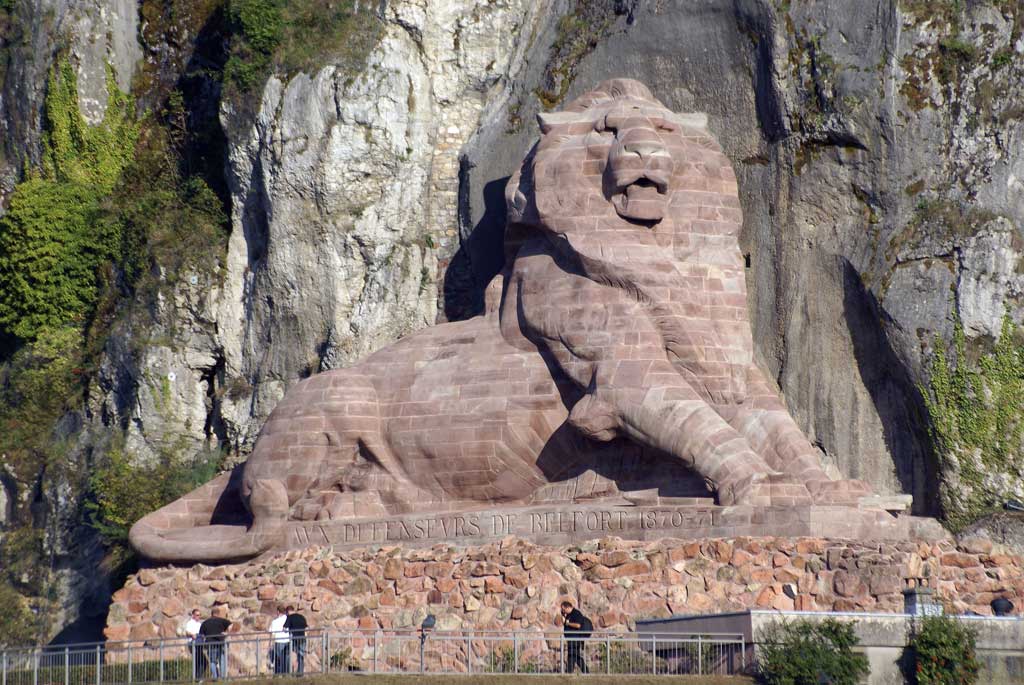
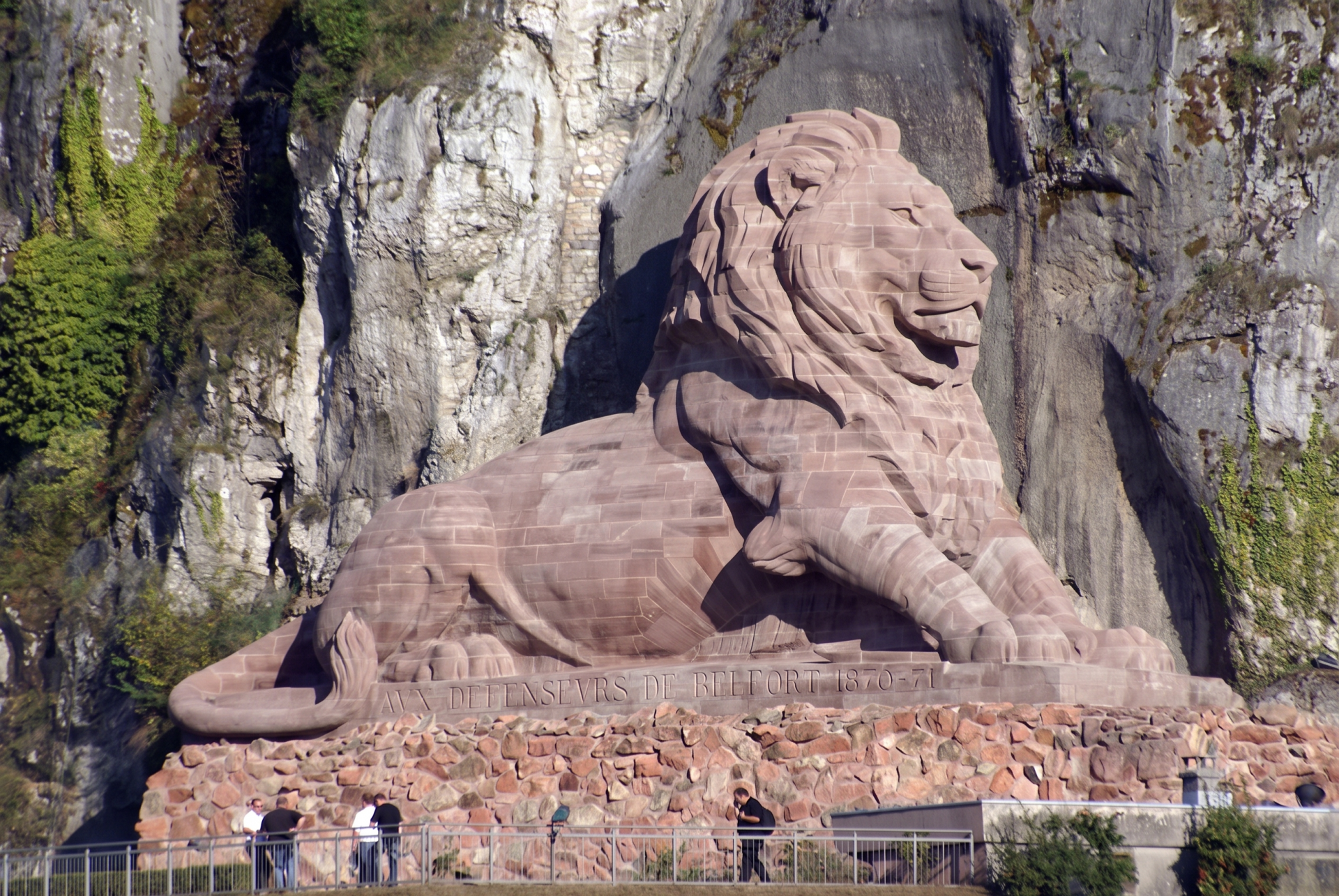
To commemorate this legendary resistance, the sculptor Auguste Bartholdi (creator of the Statue of Liberty) created the monumental Lion of Belfort between 1875 and 1880. Carved directly from the pink sandstone at the foot of the citadel, this masterpiece – 22 metres long and 11 metres high – stands as an eternal symbol of pride, strength and courage in the face of the invader.
This stage serves as a reminder of the reality of siege warfare in the 19the century and the way in which a population’s spirit of defence and unity can transform a city into a national symbol of remembrance.
Stage 14 – Alsace: 152e RI at Hartmannswillerkopf: commemorating the «Red Devils» in the hell of the Vosges
The Tour Athéna stops today at a significant site commemorating the Great War in Alsace: the Hartmannswillerkopf (HWK), renamed «Vieil Armand» by French soldiers. This steep mountain in the Vosges, overlooking the Alsace plain, was a major strategic point on the front line, fiercely contested by the French and German armies.
At the heart of this terrible battle, one elite regiment distinguished itself: the 152nde Infantry Regiment (152e RI). Historically based in Colmar, this regiment earned a reputation for exceptional fighting spirit during the battles of 1915, to the extent that its German opponents nicknamed it the «Red Devils» – a name it proudly retains to this day.
In 1915, the Hartmannswillerkopf was transformed into a veritable hell of fire and blood. To gain control of this strategic peak, the 152nde The RI both launched and withstood successive waves of attacks. The conditions of combat there were extremely gruelling: on steep, rocky slopes, in a harsh mountain climate characterised by snow and freezing cold, the men were engaged in close-quarters trench warfare, where every metre gained came at the cost of appalling human losses. The mountain, pounded by artillery, is literally stripped bare and torn apart by networks of tunnels, shelters and barbed wire.
Despite these hellish conditions, the «Red Devils» demonstrated legendary endurance and self-sacrifice, becoming a symbol of the sacrifice made by infantry troops in mountainous terrain.
Today, the Hartmannswillerkopf is one of the four national monuments to the Great War. Having become a powerful symbol of Franco-German reconciliation, the site is home to a national necropolis, a well-preserved fortified spur and a historical exhibition that remind younger generations of the price of peace and the operational value of the 152e RI, still working hard for France.
Stage 15 – Glières Plateau: the Glières maquis, a symbol of courage and the Resistance
Today, the Tour Athéna climbs up to the Glières Plateau in Haute-Savoie, a high-mountain site that has become one of the most powerful symbols of the French internal Resistance against the Nazi occupation and the Vichy collaborationist regime.
In 1944, the underground struggle against the occupying forces became deeply organised throughout the country. United under the auspices of the National Council of the Resistance, the various networks coordinated their military, intelligence and sabotage operations in preparation for the Allied landings. In areas that were difficult to access, the ‘maquis’ were formed: groups of young people who had refused to join the Compulsory Labour Service (STO) and volunteer fighters determined to take up arms.
The Glières Plateau, a vast natural stronghold surrounded by cliffs, was chosen in early 1944 by the Secret Army for a highly strategic mission: to serve as a reception base for massive airdrops of weapons and ammunition from the British Allies, in order to supply the Resistance fighters throughout the region. Under the command of Lieutenant Tom Morel, and later Captain Anjot, nearly 500 members of the Maquis — of all political persuasions, as well as Spanish Republicans and Alpine Hunters — gathered there under military discipline, united by a single motto: «Live free or die».
In March 1944, the enemy decided to destroy this symbol. The Glières Maquis came under a large-scale attack led by the French Militia, joined by substantial German army forces backed by heavily armed air and artillery units. Faced with this overwhelming numerical and material superiority, the resistance fighters put up a courageous fight before receiving orders to withdraw. Many lost their lives during the retreat or in the fierce crackdown that followed.
Although the military outcome of the battle was tragic, the sacrifice at Glières represented a tremendous moral victory. It demonstrated to the Allies the valour, organisation and determination of the French resistance forces. Today, this legacy and this prestigious motto are proudly upheld, having been adopted by the soldiers of the 27the Alpine Hunters’ Battalion (27e BCA).
Stage 16 – Thonon-les-Bains: the clash of namesakes in military history
Today, the Tour Athéna stops off on the shores of Lake Geneva, in Thonon-les-Bains, to shed light on a historical curiosity that has been a source of frequent confusion for over two centuries: the story of two illustrious generals of the Empire with almost identical names, but very different fates: Louis Charles Antoine Desaix and Joseph-Marie Dessaix.
Louis Charles Antoine Desaix (spelt with a single «s») was one of the most brilliant and legendary figures in the armies of the Revolution and the Consulate. Born in Auvergne, this officer of exceptional tactical genius distinguished himself during the German campaign, before following Napoleon Bonaparte to Egypt, where his integrity and sense of justice earned him the respectful nickname «the Just Sultan». Recalled to Italy in 1800, he arrived at the last possible moment on the battlefield at Marengo. His lightning-fast charge turned the tide of history and saved Bonaparte from certain defeat, but General Desaix was fatally struck by a bullet straight through the heart. His heroic death at the age of 31 cemented his place in history and secured his place among the pantheon of France’s greatest military leaders.
Joseph Marie Dessaix (spelt with two «s’s) has a life story more deeply rooted in the regional geography of our stage. Born in Thonon-les-Bains, this doctor by training embraced a military career with fervour during the Revolution. He raised the famous Allobroges Battalion and distinguished himself through his bravery during the Italian and German campaigns under the Empire, where Napoleon nicknamed him »the Intrepid« and made him a Count of the Empire. Although he survived the Napoleonic Wars and went on to enjoy a distinguished national career, his actions remained deeply linked to the defence of his native Savoy, where he commanded the National Guard.
This sixteenth stage of the Tour Athéna plays on this similarity in surnames to remind us of the richness of our military heritage: on the one hand, a leading strategist who has become a national legend; on the other, a fearless warlord, a hero of emancipation and of the regional history of Savoy.
Stage 17 – Grenoble: the Bastille Fort, sentinel of the Alps and legacy of the last constable
Majestically overlooking the Isère Valley, the Bastille Fort in Grenoble is a remarkable example of mountain fortification architecture, having historically controlled the strategic Alpine routes and protected the borders of the Dauphiné.
Although the current site was redesigned in the 19the century, its military origins are closely linked to one of the most powerful figures in French history: François de Bonne, Duke of Lesdiguières. An exceptional military leader on the Protestant (Huguenot) side during the bloody Wars of Religion, a loyal comrade-in-arms and close friend of King Henry IV, he established himself, through his strength and political acumen, as the undisputed master of the region.
His solemn conversion to Catholicism in 1622 marked a major turning point for the nation: King Louis XIII then conferred upon him the highest military honour of the Ancien Régime by appointing him Constable of France (supreme commander of all the royal armies). Lesdiguières will forever remain the very last man to have held this prestigious title in the history of our country.
As governor of the Dauphiné, Lesdiguières undertook a monumental programme of construction to fortify his province against external threats, notably from the Duchy of Savoy. It was he who commissioned the very first fortifications of the Bastille on Mont Rachais, surrounding Grenoble with a modern and powerful defensive wall. He understood, before anyone else, that mastery of the terrain and control of the Alpine passes were the cornerstones of the kingdom’s security.
This seventeenth stage of the Tour Athéna highlights the historical significance of mountain fortifications and commemorates a great commander who succeeded in combining the art of war with engineering to defend the territory.
Stage 18 – Mont-Dauphin: Vauban’s star-shaped Alpine stronghold
Today, the Tour Athéna stops off at Mont-Dauphin, an architectural masterpiece that showcases the genius of the greatest military engineer in French history: Sébastien Le Prestre de Vauban.
During the reign of Louis XIV, Vauban devised the «iron belt» strategy, a network of modernised strongholds designed to fortify the kingdom’s borders and make the national territory impregnable. Following a surprise invasion by troops from the Duchy of Savoy in the Alps in 1692, Vauban was urgently dispatched to devise a comprehensive defence plan for the Southern Alps border.
The choice of the Mont-Dauphin site was dictated by an absolute geopolitical and topographical necessity: situated on a rocky, deserted plateau overlooking the confluence of the Durance and the Guil, the stronghold guards the Alpine valleys, controls the natural transport routes and thwarts any attempt at invasion from Italy.
The fortress epitomises the perfection of Vauban’s theories adapted to the mountainous terrain: a star-shaped layout in which each bastion covers the blind spots of the others to eliminate any vulnerable areas; ramparts built from local pink marble, thick and sloping to absorb the impact of artillery fire; and a design that blends seamlessly with the landscape, utilising the natural cliff faces as additional defensive walls.
Beyond its role as a garrison and logistical base, the mere presence of Mont-Dauphin served as a major deterrent, sparing the kingdom from further conflicts in the region. Exceptionally well-preserved and listed as a UNESCO World Heritage Site, Mont-Dauphin bears witness to the importance of bastioned fortifications in safeguarding the territory.
Stage 19 – Chambéry: the Mountain Troops, the high standards of the 27th’s high-altitude soldierse BIM
Today, the Tour Athéna heads deep into the heart of the glaciers and Alpine peaks to discover the 27the Mountain Infantry Brigade (27e BIM), one of the most specialised and demanding units in the French Army.
This unique brigade comprises a number of prestigious elite regiments, including the 7the and the 13the Alpine Hunter Battalions (BCA), as well as the 93rde Mountain Artillery Regiment (RAM). Their operating environment? Mountainous terrain and extreme conditions, where nature itself becomes a formidable adversary. The soldiers of the 27the BIM teams are trained to operate in the harshest of conditions: at very high altitudes, in freezing temperatures, during snowstorms, on steep terrain and in areas with limited logistical support.
Operating and fighting in such an environment requires exceptional physical fitness, a perfect command of mountaineering and skiing techniques, as well as state-of-the-art, highly technical equipment that is essential for both collective and individual survival.
The 27the BIM builds on a long-standing tradition that began in the late 19the century with the formation of the first Alpine troops, raised specifically to defend the country’s natural borders. It upholds deeply rooted values: the ’spirit of the rope team«, solidarity in the face of danger, humility before the mountains, and tactical daring.
Today, these «Soldiers of the Peaks» are putting their unique expertise to use in France’s modern operations, demonstrating that mastery of hostile environments remains a major strategic asset for our armed forces.
Stage 20 – Alpe d’Huez: the cycling soldiers, the forgotten cyclists of the Great War
For this penultimate stage, the Tour Athéna tackles the legendary 21 bends of Alpe d’Huez to shed light on an unusual and little-known chapter in our military history: the epic story of the cycling chasseurs.
At the beginning of the 20the In the 19th century, as European armies sought to increase the speed of their troops without relying exclusively on horses or the railway, the French army broke new ground by forming companies of cycling chasseurs. Attached to the prestigious battalions of infantry chasseurs, these soldiers used the bicycle as a genuine tactical tool. Thanks to the use of revolutionary folding bicycles (Captain Gérard’s model, which could be carried on the back), these mobile units could move quickly over long distances, take the enemy by surprise and engage in combat on foot immediately.
On the eve of the First World War, these mobile units epitomised modernity. During the 1914–1918 conflict, the bicycle scouts distinguished themselves remarkably, particularly during periods of movement. Their missions were extremely perilous: carrying out daring reconnaissance missions at the vanguard to survey the terrain; ensuring vital links and the rapid transmission of orders between headquarters and the front lines; carrying out harassment raids and holding strategic positions whilst awaiting reinforcements.
Their agility and discretion make them a valuable asset in a chaotic environment where the speed of information is crucial.
After 1918, faced with the rapid rise of motorisation, motorbikes, civilian trucks converted for military use and the first armoured vehicles, the tactical use of the bicycle declined and then gradually disappeared from combat doctrines. Cyclist scouts, however, remain in military memory as a fascinating symbol of a major technological transition from animal power to the mechanical age.
Stage 21 – Paris: the main courtyard of the École Militaire, the pinnacle of strategic thinking
For this final and prestigious stage of the Tour Athéna, our grand summer tour draws to a close in the heart of the capital, at a highly sacred and institutional venue: the main courtyard of the École Militaire in Paris. Founded in the 18the Built in the 18th century under Louis XV, this majestic monument remains today the nerve centre of higher military education, doctrinal reflection and the promotion of defence culture in France.
This grand finale takes place against the backdrop of an exceptional commemorative year. Indeed, 2026 marks the convergence of anniversaries and major historical milestones for the leading institutions of our defence system, which are celebrating their enduring legacy and ongoing modernisation:
- The French Navy’s 400th anniversary: founded in 1626 at the instigation of Richelieu, four centuries of a glorious naval history in the service of national sovereignty, characterised today by mastery of maritime spaces, excellence in oceanic deterrence and a permanent operational commitment across all the world’s seas.
- The 275th anniversary of the École Militaire : Established by an edict of Louis XV in January 1751, this first French officer training institution had its origins in the difficulties of the War of the Austrian Succession, which had been won three years earlier. Its founder, Marshal de Saxe, succeeded in convincing the sovereign thanks to the support of the Marquise de Pompadour, the king’s favourite, with funding provided by the financier Joseph Pâris Duverney. The architectural design was entrusted to Ange-Jacques Gabriel, who also designed the Place de la Concorde.
- The École de Guerre’s 150th anniversary: as the direct successor to the École supérieure de guerre, founded in 1876 in the aftermath of the Franco-Prussian War, the institution was established with the aim of providing France with highly qualified staff officers. Having become the Joint Defence College before reverting to its historic name in 2011, the École de Guerre has, for a century and a half, been training future military leaders for the most complex joint operational responsibilities.
- The 115th anniversary of the Centre for Advanced Military Studies (CHEM) : Founded in 1911 on the initiative of General Ferdinand Foch, the CHEM has, for over a century, been training leading colonels, naval captains and commissaires for strategic command roles at the highest levels of the armed forces and the State.
- The 90th anniversary of the Institute for Higher National Defence Studies (IHEDN) : Founded in 1936 as the Collège des hautes études de défense nationale, the Institute celebrates nearly a century of unique commitment to breaking down barriers and promoting the spirit of defence, bringing together civilian and military students to consider the crises of tomorrow.
The École Militaire is not merely an architectural gem: it embodies the unbreakable link between academic knowledge, intellectual foresight and the operational reality of the forces deployed on the ground. It is here, in this temple of strategic thought, that the doctrines which guarantee our country’s security and resilience in the face of contemporary threats are formulated.
As we bring this 21-stage ‘Tour Athéna’ to a close, we realise that understanding defence is not merely a matter of examining the equipment; it is, first and foremost, about grasping the history, institutions, collective memory and schools of thought that shape the nation’s identity and future.
Thank you to everyone for following this wonderful summer cultural tour of La Défense with «Athéna at the beach» with such enthusiasm!
 French
  English