

This fact sheet is also available in audio format
Click below to listen:
Summary
- This fact sheet outlines the circumstances under which 8 and 9 May became part of the Allies’ collective memory, centring on two dates that commemorate the same event.
- More broadly, the analysis examines how Russia has transformed this symbol of 9 May, shifting the focus from commemorating the sacrifices made to glorifying force and power as being above the law.
- This dispute over a symbolic date is a case in point of the exploitation of history that characterises revisionist politics.
As some European countries prepare to mark the 80th anniversary of the end of the Second World War, this commemoration is being exploited in various ways. At the heart of debates that are not solely of a historical nature, two dates – 8 and 9 May – have taken on renewed significance in recent years, marking a dividing line in the memory of the victory over the Third Reich.e Reich. Today, one of the major victors of 1945, Russia, has invaded Ukraine, and in the wake of this event, strategies of remembrance are being put in place to serve highly political agendas.
Background – Is it simply a case of jet lag?
8 and 9 May marked the end of the war in Europe and the Allies’ victory over the Third Reiche Reich. The latter is on its last legs, following Hitler’s suicide and the Soviet capture of the capital, Berlin. The Führer’s short-lived successor, Admiral Dönitz, tried to buy time in an attempt to persuade the Western Allies to continue the war against the USSR. The Allied Supreme Commander, Eisenhower, refused to accept a general German surrender, as this applied only to the Western Front. The Germans therefore accepted the surrender, which was signed in Reims at 2.41 am on 7 May 1945. The cessation of hostilities is scheduled for the following day, 8 May, at 11.01 pm, as the German signatories have been granted a few extra hours to ensure that as many civilians and troops as possible do not fall into the hands of Red Army soldiers. Upon being informed, Stalin demanded that the surrender be ratified a second time, in Berlin, for symbolic reasons; This took place at Marshal Zhukov’s headquarters on 8 May 1945 at 11.01 pm local time – and therefore 1.01 am on 9 May Moscow time.
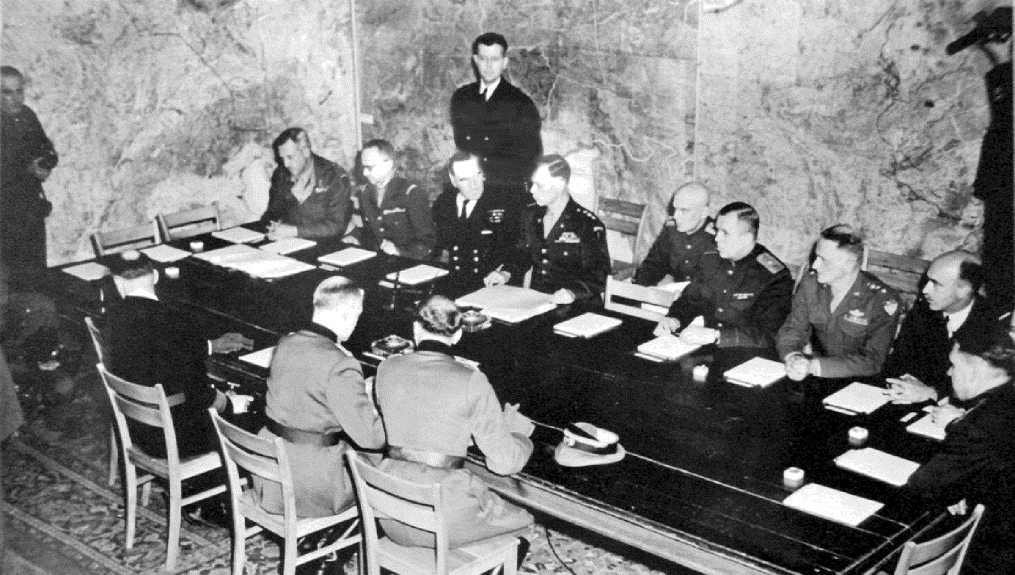
Behind what appears to be a mere anecdote, the balance of power and influence between the Allies—who could not agree on how to manage the post-war period—was already being played out. The Soviet Union, bolstered by its military might and the blood shed, made this episode the climax of the «Great Patriotic War» (the official name), with nearly 27 million dead — civilians and military personnel alike. These figures include combatants and victims from territories belonging to or occupied by the USSR: Ukraine, Belarus, the Baltic states, the Caucasus and Central Asia… In 1965, to mark the twentieth anniversary of the end of the conflict, Brezhnev declared it a public holiday, which is still celebrated in some countries of the former USSR, including Russia.
The decision to designate this date as a public holiday was not taken immediately; in France, a 1946 law established the commemoration of the victory on the condition that the day fell on a Sunday. In practice, the end of the war is celebrated on the first Sunday following 8 May. Long considered a working day, 8 May was replaced under President Giscard d’Estaing by Europe Day, to mark Franco-German reconciliation. It was not until 1981 that 8 May was finally declared a public holiday; as for 9 May, Europe Day, it refers to the Schuman Declaration of 9 May 1950, which laid the foundations for European cooperation. In the United Kingdom, whilst 8 May is also the date chosen to mark the end of the war in Europe (Victory in Europe Day, VE Day), it is rarely marked by a public holiday, as the British government prefers to grant a long weekend around 1 May (Early May bank (holidays) sometimes postponed, as was the case in 2020 to allow for the celebrations marking the 75th anniversary of the victory.
Ukraine presents a different case; throughout the Soviet era and into the early years of independence, Ukrainians observed 9 May. It was not until 2014, following the Revolution of Dignity, the war in the Donbas and the annexation of Crimea, that voices began to question the continuation of this practice. In 2015, the Rada — the Ukrainian parliament — established 8 May as a day of reconciliation and remembrance, whilst retaining 9 May as the date marking the victory over Nazism. A final step was taken in 2023 with a law combining the two celebrations on the same day, 8 May, to symbolically demonstrate both a distancing from Russia and an alignment with Western practices.
Analysis – Legacy, struggles and the use of history for propaganda purposes
In Russia, 9 May has not always been celebrated on such a grand scale: during the Soviet era, parades and patriotic commemorations took place on only four occasions – in 1945, 1965, 1985 and 1990. Under Stalin, apart from a fireworks display on Victory Day itself, there was a grand historical parade on Red Square on 24 June 1945, during which flags seized from Nazi units were burned. But whilst not underestimating the significance of the end of the war, neither the political authorities nor the population were really in the mood to celebrate what was initially experienced as a collective catastrophe at a terrible cost. It was not until Brezhnev (and 1965) that 9 May came to be used to highlight patriotism and the joy of victory, even though the military aspect played a lesser role than parades showcasing civil society and veterans. In any case, the Soviet authorities preferred celebrations of the October Revolution, whose memory and link to the regime were far more evident. The traditional military parade also took place on that date, to underline the ideological importance of an army defending communism and the legacy of 1917.
It was in 1995, under Boris Yeltsin, that a transformation took place. From then on, 9 May became an annual celebration featuring a military parade—with troops often dressed in Red Army uniforms to illustrate the link between the past and the present. Putin significantly changed the nature of the ceremony from 2008 onwards. The previous year, at the Munich Security Conference, he had denounced the West, which he perceived as aggressive. He therefore needed to rally Russian public opinion and prepare it to face this perceived threat. 9 May thus changed in character, shifting from a commemoration of atrocities, acts of heroism and the veneration of veterans to a show of force. This was particularly evident in 2009. Following the war in Georgia in August 2008, the parade became a showcase for Russia’s military capabilities: state-of-the-art aircraft, tanks and intercontinental ballistic missiles, potentially armed with nuclear warheads. The whole event was punctuated by martial music and concluded with a speech by the Kremlin leader.
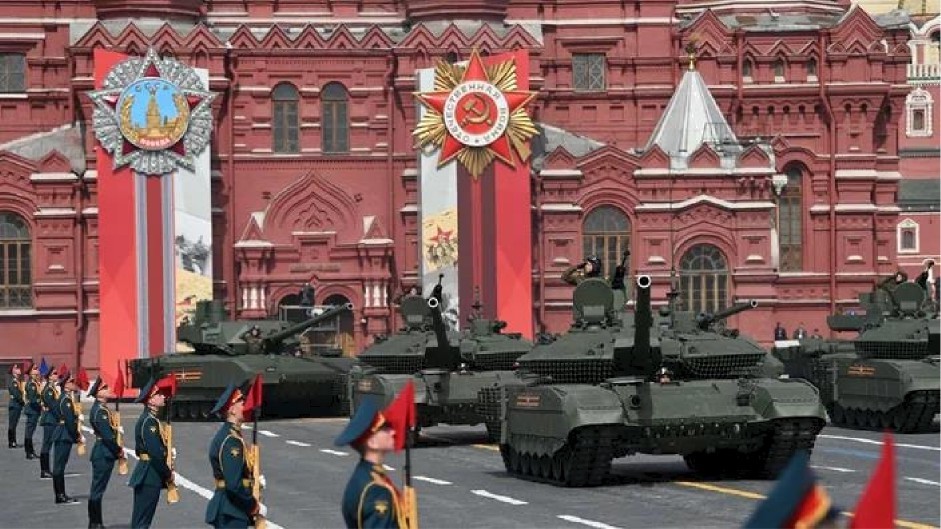
As part of this new narrative, new rituals are helping to mobilise the entire population in the broadest sense. Thus, red flags – which carry too strong an association with the Soviet Union – have taken a back seat to the display of the St George’s Ribbon. This former Tsarist symbol, with its black and orange stripes, evoking military valour and bravery, has become a sign of support for the government and for Putin himself. The second development is the desire to involve the public and make them a unified force; as veterans and the last living witnesses pass away, a spontaneous movement emerged from 2011 onwards in several Russian cities, with demonstrations honouring parents who fought during the Great Patriotic War. This «Immortal Regiment» aims to represent the continuity of the generations whose heroism is being celebrated. Very quickly, the Kremlin brought this association under its control. Originally a private initiative, the «Immortal Regiment March» became a foundation largely funded by the Kremlin. Vladimir Putin himself occasionally slips into the Moscow or St Petersburg parade, carrying a photograph of his father in uniform. This march is all the more significant as its international audience grows; the Immortal Regiment marches across every continent and in over 80 countries (for example, Lebanon, Norway, Israel, South Korea and even the United States). Each descendant is invited to hold aloft a photograph or portrait of their ancestor, in a long procession of flags and banners; in Russia, where public gatherings are strictly controlled, this march resembles the regime’s appropriation of a collective memory. For some, Putin elevates the memory of the Great Patriotic War to the status of a quasi-state religion, and even instils in Russian citizens a sense of «generational debt»: «This debt, with which every Russian citizen is said to be born, acts as a kind of original sin: if Russians do not fight and die in the pursuit of an epic and world-saving conflict, as their grandparents did, they are inevitably inferior to their ancestors.»[1]
The two parades thus draw a line of continuity between the heroism of the past and the calls to uphold the nation’s greatness through the display of its military might and the celebration of patriotic values. These values increasingly stand in stark contrast to those of a West that has been cast as an adversary over the years. Here too, the turning point came in 2007 with the speech at the Munich Security Conference, delivered before a European and American audience. In it, Putin criticised a unipolar world, «a world of a single master, a single sovereign», and denounced NATO’s eastward expansion[2]. This rejection by the West takes the form, in the context of 9 May, of a rewriting of the history of the conflict; whereas Stalin and Khrushchev acknowledged that material support — in the form of the Lend-Lease programme — from the Americans had been essential to victory, Putin now disputes this assertion[3] Year on year, the rhetoric has become more radical, blending past considerations with an analysis of contemporary geopolitical developments; the break was finalised in 2021, in a lengthy essay penned by Putin himself, which heralded the ‘storms of steel’[4]. Entitled «On the Historical Unity of Russians and Ukrainians», it accuses external forces of having erected a wall between the two parts of a single people, revisiting their shared history and accusing Ukraine and its leaders — swiftly denounced as «radicals and neo-Nazis »—of inventing myths, erasing existing ties and severing shared roots.
This narrative played a part in justifying the invasion of Ukraine, which began on 22 February 2022. From that point onwards, the significance of 9 May also changed. The display of military equipment, whilst reduced due to the ongoing war, nevertheless signals a new era. Threats to use force against Russia’s adversaries are no longer concealed: the enemy is clearly identified with historical overtones. The West is portrayed as fascists and Nazis supporting the Kyiv regime, against which the Russian regime is engaged. Historical continuity — some would say confusion — serves as a legitimisation; the 9 May celebrations project the image of a militarised Russian society, united behind its leader.
Nevertheless, military difficulties on the Ukrainian front have led to adjustments. In 2022, the focus was on the capture of the city of Mariupol, and although there was less equipment, more than 10,000 men marched across Red Square beneath an iconic ‘Z’ formed by aircraft — a reminder of the special military operation. In 2023, the festivities were altered after a Ukrainian drone flew over the Kremlin. The Immortal Regiment march was cancelled, whilst the military parade appeared rushed, with a notable reduction in the number of vehicles; thus, an iconic T-34 tank leads the procession, followed by a dozen or so vehicles, prompting speculation about the casualty rates suffered by the Russian army[5]. In May 2024, the Russian president’s traditional address came in the wake of the arrest of several senior officials from the Ministry of Defence on corruption charges[6].
Outlook – A fragile truce?
At the time of writing, it is still too early to say what form this commemoration—which holds threefold symbolic significance—will take: firstly, 9 May 2025 marks the 8the Victory Day, and Putin wanted to make this a major event by extending invitations to foreign dignitaries — including certain European heads of state and Xi Jinping. On this occasion, as he did at the time of Russian Easter, he took the initiative to announce a unilateral truce. In a statement, the Kremlin said it wished to suspend military operations for 72 hours (from 8 to 10 May) «for humanitarian reasons».
Furthermore, the celebrations come at a time of rapid developments in the international situation, particularly regarding the end of the conflict in Ukraine; the intensive negotiations led by Donald Trump, directly between the United States and Russia, demonstrate Washington’s determination to reach a solution, even if it is unfavourable to Ukraine. Between late February 2025 — when President Zelensky is humiliated in the Oval Office — and a photo of reconciliation posted at the time of Pope Francis’s funeral (late April 2025), international meetings followed one after another, with the question of what form the end of the conflict might take.
Finally, on the ground, the war continues unabated, with repeated bombardments and indiscriminate Russian attacks on civilians and infrastructure. This has led Ukraine to propose, rather than limited — and systematically violated — ceasefires, a suspension of strikes for a period of at least thirty days. In response to the celebrations in Moscow, Zelensky invited his European counterparts to visit Kyiv to stage a «counter-9 May», an initiative that most European foreign ministries have greeted with reserve[7]. Ukraine has also issued a warning to heads of state and government planning to visit Moscow, stating that it «cannot guarantee their safety»—a statement that has been strongly criticised by the Kremlin, which sees it as a thinly veiled threat[8].
In any case, this period demonstrates just how much the use and misuse of history have accumulated over the past two decades. This phenomenon is not unique to Russia but extends to other uninhibited powers (China and Turkey, among others). More surprising, and no less worrying, is the reaction from the United States, in the form of a tweet posted by the president himself on 1 May 2025; in a few lines, Trump decides to rename 8 May ‘Victory Day’ (Victory Day), embarking on a battle over memory and symbolism regarding which power contributed most to the defeat of the Nazis, whilst at the same time obscuring the end of the war in the Pacific, which came more than four months later.
[1] Ian Garner, «9 May: Putin’s Endless War», The Great Continent, 8 May 2023
[2] Laurent Zecchini, «Vladimir Putin condemns American unilateralism», Le World, 12 February 2007
[3] TASS, «Did Lend-Lease help the USSR defeat Hitler? Russia launches Sputnik Light», 7 May 2021
[4] Vladimir Putin, “On the Historical Unity of Russians and Ukrainians“, Office of the President of the Russian Federation, 12 July 2012
[5] «The Shrunken Parade», The Great Continent, 9 May 2023
[6] Nathan Hodge, «Victory Day celebrations mask simmering tensions inside Putin’s Russia», CNN, 9 May 2024
[7] Nicholas Vinocur, Hans von der Burchard and Rasmus Buchsteiner, «Kyiv asks EU officials to visit on 9 May to counter Putin’s victory parade», Politico, 14 April 2025
[8] Alain Barluet, «Vladimir Putin suspects Kyiv of wanting to spoil «his» 9 May», Le Figaro, 4 May 2025
Bibliography
This This fact sheet is based on information from the following sources:
- Marc Bouxin, “Reims, 7 May 1945: the German surrender”, Paths of Remembrance
- Fabien Deglise, “Vladimir Putin and the cult of the Cold War”, Le Devoir, 21 February 2023
- «The Shrunken Parade», The Great Continent, 9 May 2023
- Nathan Hodge, «Victory Day celebrations mask simmering tensions inside Putin’s Russia», CNN, 9 May 2024
- Vladimir Putin, On the Historical Unity of Russians and Ukrainians, Office of the President of the Russian Federation, 12 July 2012
- Wiktor Stoczkowski, “Has Putin declared war on the West?” Russia Desk, 14 October 2022
- TASS, Did Lend-Lease help the USSR defeat Hitler, and is Russia launching Sputnik Light?, 7 May 2021
- Nina Tumarkin, The Living and the Dead: The Rise and Fall of the Cult of the Second World War in Russia, New York, Basic Book, 1994
- Nicholas Vinocur, Hans von der Burchard and Rasmus Buchsteiner, «Kyiv asks EU officials to visit on 9 May to counter Putin’s victory parade», Politico, 14 April 2025
- Laurent Zecchini, «Vladimir Putin condemns US unilateralism», The blonde, 12 February 2007
This file is automatically translated
 French
  English