

This fact sheet is also available in audio format
Click below to listen:
Summary
- Russia's invasion of Ukraine in February 2022 was a major strategic turning point in Northern Europe, triggering two fundamental changes: on the one hand, the end of the principle of neutrality historically defended by Finland and Sweden, materialised by their accession to NATO in 2023 and 2024; on the other, a geopolitical transformation of the Baltic Sea, now almost entirely bordered by member states of the Atlantic Alliance.
- In the face of multi-faceted threats, ranging from hybrid actions to a return to high intensity, the Nordic model of total defence, based on the integration of civilian and military resources, is finding favour and is the subject of numerous analyses.
Context - The changing defence postures of Sweden and Finland: from neutrality to NATO membership
Sweden and Finland have long adopted a position of neutrality. For both countries, this meant being able to preserve their independence, security and stability, even in times of war, without getting involved in alliances. Militarily, this meant having an autonomous and credible defence capability. In Finland, neutrality was conceived from the outset as a means of preserving its existence in the face of neighbouring Russia. The country adopted this principle between the wars, before reaffirming it in the 1950s. However, this strategic posture during the Cold War - often referred to as «Finlandisation» - was synonymous with constrained neutrality and limited sovereignty, due to the influence exerted by the USSR on its foreign policy. Under the terms of the Agreement on Friendship, Cooperation and Mutual Assistance signed with Moscow on 6 April 1948, Finland undertook to remain outside any conflict between great powers and, more specifically, to prevent any foreign power from using its territory to wage aggression against the USSR. In return, the country preserved its autonomy in domestic policy matters.
The situation is different in Sweden, where neutrality is part of an older tradition, seen as both a pillar of national identity and a moral commitment. It became a structuring principle of Swedish foreign policy as soon as Charles XIV acceded to the throne in 1818. Although established as a fundamental principle of the country's political culture, Swedish neutrality has undergone changes. During the Cold War, for example, Sweden secretly coordinated its defence planning with the Western states, planning a joint military response in the event of an attack by the Warsaw Pact.
After 1991, without formally abandoning their neutral stance, the two countries embarked on a dynamic of international cooperation, including in the military field. They joined NATO's Partnership for Peace in 1994 and became members of the European Union (EU) in 1995. Since then, they have made an active contribution to the EU's external operations, as well as to a number of NATO operations in the Balkans, Afghanistan and Iraq. Since 2009, Sweden and Finland have participated in the Nordic Defence Cooperation (NORDEFCO) alongside Norway, Denmark and Iceland, and after the annexation of Crimea in 2014, a protocol of cooperation was signed between the two countries. Host Nation Support, This enabled NATO to intervene on their soil in the event of an emergency, while joint exercises, such as Trident Juncture 2018 or Northern Wind 2019, were evidence of gradual integration.
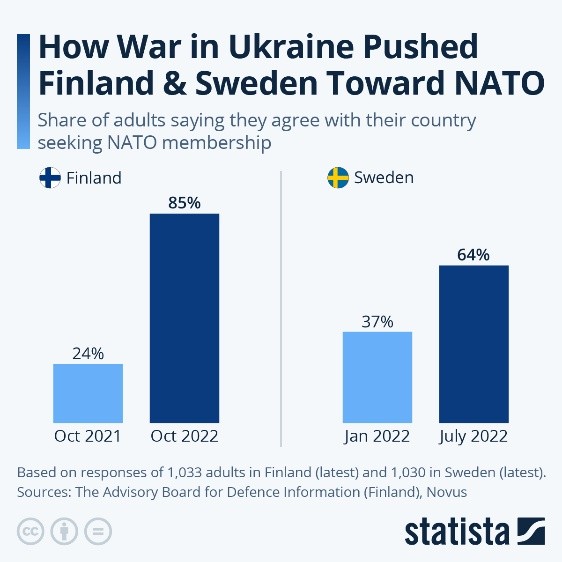
Nevertheless, Finnish and Swedish public opinion remained attached to the principle of neutrality. The tipping point came with Russia's massive invasion of Ukraine in February 2022. Between January and the end of February 2022, the proportion of Finns in favour of their country joining NATO rose from 28 to 53 %, then to 81 % in July. [1]. In Sweden, attachment to the principle of neutrality remains deeply rooted. Before Russia invaded Ukraine, 30 % of Swedes said they were in favour of joining NATO, underlining the divisions within the population. A fringe of the electorate from the ecologist and left-wing parties also denounced the lack of any real public debate on the issue. In both Sweden and Finland, however, security concerns prevailed, and in Sweden it was the fear of regional isolation if Finland joined that led to a swing. In April 2022, 64 % of Swedes questioned said they would be in favour of membership if the Finns did the same. [2].
Analysis - Rearmament and resilience: the Nordic defence model at a time of war in Ukraine
Behind the real convergence of their security interests and the evolution of their international postures, Finland and Sweden offer distinct defence policy models. After the Cold War, Sweden reorganised its military system to focus on international crisis management missions, while Finland structured its defence policy around the principle of territorial defence. Finland has maintained compulsory military service since its introduction in 1918, while Sweden suspended it in 2010 and reintroduced it in 2017.
In the face of the Russian threat, both countries have strengthened their defence and deterrence capabilities. In 2025, Sweden's annual defence budget reached SEK 143 billion (approximately €12.8 billion), representing 2.4 % of GDP, an increase of more than 14 % over one year.[4]. The 2025-2030 military programming law projects that 2.6 % of GDP will be devoted to defence in 2028. This represents a clear break with the years 2000 to 2022, when the average budget was just over 1 % of GDP. In Finland, a similar dynamic is at work, with defence spending almost doubling in absolute terms between 2021 and 2023, leading to the threshold of 2 % of GDP being exceeded. In 2024, the Finnish defence effort will amount to 6.46 billion euros, or 2.3 % of GDP.
The rearmament observed in both countries is also reflected in the increase in the number of military personnel. In December 2023, the Swedish armed forces comprised 25,600 active servicemen and 11,450 reservists.[5]. Military service, reinstated in 2017, lasts between nine and fifteen months, with selection based on motivation and qualifications. Approximately 8,000 young people are selected each year from among 110,000 potential conscripts, on the basis of medical, psychological and physical tests. However, the Swedish authorities are aiming to increase this figure to 12,000 conscripts a year by 2032. Finland, with a population of around 5.5 million, almost half that of Sweden, nevertheless has a higher number of military personnel. In 2023, the Finnish armed forces will have 24,400 active soldiers, with a wartime mobilisation capacity of up to 280,000 soldiers, thanks to a pool of 870,000 reservists who have completed their military service.[6]. These numbers make Finland NATO's third largest military power behind the United States and Turkey. The Finnish army is based on a system of compulsory military conscription for all men aged between 18 and 60, who must serve six, nine or twelve months, depending on their speciality and rank. Women aged between 18 and 30 can enlist voluntarily. According to some analyses, this model substantially strengthens the resilience of the population, as shown by surveys indicating that nearly three quarters of Finns declare themselves ready to defend their country.[7]. This state of mind is part of the culture of the sisu, This is a concept deeply rooted in Finnish identity, denoting a form of courage, tenacity and determination in the face of adversity.
When it comes to armaments, Sweden stands out for its strong defence industry, one of the largest in Europe. By 2022, it will be worth around $3 billion, of which over $2.5 billion will be exported.[8]. Companies such as Saab, which manufactures, among other things, fighter aircraft Gripen, These countries supply some of the most technologically advanced equipment on the arms market. According to the latest available SIPRI data for the period 2020-2024, Sweden ranks 14th in the world in terms of the number of weapons produced.e one of the world's largest arms exporters[9]. Against the backdrop of the Russian threat, the Swedish arms industry is undergoing significant development. The challenge is to support the Ukrainian war effort, but also to replenish national stocks.
In addition to military production, Sweden has a highly skilled private sector when it comes to technology. This success is based on close partnerships between the public and private sectors, substantial funding for research and development, and an education system that ranks among the best in the world. Sweden is also home to technology leaders such as Ericsson, the world's second largest supplier of networks and Hexagon, a specialist in industrial software. It also stands out for its ecosystem of startups This has earned it the nickname of «Europe's Silicon Valley».
Although Finland does not have any major industrial groups in the defence sector, with the notable exception of Patria and Nammo, In addition to its industrial base of highly specialised small and medium-sized enterprises (SMEs), particularly in dual-use technologies. This fast-growing sector exports between 40 % and 60 % of its production, for a volume estimated at around 2 billion dollars in 2024.[10]. Faced with the war in Ukraine, the Finnish authorities are seeking to strengthen these industries, in particular by releasing funds for sectors deemed strategic, namely defence, cybersecurity and the New Space.
The war in Ukraine also highlights the total defence model, initially developed after the Second World War. Adopted by the Nordic countries, this approach is based on a fundamental principle: the protection of a State cannot be limited to the armed forces alone, but requires the coordinated mobilisation of the whole of society, civil and military, in which each player plays an essential role and makes his or her own contribution to defence. Based on the idea that «everyone can contribute and has a duty to contribute», the total defence model is based on six essential pillars that guarantee the country's resilience:
- military defence, encompassing not only the armed forces but also the systems and operations needed to prevent or manage conflict, while ensuring the sustainability of military capabilities;
- critical infrastructure, including basic services such as electricity, water, gas and waste management, essential to the continuity of strategic operations;
- construction materials, such as steel and cement, needed to maintain physical infrastructure during periods of crisis;
- communications, cyber security and systems security;
- health, including medical equipment and access to essential goods;
- transport and logistics.
The example of Finland, where preparedness exercises for civilians are organised several times a year, is a good illustration of this «total defence» concept. The government has also introduced a so-called «72-hour» campaign, which encourages every household to keep a three-day supply of essential equipment in case of a crisis. Distrust of Russia is also evident in the way the country is organised, with public bunkers built into schools, hospitals and buildings to house a total of 4.4 million people. Sweden, for example, has updated and distributed to five million households the guide «In the event of crisis or war» drawn up by the Swedish Civil Contingencies Agency in November 2024. This document provides practical recommendations aimed at preparing the Swedish population both mentally and logistically.
Outlook - Sweden and Finland, strategic opportunities for enhanced European security
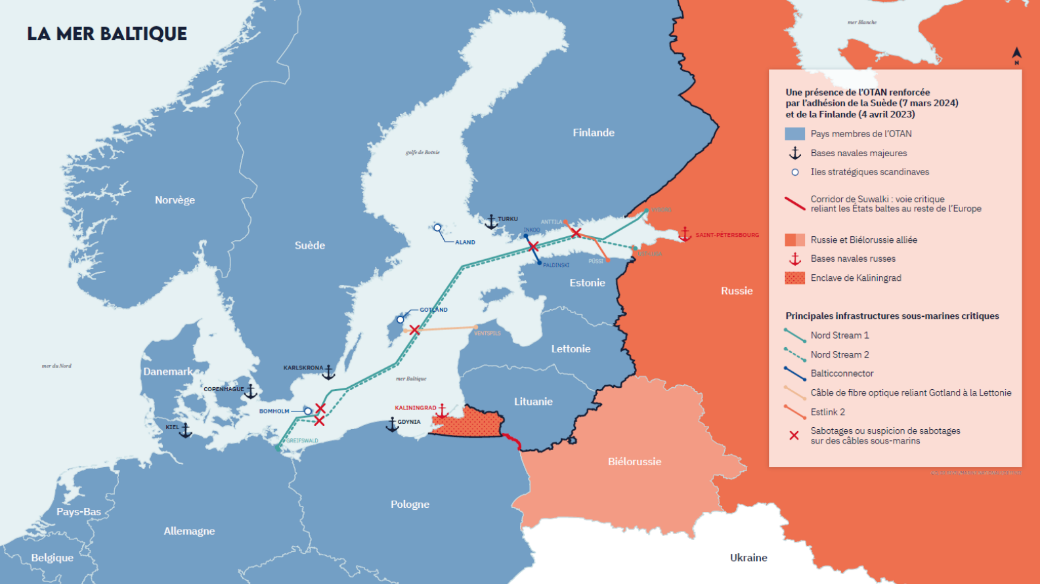
Induced by Russia's war in Ukraine, the accession of Finland and Sweden to NATO represents both major strategic challenges and opportunities for the Alliance. Finland's very long border with Russia is now Nato's eastern border, and therefore its longest direct line of contact with Russia. It should be noted that the accession of these two countries to NATO strengthens the Alliance's naval posture in the Baltic Sea. Thanks to the remilitarisation of Gotland, Sweden is helping to restrict Russia's maritime access, which is now limited to the Kaliningrad and St Petersburg coasts. Sweden's geographical proximity to Russia, although not as close as Finland, also makes it an ideal base for the storage and deployment of NATO forces.
The total defence approach now permeates the development and assessment of resilience policies throughout the Atlantic Alliance. Derived from Article 3 of the North Atlantic Treaty, which requires member states to develop their own defence capabilities, resilience policy is based on the idea that «each Nato member country must have the resilience to withstand a shock». This approach places the preparation and mobilisation of the civilian sector at the heart of the continuity of public authorities and services to the population, in addition to the support it can provide to military operations in the event of a crisis. In this respect, the experience of the Nordic countries is a valuable source of enrichment for strengthening the resilience, deterrence and defence capabilities of the Atlantic Alliance.
[1] HIVERT, Anne-Françoise. «War in Ukraine: Finnish opinion swings in favour of NATO membership». Le Monde, March 2, 2022
[2] Novus. «The Swedes on NATO. 21 April 2022
[3] Finnish Government. «Prime Minister Sanna Marin's New Year's Message, 31 December 2021. 31 December 2021
[4] Government Offices of Sweden. «Military budget. 10 March 2025
[5] Försvarmakten (The armed forces). «Staff figures. December 2023. Updated on 26 June 2024
[6] Defense Advancement. «Overview of the Finnish Defence Forces. 27 December 2024
[7] HIVERT, Anne-Françoise, «En Finlande, la population se tient prête en cas d'invasion par la Russie : « Si la guerre éclate, je veux pouvoir défendre mon pays » (In Finland, the population is ready in case of invasion by Russia: "If war breaks out, I want to be able to defend my country"), Le Monde, 6 May 2022
[8] MOYER, Jason C., WINBERG, Henri. «Sweden's Contributions to NATO: Bolstering the Alliance's Defense Industry and Air Capabilities. Wilson Center, 23 January 2024
[9] DJOKIC, Kataria, GEORGE, Mathew, HUSSAIN, Zain et al. Trends in International Arms Transfers, 2024. SIPRI, March 2025
[10] CIMERMANIS, Arnis, LANDRUM, Lance. «What Finland and Sweden Bring to NATO. CEPA, 18 December 2024
To find out more
Bibliography
This This fact sheet is based on information from the following sources:
- French Embassy in Sweden. «Defence Review Sweden. March 2025
- CARREZ, Maurice. «L'intégration totale de l'espace nordique à l'OTAN (1980 à 2024)». The United States left to Biden, Recherches internationales, n°130, 2024. pp. 23-39
- CIMERMANIS, Arnis, LANDRUM, Lance. «What Finland and Sweden Bring to NATO. CEPA, 18 December 2024
- DA SILVA, Lucas. «Military manpower in the Member States of the European Union». All of Europe, 19 February 2025
- DA SILVA, Lucas. «Finland and Sweden want to leave their neutrality and join NATO». All of Europe, 16 May 2022
- DJOKIC, Kataria, GEORGE, Mathew, HUSSAIN, Zain et al. Trends in International Arms Transfers, 2024. SIPRI, March 2025
- ENOS-ATTALI, Sophie. «The “neutral” countries of Europe faced with the war in Ukraine». Annuaire français de relations internationales 2023. Éditions Panthéon-Assas, 2023. pp.61-78
- HANHIMAKI, Jussi, «La fulgurante conversion de la Finlande à l'OTAN». The Conversation, 14 March 2024
- HIVERT, Anne-Françoise. «War in Ukraine: Finnish opinion swings in favour of NATO membership». Le Monde, March 2, 2022
- HYLLANDER, Jan, JERMALAVICIUS, Tomas, LAWRENCE Tony, «The Newest Allies: Finland and Sweden in NATO». International center for defense and security, 12 March 2024
- Finnish Government. «Prime Minister Sanna Marin's New Year's Message, 31 December 2021. 31 December 2021
- KUNZ, Barbara, ZIMA, Amélie. «Episode 11/29: Sweden, «NATO». Le temps du débat, France culture, 22 March 2024
- MAZERAN, Hélène. «Baltic: Sweden and Finland, from neutrality to commitment». National Association of War Crosses and Military Valour, 2018
- MESSMER, Marion. «The Baltic Sea is far from a ‘NATO lake’ - the alliance must strengthen its defences». Chattam House, 22 April 2024
- Finnish Ministry of Defence. «Finns’ opinions on foreign and security policy, national defence and security. 1er December 2021
- MORTEO, Carletto. «Defending Finland: more than a policy, a state of mind». Feature story, RFI, 24 October 2023
- MOYER, Jason C., WINBERG, Henri. «Sweden's Contributions to NATO: Bolstering the Alliance's Defense Industry and Air Capabilities. Wilson Center, 23 January 2024
- NORLEN, Johan. «Sweden's accession to NATO: the evolution of its security policy and strategic implications in the Baltic region. Au(x) défi(s) de la puissance». Regards du CHEM, 72e session, 2023/HS13 N° Hors-série. pp.324-341
- Novus. «The Swedes on NATO. 21 April 2022
- PALACIN, Hugo. «What is the military expenditure of the countries of the European Union?. All of Europe, 23 June 2025
- Pub Affairs Brussels. «What Benefits and Disadvantages do Sweden and Finland get from NATO?». 11 July 2023
- REINHART, Rj, «Most Finns, Swedes Approve of NATO's Leadership». Gallup, 16 September 2022
- SEMO, Marc, «Histoire d'une notion: la «finlandisation», ou la neutralité obligée». Le Monde, February 2, 2022
- WILLET, Lee. «The Baltic: A ‘strategic sea’». European Security and Defence, 17 February 2025
- Yle. «For the first time, Yle poll shows majority support for Finnish Nato application». 28 February 2022
- «Sweden plans to massively increase its defence budget between now and 2030, La Tribune, 26 April 2024
- «In Finland, the rise of defence start-ups», Les Echos, 25 November 2024
- «Finland in NATO, a good deal for the military», La Croix, 34 March 2023
This file is automatically translated
 French
  English