
This fact sheet is also available in audio format
Click below to listen:
Summary
- Japan has transformed its defence capabilities in recent years: relaxing certain constitutional constraints inherited from the Second World War, the country has increased its military spending and is now investing in offensive capabilities;
- The transformation underway can only be understood in the context of increasing regional tensions - around Taiwan - and international tensions - in Ukraine; Japan's rise to military power remains constrained by a number of challenges, and the country remains highly dependent on its partnerships, particularly with the United States;
- For the future, it is in Japan's interest to clarify the military responsibilities it wishes to assume individually and those shared in the event of a major conflict in East Asia, as well as to diversify its strategic partnerships.
Context - From self-defence to collective defence?
Heavily dependent on international trade - particularly maritime trade - for its economic development, Japan today sees itself as the promoter of an open Indo-Pacific region, governed by the principles of the rule of law, freedom of navigation and free trade, the defence of strong connectivity, and a deliberate commitment to peace and security.
Japan is often described as a «pacifist» country. This designation stems from its 1947 constitution, drafted after the surrender of September 1945 and in the context of the occupation of the country by the United States. Article 9 states that Tokyo «forever renounces war as a sovereign right of the nation and the threat or use of force as a means of settling international disputes».»[1]. In the immediate post-war period, the consequence was a complete renunciation of the possession of forces.
Nevertheless, the situation changed rapidly. Eager to have an ally in the region, the United States agreed to the creation of the Japanese Self-Defence Forces (SDF) in 1954 following the Korean War. An interpretation of Article 9 then allowed Tokyo to build up sufficient forces to defend itself in the event of an attack, without being able to take offensive action. Three conditions authorising the possible use of force were set out in 1954: there must be a threat to national survival; no other means can avert the danger; and the use of force must be limited to the strict minimum. In return for this limitation, the United States promised to defend Japan by signing an alliance in 1960: the Treaty on Mutual Cooperation and Security.
This concept of the use of force based exclusively on self-defence dominated the decades that followed, including after the end of the Cold War. However, Japan's military stance hardened in recent years. Several constitutional restrictions were relaxed. Significant developments took place in 2014-2015. Reforms reinterpreted Article 9 of the Constitution to allow the right to self-defence, subject to certain conditions. collective. Even if the national territory is not targeted, the SDF can support partners under attack if Japan considers that its survival is incidentally threatened in this way. Japanese forces can also take part in combat missions abroad.
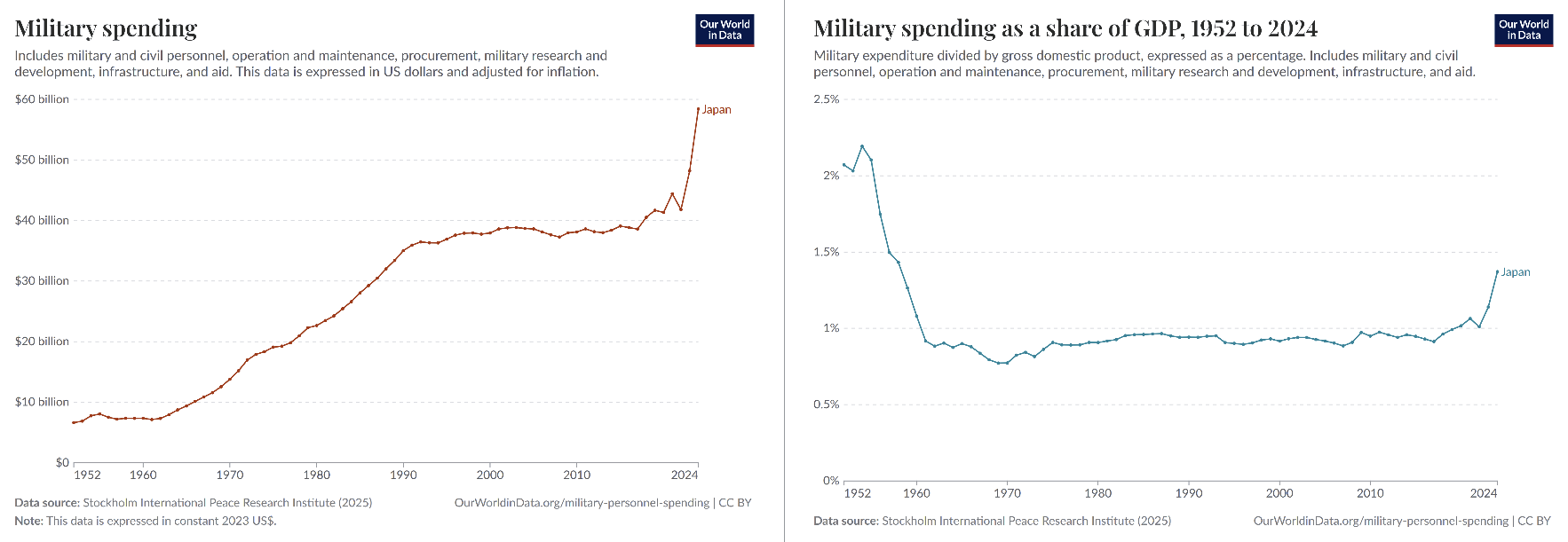
Three key documents published in December 2022 confirm the real increase in the power of the SDF, moving towards a more direct alignment of the country's economic and military powers: the National Security Strategy, the National Defence Strategy and the Defence Strengthening Programme. Tokyo is announcing a doubling of its defence spending. While the country had previously respected an unofficial ceiling of 1 % of GDP, it is committed to increasing its spending to 2 % by 2027. The graphs below show the evolution of Japanese military spending in recent years, both in absolute terms and as a percentage of national GDP.
Analysis - A response to the international context, but severe constraints
The ongoing transformation of the Japanese army certainly reflects a sense of vulnerability in the context of rising tensions both regionally and globally. Japan's strategic documents for 2022 state that «[the] security environment is more serious and complex than at any time since the end of the Second World War».»[3]. The texts expressly identify China's growing military capabilities - Beijing, which disputes certain islands with Japan, is designated as the greatest «strategic challenge».»[4] - and North Korea's nuclear and ballistic capabilities as direct threats to the country's security. More broadly, the documents point to Russia's invasion of Ukraine as a possible prelude to future regional conflict. «Today's Ukraine could be tomorrow's East Asia».»[5] A high-intensity war zone.
The strengthening of our defence capabilities is therefore aimed at dissuading China, Russia and North Korea from any destabilising actions at regional level. The fact that these nuclear powers are themselves strengthening their strategic partnerships probably only increases Japan's sense of vulnerability. One notable point today is the existence of a certain consensus in Japan on the need for a more robust defence capability. The main political parties and the population are overwhelmingly in favour of increasing defence spending. The threat - from China in particular - is therefore not only perceived at the level of the country's leadership, but is widespread within a society that has been recognised as anti-militaristic since the post-Second World War period.
Takaichi's arrival in power exacerbated Sino-Japanese tensions at the end of 2025. The Prime Minister told the Japanese parliament that an attack by Beijing on Taiwan could be perceived as an existential threat to Japan, justifying armed intervention. Japan would in fact be in the front line of a conflict over Taiwan - Japan's most westerly island lies 110km from Taiwan - and Beijing's seizure of Taipei would leave Tokyo very isolated. China reacted violently to these statements by suspending certain imports and exports to Japan, advising its citizens against travelling there and stepping up its military exercises in the sub-region - a strategic signal.
Even so, Japan faces a number of challenges in its bid to regain military power. The first is financial. So far, the Japanese government has honoured its promises to increase military spending, but this has been achieved partly through an accounting trick. Expenditure such as that on the coastguard is now included in defence spending, which was not the case before. Some experts believe that it will be difficult to go any further given the constraints on the country's budget, which is already heavily in debt. The government is reluctant to raise the debt ceiling for current expenditure, while raising taxes or cutting other public spending would be politically costly. The depreciation of the Japanese yen is also weighing on foreign military purchases: the initial procurement strategy was based on an exchange rate of 108 yen to the US dollar, but this is now much more unfavourable for Japan.
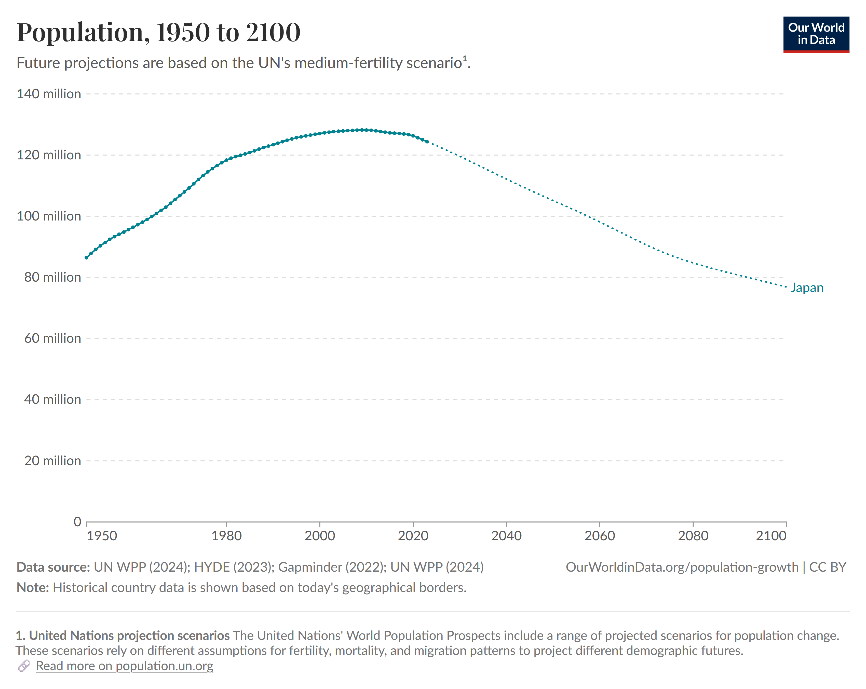
The second challenge is demography. Japan has one of the lowest birth rates in the world and, as illustrated in the graph below, its population is falling every year.
Outlook - A need for strategic diversification?
While the Japanese government plans to review its main strategic documents in 2026, the country is likely to continue to strengthen its defence posture in the coming years, with an increase in military spending and a greater search for strategic partnerships.
For the future, Japan has every interest in clarifying the responsibilities that it wishes to assume individually, and those that will certainly be shared in the event of a conflict in East Asia. At a time when Japan's military capabilities are increasing, Tokyo and Washington would also benefit from harmonising their defence policies, by endeavouring, for example, to define a joint command structure capable of meeting the requirements of a high-intensity conflict through the possession of interoperable forces. The fact that Japan now possesses offensive weapons means that the control of any escalation vis-à-vis China or North Korea will no longer be the sole responsibility of Washington, requiring greater Japanese-American coordination.
Today, Japan is showing no signs of distancing itself from the United States. The new government is clearly counting on full American support in the future, and thus seems, by strengthening its defence posture, to wish to present itself as a reliable partner. Paradoxically, the stronger Japan becomes, the more the United States may consider that disengagement is possible, as it would have less impact and run counter to Tokyo's primary strategic interests.
Faced with the risk of American disengagement, Japan has every interest in continuing to diversify its partnerships, notably with Australia and European countries. Beyond this diversification, autonomy in terms of conventional defence seems to be an imperative for Tokyo. In a scenario where the United States withdraws completely, and the other partners are unable to compensate for this, Japan would have no choice but to assume responsibility for its own defence. In such a case, a nagging question would inevitably arise for the country: as the only country in history to have used the atomic bomb, should Japan nevertheless acquire nuclear weapons?
[1] Embracing Arms: Securing Japan in a “New Era of Crisis” (International Crisis Group (ICG), 2025), 3
[2] Sebastian Maslow, «Make Japan Strong Again: Sanae Takaichi's Plan to Transform Her Country's Military», The Conversation, 17 February 2026
[3] Embracing Arms, 1
[4] Jingdong Yuan, «Japan's New Military Policies: Origins and Implications», Stockholm International Peace Research Institute (SIPRI), 2 February 2023
[5] Embracing Arms, 1
[6] Embracing Arms
To find out more
Bibliography
This This fact sheet is based on information from the following sources:
- Beech, Hannah. «Why Japan Is Rethinking Its Peace Vow. The New York Times, 6 August 2025
- Blumenthal, Dan, Mike Kuiken, and Randy Schriver. «Japan Can't Go It Alone. Foreign Affairs, 30 January 2026
- Cooper, Zack, and Eric Sayers. «Japan's Shift to War Footing. War on the Rocks, 12 January 2023
- Embracing Arms: Securing Japan in a “New Era of Crisis”. International Crisis Group (ICG), 2025
- Fackler, Martin. «Japan Flexes Its Military Muscle at China, and Trump. World. The New York Times, 8 June 2025
- Hornung, Jeffrey W., and Zack Cooper. «Shifting the U.S.-Japan Alliance from Coordination to Integration. War on the Rocks, 2 August 2024
- Kawai, Daisuke. «Japan's Defence Budget Surge: A New Security Paradigm. Royal United Services Institute (RUSI), 2 December 2024
- Maslow, Sebastian. «Make Japan Strong Again: Sanae Takaichi's Plan to Transform Her Country's Military. The Conversation, 17 February 2026
- Matsuo, Miki. «Unaddressed Challenges for Defense Policy Reform in Japan. Center for Strategic and International Studies (CSIS), 9 May 2024
- Ng, Kelly, and Shaimaa Khalil. «Trump Endorses Japan's Takaichi Before Snap Election». BBC, 6 February 2026
- Okano, Masataka, «Japan's National Security Reckoning». Foreign Affairs, 24 February 2026
- Rich, Motoko, Hikari Hida, and Chang W. Lee. «Japan Wants a Stronger Military. Can It Find Enough Troops?» The New York Times, 13 December 2023
- Rubinstein, Gregg. «Cooperative Defense Acquisitions Strengthen U.S.-Japan Alliance. Center for Strategic and International Studies (CSIS), 30 January 2025
- Sato, Tomohiro. The Personnel Base of the Japan Self-Defense Forces in an Era of Demographic Decline. Brookings, 2025
- Schulenburg, Rupert. «Japan's Emerging ‘Counterstrike’ Missile Posture. International Institute for Strategic Studies (IISS), 3 April 2026
- The Economist. «How Will Japan's Defences Evolve Under Its Hawkish New Leader?» 20 November 2025
- Yamaguchi, Mari. «Pacifist Japan Moving from Exclusive Self-Defense to Military Buildup. Name. Defense News, 31 December 2025
- Yuan, Jingdong. «Japan's New Military Policies: Origins and Implications. Stockholm International Peace Research Institute (SIPRI), 2 February 2023
This file is automatically translated
 French
  English