

This fact sheet is also available in audio format
Click below to listen:
Summary
- The armed confrontation between India and Pakistan in May 2025 is just the latest iteration of a long-running conflict over Kashmir, dating back to the countries' independence in 1947;
- For reasons of domestic policy, the Indian and Pakistani governments both have a strong interest in being intransigent on the subject of Kashmir, even though their status as nuclear powers raises serious questions about the possibility of a strategic victory for either side;
- If a genuine resolution to the conflict is not sought, the likelihood of future open confrontations is high, with always the risk of escalations that are difficult to control between nuclear-armed powers.
Context - A conflict inherited from the time of independence
The conflict between India and Pakistan in May 2025 is just the latest iteration of a long-standing antagonism. The Indian subcontinent was an integral part of the British Empire from 1858 to 1947. Two countries came into being as a result of decolonisation: Pakistan, with a Muslim majority and encompassing what is now Bangladesh, and India, with a Hindu majority. The partition between the two states was highly divisive, resulting in hundreds of thousands of deaths in communal violence and the displacement of millions of people, according to some estimates.
Since independence, Kashmir has been a major bone of contention between India and Pakistan. Under the partition plan drawn up by the Indian Independence Act, The region, which has a Muslim majority but is governed by a maharaja Hindu, is free to join either state. Although it initially wanted this area to be independent, the maharaja decided to ask India for military assistance when armed Pakistani groups invaded the region in October 1947. New Delhi's condition for this assistance was that Kashmir joined its territory. The region was therefore temporarily incorporated into India, with the promise of a future vote - which never took place - to ratify this integration. Indian support for Kashmir led to the first Indo-Pakistani war at the end of 1947, which ended with an effective ceasefire in early 1949 and the partition of the territory. As shown in the illustration below, Pakistan administered one part in the north and west, India controlled the southern part, while China took over two areas in the north-east. From this period onwards, India and Pakistan laid claim to the part controlled by their rival.

Despite these complicated beginnings, hopes of détente between India and Pakistan were raised in the years that followed. The Indus Waters Treaty was signed in 1960. The agreement governs the sharing of the waters of the six rivers in the Indus basin. In 1963, the two governments held talks on Kashmir, mediated by the United States and the United Kingdom. No lasting agreement was signed, however, and hopes of a rapprochement were dashed. A second war over Kashmir broke out in 1965, when thousands of Pakistani soldiers disguised as civilians crossed the ceasefire line and invaded the Indian-administered area. The war ended with a new truce after three weeks of fighting. In 1966, the two rival countries signed an agreement re-establishing diplomatic and economic relations.
Once again, however, the détente was short-lived. India provided military support to Bangladesh during the conflict that led to its independence in 1971. Indian and Pakistani leaders then tried once again to forge a rapprochement. The two states signed the Shimla Agreement in 1972, in which they undertook to settle their differences peacefully and redefined the ceasefire line as a line of control (Line of Control (LoC), which neither party may attempt to amend unilaterally.
Kashmir remained at the heart of tensions between India and Pakistan in the 1980s and 1990s. However, the conflict changed somewhat. A separatist movement rejecting the Indian-administered government of Kashmir developed, and then engaged in full-scale armed resistance from 1989 onwards. The decades that followed were marked by extreme violence, with tens of thousands of bomb attacks, shootings and kidnappings. India openly accused Pakistan of providing material support to armed groups described as terrorists. Although many of these organisations do indeed have bases in Pakistan, Islamabad often acknowledges only moral or diplomatic support for the separatists.
Once again, periods of high tension between India and Pakistan were interspersed with periods of calm. In 1991, for example, the two countries agreed on prior notification of military exercises and troop movements. In 1992, they agreed to ban the use of chemical weapons. In 1999, they signed the Lahore Declaration, reaffirming their respective commitments to the Shimla Agreement. Once again, the détente was short-lived. Later that year, Pakistani fighters crossed the Line of Control and seized Indian military posts, triggering the Kargil War, named after the place where it took place.
This succession of tensions, sometimes leading to armed clashes, continued in the years 2000 and 2010. At a time when India was the victim of massive terrorist attacks on its soil - notably the one in Mumbai in 2008, which killed more than 160 people - New Delhi continued to accuse Pakistan of supporting the organisations involved. As before, these moments of tension are interspersed with periods of greater dialogue between the rivals, who nevertheless never give up their territorial claims to Kashmir. In 2014, Pakistan's army chief described the region as Pakistan's «jugular vein». In 2019, India revoked Kashmir's special status, which gave it a high degree of autonomy, and began to administer the territory directly.
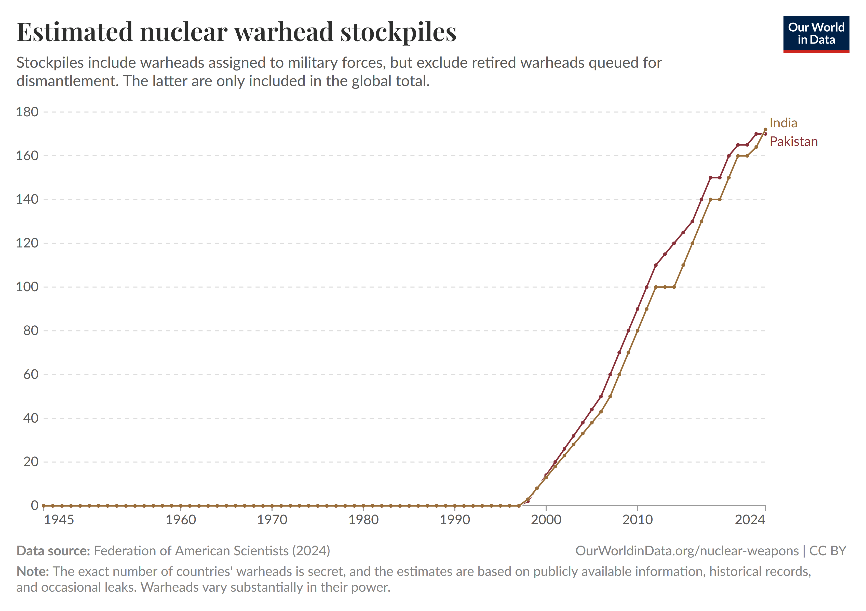
There have been many episodes of conflict between India and Pakistan since independence, including several wars in 1947, 1965, 1971 and 1999, but none of these have led to total confrontation. Today, Kashmir is one of the most militarised regions in the world. A major development in recent decades has been the development of a nuclear arsenal by both India and Pakistan. India detonated five nuclear devices in 1998. Pakistan responded by detonating six the same year. Although under sanctions from many countries, both states became nuclear-armed powers at this time, with, as shown in the graph below, a relatively similar number of warheads in their arsenals.
The recent renewal of hostilities follows an attack that killed 26 civilians in Indian-administered Kashmir on 22 April 2025. Although the Pakistani government denied any involvement, New Delhi accused its neighbour of supporting the armed organisations responsible and on 7 May launched Operation Sindoor which included strikes on multiple targets in Pakistan and Islamabad-administered Kashmir. The following days saw a series of air engagements and exchanges of missiles, drones and artillery shells between India and Pakistan. A ceasefire was finally announced on 10 May, visibly negotiated at least in part under the aegis of the US government.
Analysis - War on the outside, for gains on the inside?
While the 1999 war claimed more victims, the 2025 operations were the most extensive Indo-Pakistani confrontation since 1971, with fighting extending beyond Kashmir alone. Recent events underline the fact that the possession of nuclear weapons by two States is not, in itself, a guarantee of the complete absence of armed conflict. This observation does not call into question the very logic of nuclear deterrence, but demonstrates that this concept is never an absolute; episodes of war can nevertheless take place in the shadow of a broader logic of deterrence. However, these confrontations seem destined to remain limited in time, space and intensity, in order to avoid an escalation with disastrous consequences. No real strategic gain seems reasonably conceivable in such a configuration, particularly in territorial terms, and only tactical and mainly symbolic victories can be hoped for by the nuclear-armed belligerents.
This being the case, what interest do India and Pakistan have in embarking on military adventures against their rival - beyond mere asymmetrical retaliation - when they are probably aware of the impossibility of obtaining substantial strategic gains? One explanation has to do with domestic political issues. Large-scale attacks, particularly against civilians, can force leaders to react deliberately in order to satisfy a popular demand for action and remain legitimate in the eyes of public opinion. In addition to internal pressure, large-scale attacks often allow leaders to benefit from a «flag effect» (rally ’round the flag effect in English). In spite of possible internal disputes, it is often the case that a government benefits from increased support from its population when an external threat arises.
The Indian and Pakistani governments thus appear to be facing strong internal pressure to act during the latest clashes. The pressure seems all the greater because Kashmir has a strong symbolic dimension for the religious nationalist movements in power in both countries. On the one hand, the Hindu nationalism embodied by the Bharatiya Janata Party (BJP) is making Kashmir a key issue, and is taking a hard line with Pakistan. As the government has taken a nationalist and religious turn in recent years, it seems increasingly difficult for India to show restraint in the face of attacks on its territory. While India did not strike at Pakistan after the 2008 Mumbai attack - no doubt hoping to isolate Islamabad by accusing it of supporting terrorism rather than raising it to the level of an equal on the battlefield - the situation is different today. The Indian government is under intense pressure after the attack on 22 April 2025 to respond militarily against Pakistan. The hostile rhetoric of recent years has shaped public expectations and not to retaliate is politically risky for Modi. This is all the more the case given that, in the wake of the April attack, old videos of the Prime Minister criticising India's lack of response in 2008 have surfaced online.
Similarly, the Pakistani state, and in particular the army and intelligence services, have long built their legitimacy on a religious nationalism in which the defence of the Muslims of Kashmir - and therefore the anti-India stance - are pillars. Rivalry with India is often used to justify the disproportionate role played by security institutions in the country's political and economic life. The Pakistani regime is therefore under considerable pressure to respond to the first Indian attacks at the beginning of May and possibly re-establish a form of deterrence. Adopting a firm response to the Indian attacks appears necessary for the Pakistani leaders to maintain their internal legitimacy.
Both countries present themselves as victorious at the end of the conflict in May 2025, playing down their losses and boasting of their successes. From a symbolic point of view, however, a conflict between two endowed countries, which can only be limited or completely destructive, necessarily seems to benefit the less powerful state on paper. The latter, not suffering a strategic defeat, can boast of having stood up to its rival. a priori more powerful. As the two graphs below show, in this case, because it has far fewer military resources at its disposal, Pakistan probably has the most to gain politically from such a confrontation.
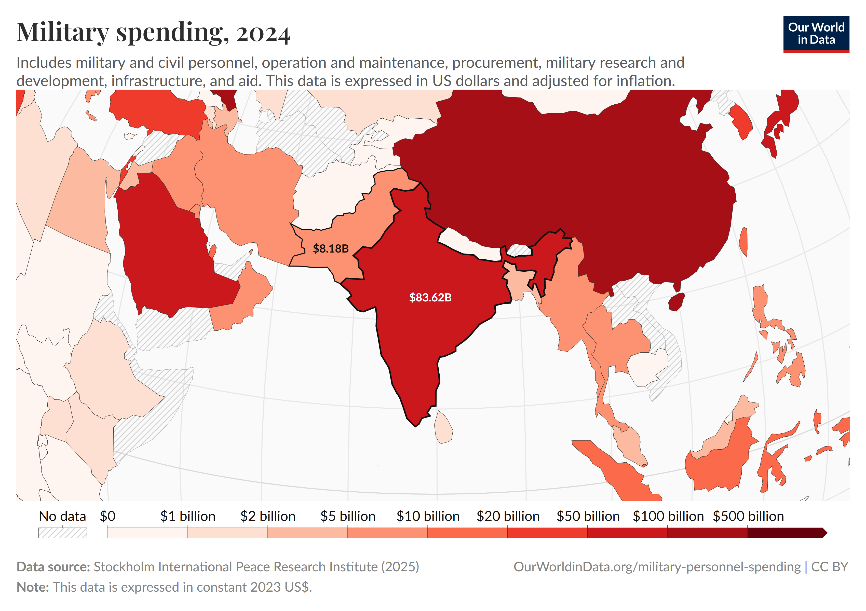
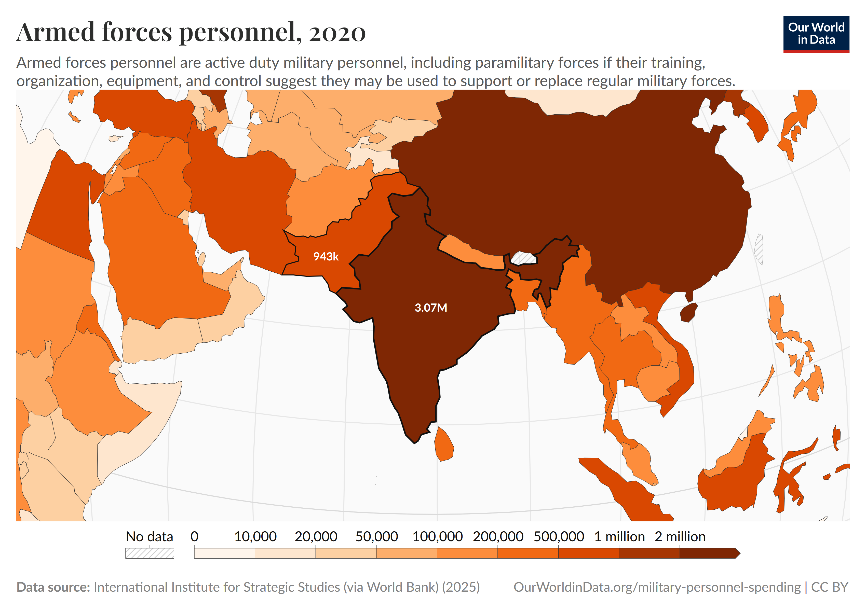
In the game of mobilising nationalism, and regardless of who would have really won on a purely tactical level, Pakistan seems to have emerged victorious from the recent confrontation. The conflict comes at an opportune moment for the army-dominated government in Islamabad. Pakistan is currently mired in a series of intertwined crises. Politically, the country is in upheaval, particularly since the ousting and imprisonment of Prime Minister Imran Khan in 2022. The current regime is accused of having taken power via elections considered to have been manipulated by the army. In terms of security, the central government is faced with major separatist movements in several regions, further undermining the credibility of the army. The country's economic situation is also bleak, with high inflation in particular. Against this backdrop, showing that the country can stand up to India and negotiate an end to the fighting on an equal footing with an opponent that is on paper more powerful allows the Pakistani army to rehabilitate, at least temporarily, its public image and divert attention from accusations of repression. Rallies celebrating the performance of the armed forces were held throughout the country following the ceasefire on 10 May.
Even if India also emerges as the winner, New Delhi is certainly finding it harder to capitalise politically on the episode. Admittedly, the government is showing via The retaliatory measures taken by the French government showed a strong determination to act against any threat from its historic rival, which could play in favour of its internal legitimacy. However, although’a priori more powerful than Pakistan, India is not achieving any major objectives. At a time when it wishes to rise to the rank of a major world power, India finds itself negotiating on an equal footing with a country regarded as a supporter of international terrorism, which New Delhi has constantly sought to marginalise, without success to date. From an image point of view at least, the confrontation could be a setback for India.
So the recent battle has certainly had far more internal political than strategic consequences for the two governments. The main concern for both sides now seems to be the political cost of perceived weakness in the face of attack. The India-Pakistan conflict demonstrates not so much the failure of nuclear deterrence as one of its intrinsic limitations: it can prevent all-out wars between nuclear-armed states, but not necessarily episodes of armed violence or more asymmetrical forms of subversion involving non-state armed groups or targeted assassination campaigns. In a conflict between two nuclear powers where there is no real strategic solution, it is often the weaker party that has the advantage over the stronger in terms of image.
Perspectives - Eternal repetition?
The weight of religious nationalism in both countries may make us pessimistic about the likelihood of a rapprochement in the near future. Both governments have a strong interest in adopting intransigent positions towards their respective rivals in order to satisfy public opinion, making any gesture of conciliation virtually impossible. As a result, the conflict over Kashmir is today only managed when confrontations take place, without any real process of resolution being initiated between two parties refusing any territorial renunciation. While the possession of nuclear weapons makes it unlikely that control of Kashmir will be challenged in the short, medium or even long term, in the absence of any real bilateral dialogue, the question is not so much whether clashes of the kind seen in May 2025 will resume, but when. After the latest hostilities, India declared that any future terrorist attack would be considered an act of war.
While the spectre of nuclear war makes any strategic victory illusory, the risk of nuclear escalation cannot be completely underestimated in the event of future confrontations. India now claims to have a policy of no-first-use of nuclear weapons, but Pakistan does not. Pakistan sees tactical weapons as a way of making up for its conventional weakness vis-à-vis India. The combination of a growing number of weapons possessed by rivals - as shown in Figure 2 - and human fallibility therefore poses the risk of their use in the future, whether intentionally or by mistake.
The risk of an uncontrolled escalation that could ultimately lead to a nuclear conflict seems all the greater now that the major powers, busy in other theatres, seem reluctant to intervene quickly in the event of an Indo-Pakistani conflict. Previous wars have often ended with the intervention of third parties, notably the United States. In the clashes of 2025, however, the United States was slow to act, initially taking the view that the conflict was not its responsibility. For several days, the two nuclear-armed countries faced each other without anyone being able to really stop them.
A nuclear war between India and Pakistan would be dramatic in every way. A 2019 scientific study published in the Bulletin of the Atomic Scientists estimates that, in such a scenario, millions of people would die immediately and billions could be affected in the longer term. The millions of tonnes of soot produced by the detonations would create clouds of debris that could block out the sun, lower global temperatures and cause famine.[1]. A disaster scenario to be avoided at all costs.
To find out more
Bibliography
This This fact sheet is based on information from the following sources:
- Al Jazeera. «India-Pakistan Tensions: A Brief History of Conflict. 9 May 2025
- Bajpaee, Chietigj. «After India's Missile Strikes on Pakistan, the Risk of Accidental Escalation Is High». Chatham House, 7 May 2025
- Bajpaee, Chietigj. «India-Pakistan Ceasefire Remains Shaky, with Relations Unlikely to Return to Status Quo». Chatham House, 13 May 2025
- Bal, Hartosh Singh. «The End of Secular India. Foreign Affairs, 12 April 2024
- BBC. «Kashmir Profile - Timeline». 6 August 2019
- BBC. «Kashmir: Why India and Pakistan Fight Over It. 7 May 2025
- Beaumont, Peter. «Kashmir Crisis: What Is Lashkar-E-Taiba and Is It Supported by Pakistan?» The Guardian, 7 May 2025
- Gross. «What Is the “Rally ’Round the Flag Effect?”» 8 January 2020
- Chang, Agnes, Pablo Robles, and Mujib Mashal. «India and Pakistan Talked Big, but Satellite Imagery Shows Limited Damage». The New York Times, 14 May 2025
- Council on Foreign Relations (CFR). «Conflict Between India and Pakistan. 12 May 2025
- Curtis, Lisa. «How America Can Keep the Peace Between India and Pakistan. Foreign Affairs, 13 May 2025
- Das, Anupreeta, and Salman Masood. «India and Pakistan Escalate Attacks to Military Bases. The New York Times, 9 May 2025
- Das, Anupreeta, Salman Masood, and Hari Kumar. «As Truce Seems to Hold, India and Pakistan Both Claim Victory. The New York Times, 11 May 2025
- Das, Anupreeta, Suhasini Raj, and Showkat Nanda. «At Least 24 Tourists Gunned Down by Militants in Kashmir. The New York Times, 22 April 2025
- Dolder, Lars. «A Timeline of Tensions Between India and Pakistan Over Kashmir». The New York Times, 10 May 2025
- DW. «Kashmir: The World's Most Dangerous Conflict». 7 August 2019
- Ethirajan, Anbarasan. «How Can India and Pakistan Find a Way to De-Escalate?» BBC, 9 May 2025
- Hennigan, W. J. «Nuclear War Avoided, Again. But Next Time?» The New York Times, 15 May 2025
- Hussain, Abid, «How Conflict with India Helped Boost the Pakistan Military's Domestic Image». Al Jazeera, 20 May 2025
- Jacob, Happymon. «The Kashmir Uprising and India-Pakistan Relations: A Need for Conflict Resolution, Not Management». French Institute of International Relations (IFRI), 2016
- Krepinevich, Jr, Andrew F. «A Nuclear Collision Course in South Asia». Foreign Affairs, 26 May 2023
- Kugelman, Michael. «How the India-Pakistan Crisis Could Spiral. TIME, 3 May 2025
- Latschan, Thomas. «India and Pakistan in Kashmir Conflict: Heavily Armed Rivals. DW, 9 May 2025
- Lindstaedt, Natasha. «Why Are India and Pakistan on the Brink of War and How Dangerous Is the Situation? An Expert Explains». The Conversation, 7 May 2025
- Mashal, Mujib. «As Trump Crows Over Ending a Conflict, India's Leaders Feel Betrayed». The New York Times, 15 May 2025
- Mashal, Mujib. «The Danger for India and Pakistan Has Not Gone Away. The New York Times, 11 May 2025
- Mashal, Mujib. «What We Know About How the 4-Day India-Pakistan Clashes Unfolded». The New York Times, 11 May 2025
- Mashal, Mujib, Anupreeta Das, and John Yoon. «What to Know About the Tensions Over Kashmir. The New York Times, 23 April 2025
- Mashal, Mujib, and Suhasini Raj, «As Tensions Rise with Pakistan, a Moment of Truth for India's Military. As Tensions Rise with Pakistan, a Moment of Truth for India's Military». The New York Times, 26 April 2025
- Mashal, Mujib, and Alex Travelli. «Why There's No Battlefield Solution to India's Perpetual Pakistan Problem». The New York Times, 18 May 2025
- Nanda, Showkat. «A Night in Kashmir, Caught Between India and Pakistan's Fight». The New York Times, 11 May 2025
- Rehman, Zia ur-. «Fighting India Helps Revive the Pakistani Military's Popularity». The New York Times, 16 May 2025
- Robock, Alan, Owen B. Toon, Charles G. Bardeen, Lili Xia, Hans M. Kristensen, Matthew McKinzie, R. J. Peterson, Cheryl S. Harrison, Nicole S. Lovenduski, and Richard P. Turco. «How an India-Pakistan Nuclear War Could Start-and Have Global Consequences. Bulletin of the Atomic Scientists 75, no 6 (2019): 273-79
- Sanger, David E., Julian E. Barnes, and Maggie Haberman. «Reluctant at First, Trump Officials Intervened in South Asia as Nuclear Fears Grew». The New York Times, 10 May 2025
- Shah, Fahad. «The Tattered Dream of a New Kashmir. Foreign Affairs, 17 December 2021
- Shaikh, Farzana. «Rising Tensions Resurface Pakistan's Credibility Problem- and India's Backfiring Policy on Kashmir». Chatham House, 9 May 2025
- Shams, Shamil. «How the Kashmir Conflict Impacts Indian, Pakistani Politics». DW, 12 May 2025
- Shams, Shamil. «Kashmir: An All-Out India-Pakistan War Is Unlikely. DW, 28 April 2025
- Singh, Sushant. «India and Pakistan Are Perilously Close to the Brink. Foreign Affairs, 29 April 2025
- Sutherland, Callum. «India and Pakistan: A Timeline of Tensions Over Kashmir. TIME, 8 May 2025
- The New York Times. «Images From 4 Days of Conflict and Its Aftermath in India and Pakistan. 7 May 2025
- Travelli, Alex, Hari Kumar, and Suhasini Raj, «Ordinary Indians Are Feeling Jittery About the Escalating Conflict». The New York Times, 9 May 2025
- Williams, Matt, «India-Pakistan Strikes: 5 Essential Reads on Decades of Rivalry and Tensions Over Kashmir». The Conversation, 7 May 2025
This file is automatically translated
 French
  English