

This fact sheet is also available in audio format
Click below to listen:
Summary
- After the Second World War, Germany's rearmament was gradually organised from 1955 within the framework of NATO. After the Cold War, the Federal Army (Bundeswehr) accompanies the Alliance's missions, becoming an army engaged in international missions with a primarily humanitarian focus.
- The invasion of Ukraine in 2022 marks a change of era (Zeitenwende) for Germany, which is initiating a profound reorientation of its defence policy through massive reinvestment in its military, despite political and institutional constraints.
- Located at the heart of Europe and closely linked to the United States and NATO, Germany today plays a central role in the defence of Europe's eastern flank, not least because of its logistical capabilities and its position as a key military hub. However, its special relationship with the United States is also a source of vulnerability.
Context - The German Army, from «shield of the West» to peacekeeping force
The issue of German rearmament has a long history. From the end of the Second World War in 1945 until the creation of the two German republics in 1949 - the Federal Republic of Germany (FRG) and the German Democratic Republic (GDR) - Germany was demilitarised and divided into four zones of occupation by the Allies. However, the question of a potential rearmament of the country emerged as early as 1950, in the context of the Cold War. The Korean War and the Communist threat underlined the urgent need to organise European defence. The Prague coup (1948) and the Berlin blockade (1948-1949) raised concerns about the possibility of a major crisis in Europe, especially as the Soviet Union (USSR) had acquired nuclear weapons in the same years. The creation of the North Atlantic Treaty Organisation (NATO), signed in Washington in April 1949, did not initially involve Germany.
However, the need to rearm West Germany was supported by the American government and Chancellor Konrad Adenauer officially demanded the right to raise an armed force capable of protecting the country from the Soviet threat. But the memory of the war and the Allied military occupation made the search for a solution more difficult. In the summer of 1950, Jean Monnet, the French Planning Commissioner, proposed organising Europe's defence within a supranational framework. At the same time, the United States asked its allies to prepare the rearmament of West Germany. But Monnet was also trying to prevent Germany from turning away from the European Coal and Steel Community project. He therefore presented his project to the President of the French Council, René Pleven. Pleven proposed the creation of a European army that would integrate future German units into a single European military and political authority. However, this European Defence Community (EDC) project was finally rejected by the French National Assembly in August 1954. Cooperation on defence and security was then organised within Western European Union, a body created in 1954, while German rearmament took place within NATO from May 1955.
Situated at the centre of the main front line of the Cold War, Germany occupied a decisive position for the various protagonists. In the East, the GDR had the Nationale Volksarmee, created as part of the Warsaw Pact. In the West, the creation of the Bundeswehr However, it reached its target of twelve armoured divisions (each with around 16,000 men) from the mid-1960s onwards. Then, in the 1970s, it reached a total strength of 495,000 men, not counting the mobilisation capabilities of 1.3 million active or reserve soldiers. At that time, the Bundeswehr is mainly made up of conventional armed forces, i.e. units that are not intended for nuclear warfare, such as the army, characterised by its armoured forces. In 1980, these armed forces numbered 345,000 soldiers in peacetime and more than a million men in defence. The air force, on the other hand, was transformed from the late 1950s into a nuclear «strike force», within the framework of NATO and its special relationship with the United States. The US set up depots in Europe, including Germany, and authorised certain allies to carry out nuclear raids. However, these warheads remain in the custody of the United States. Any independent strategic nuclear role for the Federal Republic and its Bundeswehr is excluded from the outset.
After the fall of the Berlin Wall in 1989, the United States called for greater German participation in NATO. At the time of the Kuwait war, it called for the support of the Bundeswehr, within the framework of the Alliance. But German public opinion was vehemently opposed to any form of intervention outside the «NATO zone». It was not until 1994 that the Federal Constitutional Court finally approved this type of intervention. This marked a major turning point in German foreign policy, as the country began to take on more responsibilities abroad.
As a result, in the context of its commitments outside Germany, the Bundeswehr distinguishes between operations abroad and «recognised missions».»[1]. Operations abroad are aimed at maintaining a secure environment and are generally mandated by the UN or the EU. The European Parliament (Bundestag) must give its prior consent to the participation of the Bundeswehr to such armed operations abroad. This does not apply to «recognised missions»: these allow the Bundeswehr to demonstrate its defence capability within NATO. In addition to this Bundeswehr is involved in international disaster relief and evacuation operations in crisis zones. Generally speaking, it is important to stress that since reunification and until 2022, unlike other countries, Germany maintains an army in the hope that it will never be deployed in a high-intensity conflict.
Analysis - 2022, a new turning point for German rearmament
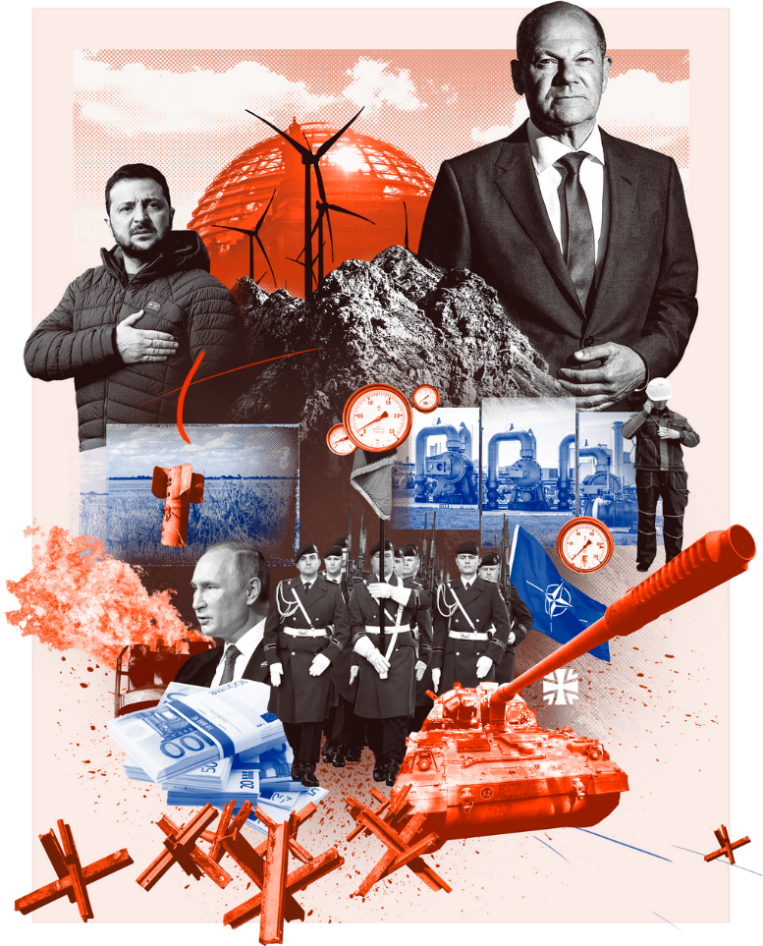
However, there is a kind of paradox that various opinion polls show: while Germans are concerned about the conflict, many of them fear an escalation. This explains Olaf Scholz's reluctance to send arms to Ukraine. Indeed, the former Chancellor initially refused to send offensive weapons. But as the conflict dragged on, the Germans gradually began to deliver a range of equipment, the most emblematic of which were tanks. Leopard 2. In addition, the war has given rise to strong polarisation, with the issue of support for Ukraine giving rise to the emergence of new parties (notably the Bündnis Sahra Wagenknecht, a populist, anti-militarist and pro-Russian party). The main political and media controversy concerns the delivery to Ukraine of long-range missiles of the Taurus. These missiles, capable of reaching targets more than 500 km away, could theoretically enable the Ukrainians to target Moscow. Still holding back and fearful of escalation, a majority of the Bundestag was opposed to sending them. The new Chancellor, Friedrich Merz, who has been in power since May 2025, has made this issue a campaign argument, claiming that he wants to deliver them. However, no decision has yet been taken.
This controversy focuses on several key aspects of German strategic culture: firstly, it highlights the German Chancellor's extremely limited room for manoeuvre. Unlike the French President who, as head of the armed forces, enjoys his «reserved domain», in Germany the Bundestag is required to approve all decisions relating to security and defence. In addition, the various ministries have a high degree of independence in the design of their policies. Ressortprinzip (principle of autonomy). Finally, the parliamentary system, which forces the different political forces to find majorities, also reduces the Chancellor's autonomy. Friedrich Merz's failure to take a decision on this issue could be linked to the fact that his coalition partners are opposed to it. Faced with these institutional difficulties, the Chancellor has just created a «National Security Council». This new institution, inspired by the American model, is supposed to make decision-making more agile.
Outlook - A strategic role in support of Europe's eastern flank?
Located at the heart of the European continent, Germany once again occupies a strategic geographical position in the continent's security architecture. Its logistical and military centrality gives it an essential role within NATO. It is also home to six American bases with around 37,000 troops. These forces, designed as operational reserves to be deployed in crisis zones, make Germany a pivotal player in the transatlantic system - but also one that is structurally dependent on American protection. This dependence is becoming increasingly problematic in a context of growing uncertainty about the reliability of the American commitment in Europe.
At the same time, Berlin was seeking to assert its own military credibility, in particular by modernising the Bundeswehr and better preparation for collective defence scenarios. The «Red Storm Bravo» exercise, held in Hamburg from 27 to 29 September 2025, illustrates this effort: it aimed to test Germany's ability to ensure a rapid transfer of troops and equipment to the eastern flank in the event of Russian aggression. However, the scope of these initiatives remains limited by bureaucratic delays, institutional fragmentation and budgetary constraints, which hamper the practical implementation of the Zeitenwende announced in 2022.
More broadly, the German position reveals a structural paradox: while Germany claims to be a driving force in European defence, its actions are still dominated by a strategic culture of restraint and a complex decision-making system that hampers any capacity for autonomous initiative.
[1] Deutsche Gesellschaft für Auswärtige Politik, „Auslandeinsatz und anerkannte Missionen“, Glossar/Sicherheitsglossar, consulted on 24.10.2025.
[2] For example, German defence investment was 1.1% of GDP in 2007. Today, it has risen to over 2%. As part of NATO's objectives, a significant increase is planned for the coming years: Barnstorf, Philip, «Von der Entmilitarisierung zum Rüstungsrekord: Geschichte der deutschen Militärausgaben», Geo Wissen, 24 June 2025.
To find out more
- Delphine Deschaux-Dutard. French-German Military Cooperation and European Defence. Routledge, 2025.
Bibliography
This This fact sheet is based on information from the following sources:
- Auswärtiges Amt, „Nationale Sicherheitsstrategie“, 1 July 2024, consulted on 3 October 2025.
- Bauer, Anne, „Le fossé culturel entre les arméees française et allemande trouble la coopération», Les Echos, 15 October 2019.
- Barbin, Jeronimo, Deutschland in der militärischen Führungsrolle?, Zentrum für Militärgeschichte und Sozialwissenschaften der Bundeswehr (Centre for Military History and Social Sciences of the German Armed Forces), 10 September 2025.
- Barnstorf, Philipp, „Von der Entmilitarisierung zum Rüstungsrekord: Geschichte der deutschen Militärausgaben“Geo Wissen Geschichte, 24 June 2025.
- Virtual Knowledge Centre on Europe, «The question of German rearmament», accessed on 3 October 2025.
- Europäische Sicherheit & Technik. „Carlo Masala sieht ‘Zeitenwende’ bei Deutschen angekommen“, 24 September 2025.
- Friedrich Ebert Stiftung, „Aussenpolitik - Zeitenwende“, accessed on 3 October 2025.
- Keller, Patrick, Anmerkungen zur Wehrpflichtdebatte, Internationale Politik, 18 August 2025.
- Krpata, Marie, Friedrich Merz and the Zeitenwende 2.0. A “new era” for transatlantic relations? IFRI studies, CERFA, 7 March 2025.
- Lange, Philipp: „Noch nicht Krieg aber auch nicht Frieden - Drei Impulse für die nationale Wehrhaftigkeit und Resilienz“, Bundesakademie für SicherheitspolitikJanuary 2025.
- Mennerat, Pierre, «L'Allemagne veut renforcer la Bundeswehr en rétablissant un service militaire sur la base du volontariat», The Great Continent, 28 August 2025.
- Müller, Björn, Zinn, Wolf, „Strategische Industrie mit Zukunft“, Deutschland.de, 10 July 2025.
- Rink, Martin, „Die Bundeswehr im Kalten Krieg“, Bundeszentrale für politische Bildung, 1 May 2015.
- Tenenbaum, Elie, Péria-Peigné, Léo. Zeitenwende: la Bundeswehr face au changement d'ère. IFRI studies, 29 September 2023.
This file is automatically translated
 French
  English