
IHEDN Mondays are now available in audio format!
Click below to listen:
Currently an international politics columnist on BFM, Elsa Vidal was previously editor-in-chief of the Russian-language editorial team at Radio France Internationale, director of the Europe and Central Asia office of Reporters Without Borders, head of mission for Médecins du Monde in Russia and director of Oxfam in that country, among others.
Educated at Inalco, Sciences Po, Keio University (Japan) and the Russian University of Social Sciences (RGGU) in Moscow, where she later became a research assistant, she has lived and worked in the Russian Federation on several occasions since 1990, including three years in Chechnya.
In his essay «What do the Russians think?»,published in February by Gallimard in the «En attendant le réel» collection, Elsa Vidal rigorously unravels the preconceptions about Russia that prevail in Western Europe, drawing on numerous interviews and references. She reminds us that «several Russias exist side by side, Slavs and non-Slavs, cities and countryside, and they are much closer to us in terms of morals than the positions of Russian leaders would lead us to believe».
In fact, the Russian Federation today has a population of 146 million divided into 89 administrative entities (including 5 occupied Ukrainian entities) and more than 190 national groups speaking 25 official languages - out of a total of 277 idioms still spoken. Taken as a whole, she says, «Russian society, in many ways an industrialised, secularised, individualistic society, is more like our own than the mythical version of the Rus traditional, promoted and vaunted by the authorities».
AT PRESENT, THE WAR IN UKRAINE SEEMS TO BE GENERATING MORE WEARINESS THAN OPPOSITION IN RUSSIAN SOCIETY. OVER TIME, COULD THIS WEARINESS TURN INTO OPPOSITION?
This seems possible to me, provided that the war once again breaks into the daily lives of the majority of Russians, disrupting them in a large number of homes, as the announcement of the partial mobilisation in September 2022 did.
In this respect, the increasingly frequent internet blackouts carried out by the Russian security services, with the autonomy they now have, are likely to crystallise opposition - if not to the war itself, at least to its consequences for the population. In the past, the authorities have come up against mobilisations of this type, i.e. on a socio-economic basis. In 2018, for example, on the issue of reforming the retirement age for women, the government had to back down, and President Putin himself distanced himself from the bill, so that his popularity would not be affected by the protest.
Social issues are those for which the citizens of the Federation feel the most legitimate to mobilise, and they are doing so. That's why there is a real risk in trying to impose Internet blackouts on the population. All the more so in a country where digital life and digital services are highly developed for the most day-to-day aspects, but also for relations with administrations, the authorities, family life, etc.
FOR RUSSIAN CITIZENS, WHAT DOES THE DIVISION BETWEEN PUBLIC AND PRIVATE DISCOURSE MEAN, PARTICULARLY IN RELATION TO THE WAR IN UKRAINE?
If you have grown up and lived in France - or in any other democracy - for most of your adult life, you have had the opportunity to experience speech that is free of consequences for your safety. The things you say in your bedroom, at the Sunday dinner table, in the metro, at work or even on television are not likely to cost you your job or, worse still, land you in prison.
The same cannot be said for the people of the Russian Federation. Especially since the authorities equipped themselves with a repressive arsenal at their disposal to crush citizens who protested against the start of the large-scale invasion of Ukraine. According to OVD Infos, more than 20,000 people have been repressed for expressing opinions hostile to the war. Some were arrested for standing in the street with a sheet of paper as a placard - a sheet of paper without a slogan!
YOU DESCRIBE THE «NETWORKED SOLIDARITY» THAT WEAVES ITS WAY THROUGH RUSSIAN SOCIETY. COULD OPPOSITION TO THE WAR BENEFIT FROM THIS?
Yes, and it is already benefiting from them, but this type of solidarity action cannot be turned into a mass mobilisation to stop the war or change the regime. The networked solidarity I am talking about is driven by an affinity of values, a rejection of the bureaucratic and institutionalised world - even that of NGOs, which are also suspected of being nothing more than career tools for their founders - and a focus on human beings caught up in tragic situations.
It's almost like an underground world, parallel to the so-called political world, which sets itself up as an alternative to it. Politics and institutions have been deeply devalued, after several decades of Soviet power claiming to bring happiness to humanity through crimes and mass repression. Solidarity chains are therefore built at a sub-national level and do not take the form of a party with a programme for the future of the entire nation.
YOU SAY THAT POLITICIANS ARE VERY AWARE OF THE GAP BETWEEN OFFICIAL RUSSIA AND THE REAL COUNTRY. TO WHAT EXTENT SHOULD THE KREMLIN TAKE PUBLIC OPINION INTO ACCOUNT?
It is these mistakes that remind politicians that the «paper country», created and portrayed through reports, conferences and state media, has little in common with the «real country». To complicate an already sensitive situation, the real country is extremely diverse (Russia has more than 190 national groups, several languages are spoken, etc.).
For example, the presidential administration had not anticipated the profound rejection that the partial mobilisation in September 2022 would engender in the population. Several hundred thousand young Russians left the country in reaction to its announcement, and the most frequent query on the internet was «how can I break my arm at home? But this alarm rekindled the vigilance of the Presidency.
In fact, it is the presidential administration that commissions the most opinion polls and surveys in the country: more than 400 a year on average. In my opinion, this reflects two things: firstly, the need to know the state of opinion in the Federation in order to adapt political action, and secondly, the intransigence of the authorities. All this stems from a pessimistic vision of politics and a vision of power that is far from omnipotent. Hence the emphasis on seeking consent. To achieve this, we need to know the expectations, the basic needs and the fundamental fears of the people we serve. Not to serve the population, but to «know how far to go too far».
WHAT CONSEQUENCES COULD THE RECENT BAN ON TELEGRAM AND VPN HAVE FOR THE REGIME?
We mentioned it at the start of this interview: along with the rise in consumer prices - and in particular the price of cucumbers, a more than common consumer good - this is the main risk hanging over the regime and its war economy policy.
Taking away the opportunity for Russians to live their lives as citizens of the developed and connected world, and handing them over to the arbitrary decisions of the security services whose impact intrudes on the daily organisation of their lives, is certainly a major danger. I would be inclined to say that if this policy is pursued, even greater repression will result. Perhaps the decision has already been taken, or it is the wish of institutions such as the FSB. [The Federal Security Service of the Russian Federation, which is responsible for internal security.].
The FSB is the main beneficiary of this war, in the sense that it has considerably increased its power and influence in the political arena, but also in the economic sphere. In August 2025, Dmitri Kozak, Vladimir Putin's diplomatic adviser at the time, asked the Russian President to entrust him with the role of defending the rights of entrepreneurs.
They complain about the raids they suffer at the hands of the FSB, which, with the complicity of the local authorities, raids flourishing businesses in the war economy. To no avail. The President has taken the side of the FSB against his collaborator, whom he has released from his duties by presidential decree.
REGARDING THE RULING ELITES AND THEIR CHILDREN, YOU MENTION A «PATRIOTIC DOUBLE STANDARD», A «FASCINATION-REPULSION» FOR THE WEST. IS THIS ALSO THE CASE FOR VLADIMIR POUTINE AND HIS ENTOURAGE?
It's difficult to give a clear answer for Vladimir Putin, but the question is simpler for those around him. I believe above all that the position of the elites is not ideological, but dictated or influenced by the logic of the court. You have to realise that the Russian elites were fully integrated into a globalised way of life.
They have a foothold abroad, send their children to the best American or European schools (as is the case for the daughter of Foreign Minister Sergei Lavrov, or that of the Deputy Chairman of the State Duma Piotr Tolstoy, etc.), and spend their holidays outside Russia...
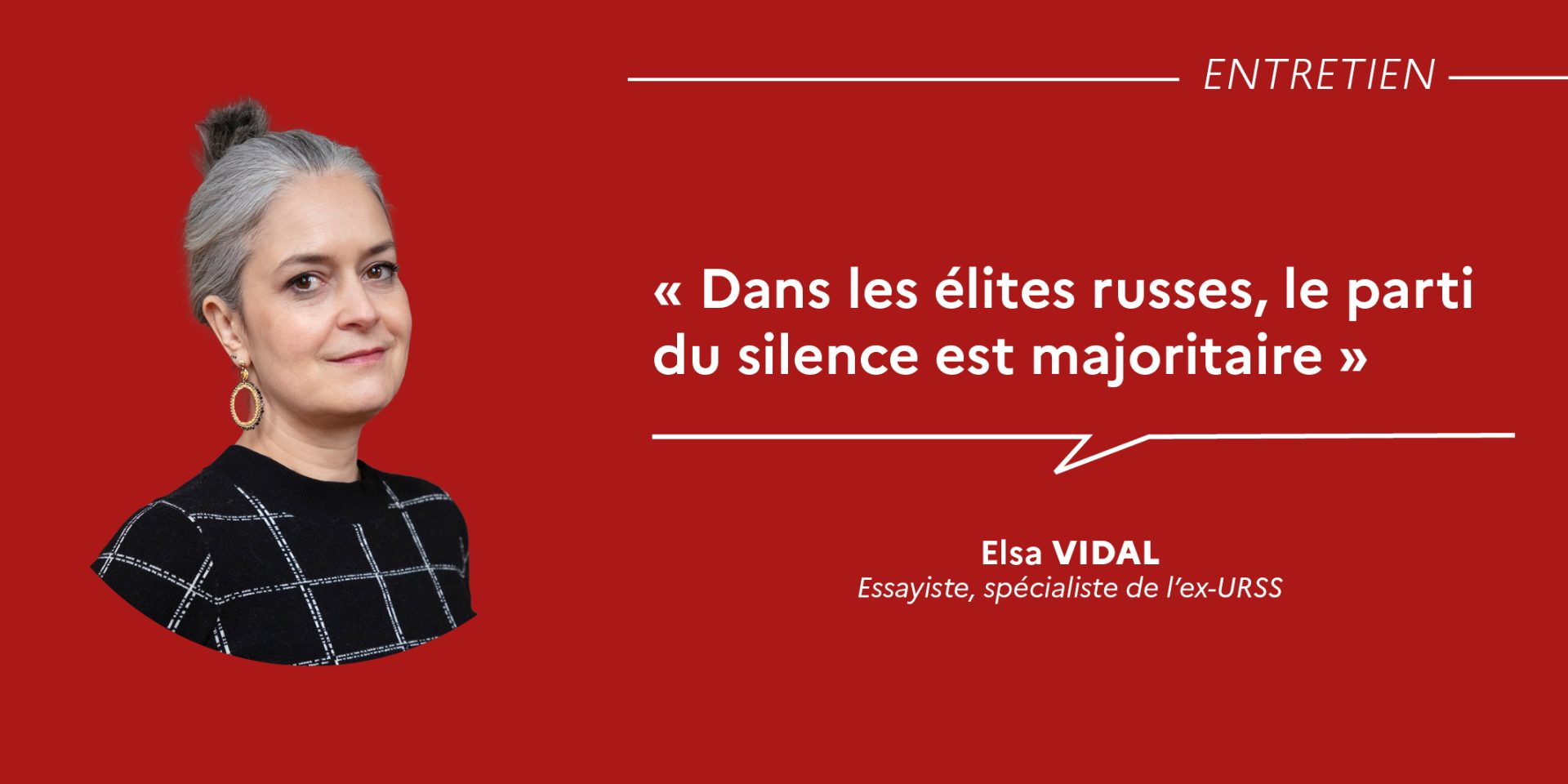
With the exception of a handful of men, the war has the support of none of the 200 families who run Russia, and all of them would be ready to resume relations with the West tomorrow if it were to end. They never wanted this war, even though very few people in the ruling circles have spoken out openly against it: an oligarch, a banker, a head of the secret services and Dmitri Kozak. The party of silence, which thinks no less, is in the majority.
«THE FIXATION ON RELATIONS WITH THE WEST IS A USEFUL LURE FOR THE RUSSIAN AUTHORITIES IN MORE WAYS THAN ONE».»
But if we come back to this fascination-repulsion for the West that you mention, it is quite structuring. I don't know whether Vladimir Putin subscribes to it or feels it personally, but he knows that mobilising this feeling is a powerful weapon. Because in this Russia-West link, the two terms are mirrored in a rivalry between equals that allows the imaginary of Soviet power to be revived.
This power, associated with Russia and not with all the former Soviet states - in a historic sleight of hand - de facto positions Moscow as Washington's alter ego, in a global condominium. This has the not inconsiderable corollary of concealing the fact that Russia is a regional power, now in the shadow of China.
This posture of defiance towards the West, in which Russia is always the victim rather than the aggressor, also helps to channel the attention of the public away from what Russian leaders fear, namely the possibility of Russia being governed democratically. Ukraine, presented as a sister country, is demonstrating this.
Now, if a democratic Ukraine free of Moscow's influence could exist, it would almost automatically mean that the Russians too could have a democratic destiny. This is what the Russians fear above all else. The fixation on the relationship with the West is therefore an illusion, useful in more ways than one for the Russian authorities.
 French
  English