
IHEDN Mondays are now available in audio format!
Click below to listen:
«A resilient European population, equipped with medical capabilities and prepared to face and sustain a potential armed conflict with Russia, constitutes a means of deterrence». This declaration by Norwegian General Petter Iversen, Chairman of NATO's Committee of Chiefs of Military Medical Services (COMEDS), in January 2026 at the European Union (EU) Health Security Committee, reveals a major issue: health is an attribute of power and strategic credibility in its own right. A nation can no longer be prepared for armed conflict without a truly resilient health system.
THE MAJOR COMMITMENT HYPOTHESIS, A NEW AREA OF PREPARATION FOR EUROPEANS
The return of uninhibited conflict and high-intensity warfare in Eastern Europe means that France, like its partners in the Atlantic Alliance, must prepare for the Major Engagement Hypothesis (MEH). In other words, the scenario in which the operational commitment of the armed forces would be at its maximum. This preparation involves planning not only for the projection of a force abroad as part of a multinational coalition, but also for managing the consequences on national territory.
A major engagement in Eastern Europe would inevitably put a strain on France's vital functions. Health systems, both military and civilian, would be destabilised: heavy demands on health establishments, disruption of logistical flows including health products, organisation of a chain of evacuation of wounded and sick across Europe, etc.
«The scale and complexity of these challenges must be anticipated so that France can guarantee the best level of care for the population in general, and the military in particular,» says General Eric Czerniak, Head of the Operations Division of the French Armed Forces Health Service (SSA), a joint structure under the direct authority of the Armed Forces Chief of Staff.
This reflection must also take into account the fact that a major commitment is first and foremost part of a multinational coalition. The treatment of foreign patients (both military and civilian) in French medical facilities must therefore also be planned.
On the one hand, the concept of «host nation support» requires NATO nations to provide the required support - including medical support - to allied armed forces transiting or staying on their territory. On the other hand, the population movements generated by a conflict are likely to cause an influx of refugees on national territory, and therefore an additional burden on the healthcare system.
The cross-functional nature and the workload of the planning justifies the involvement of all government departments. Strictly military preparation of the healthcare system for the EHF cannot meet the nation's health and resilience challenges. It must therefore be part of an interministerial approach.
This need had already been demonstrated during the Covid-19 crisis. General Czerniak explains the lessons that were learned:
«Although the context is different, this exceptional situation has shown us that a health crisis can have consequences that go beyond the health sphere. In France, the economic and social impact meant that the actions of the various ministries (Health, Economy, Interior, Armed Forces) had to be coordinated. The EMH requires a similar methodology».»
COOPERATION BETWEEN THE ARMED FORCES AND HEALTH MINISTRIES ACCELERATES
Dialogue between ministries is not new. Back in 2017, the Armed Forces, Health and the Budget institutionalised a working relationship by signing a multi-year protocol. By defining their relationship and mutual commitments, the three ministries are demonstrating their desire to better meet health needs and prepare for exceptional health situations, while safeguarding the resources required for the specific needs of defence. Renewed in 2022, the new protocol draws on the lessons learned from the Covid-19 crisis and reinforces the principle of complementarity in the event of a major event.
Aware of the need to continue this civil-military cooperation, in October 2025 the SSA and the French General Directorate for Health (DGS) signed a new charter for emergency preparedness. This ratifies the common objective of ensuring the resilience of the national healthcare system to be able to support the military effort in such a scenario.
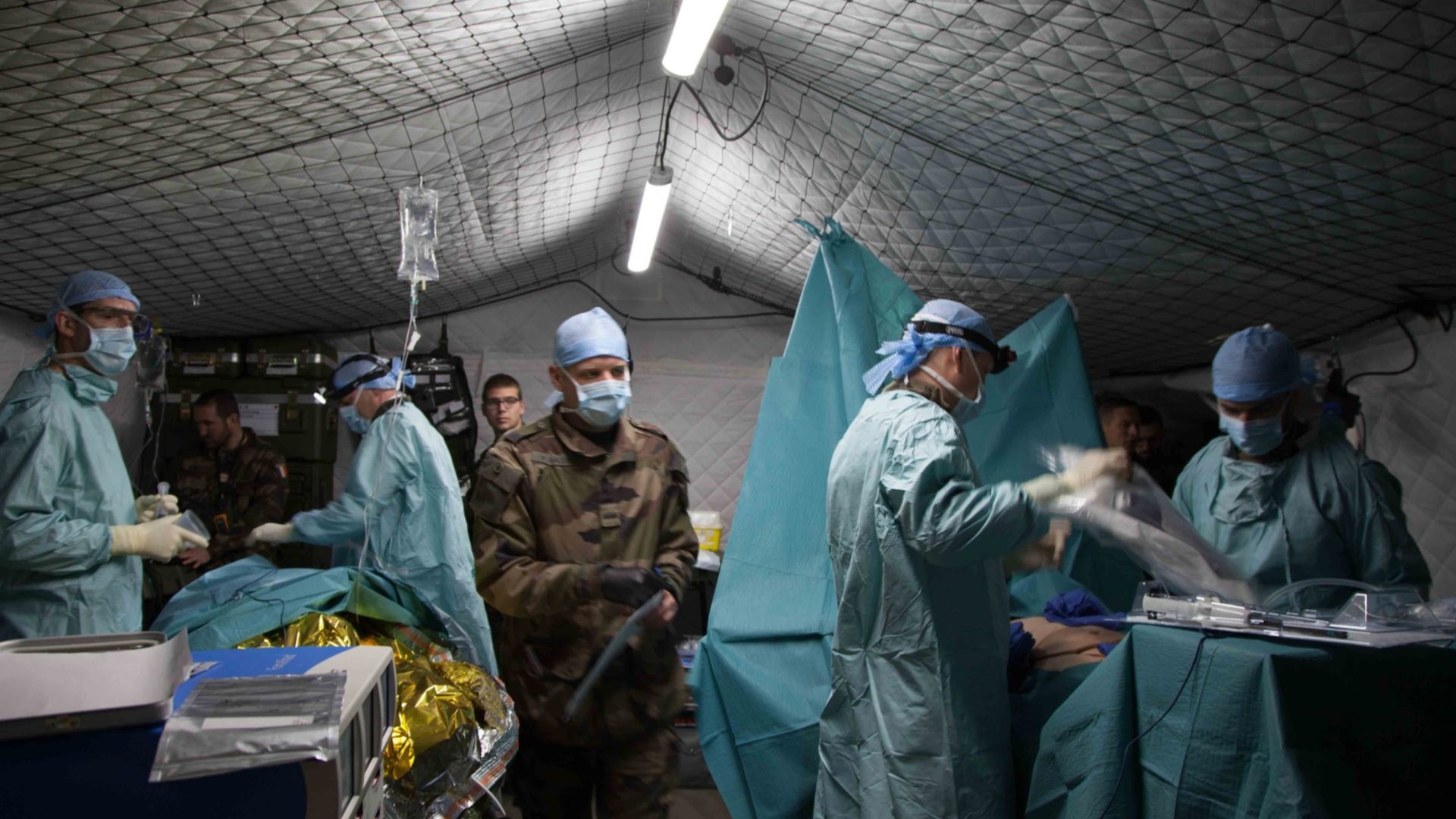
Responsible for medical planning for the armed forces, the SSA's primary mission is to provide medical support to the French armed forces at all times and in all places. Accustomed to intervening in conflict zones, this service has been able to provide wounded and sick soldiers with an internationally recognised level of care since it was set up more than three centuries ago (in 1708).
«The SSA relies on a territorial network of medical facilities of varying sizes and functions, ranging from national army training hospitals (HNIA) to specialist rehabilitation and psychiatric facilities,» explains General Czerniak. However, it represents only 1% of the public health landscape in France.
In the event of a conflict breaking out in Eastern Europe, the armed forces would be deployed outside France. It would become necessary to treat, evacuate, monitor and trace injured and sick military personnel from the zone of operations to French hospitals. The national health system will therefore have to be able to mobilise, in conjunction with the ministries affected, such as the Interior.
This interministerial and national (or even international) response must be integrated into an efficient decision-making chain, which must be tested during implementation exercises. ORION 26, which includes an interdepartmental planning phase to protect the territory while supporting French and allied forces, is currently taking part in this process.
NATO AND THE EU, CIVIL-MILITARY COOPERATION FRAMEWORKS FOR HEALTH
The subject of medical support in the event of an EHF is now at the heart of discussions in all the nations of the Euro-Atlantic area. Their plans are based on the operational framework provided by NATO.
Recognising the international impact of the health crisis caused by an EHF, since 2023 the Alliance has strengthened cooperation between its military and civilian bodies in the field of health.
To prevent this impact from becoming a limiting factor, NATO nations are working together to exchange best practice, strengthen their interoperability and develop an efficient chain of command.
In this context, the SSA and the DGS represent France in multinational bodies dealing with medical issues and resilience. At NATO, the Joint Health Group (Joint Health Group) and COMEDS are forums where civilian and military medical experts from 32 nations establish political and strategic guidelines in their fields.
This increased civil-military cooperation led to the adoption in 2025 of the Medical Action Plan plan. Co-drafted by the two Alliance bodies mentioned above, this plan identifies the actions to be taken to prepare the health systems of the Allies for the EMH. To support these efforts, the EU has also made a commitment by creating a working group dedicated to civil-military cooperation in health (TWG CIVMIL).
FRANCE PILOTS AN NATO INITIATIVE TO OPTIMISE MEDICAL LOGISTICS
Among the work carried out jointly by the SSA and the DGS, an NATO initiative aimed at optimising medical logistics within and between Alliance nations has been led by France since the beginning of 2026.
Named Critical Medical Initiative - Medical Logistics (CMI MEDLOG), this international initiative aims to coordinate the ministries of health of allied countries with a view to securing health product supply chains. The initiative aims to accelerate the development of civil-military interoperability at national, NATO and EU level, in order to provide a dedicated coordination framework. It is part of a context in which the long-term maintenance of medical logistics capabilities in the event of armed conflict is a major challenge, leading NATO to organise the coordination of civilian players in conjunction with existing military projects.
Other initiatives of this type are also being carried out by other partners under the aegis of NATO. They deal with patient evacuation and mass casualty management.
Carrying out this interdepartmental work, at both national and international level, is imperative in order to strengthen the national resilience needed to cope with a severe weather event.
«If it comes to fruition, this major commitment will certainly entail major adjustments, but the SSA and the DGS will have made an active contribution to preparing the healthcare world on a scale unseen in recent decades», concludes Dr Czerniak.
 French
  English