
IHEDN Mondays are now available in audio format!
Click below to listen:
A first-rate human force, the army has the most extensive territorial network: 500 establishments (including 115 garrisons) spread across 93 departments in mainland France and overseas, housing no fewer than 128,000 military personnel and 8,200 civilians (excluding apprentices), as well as 30,000 operational reservists.
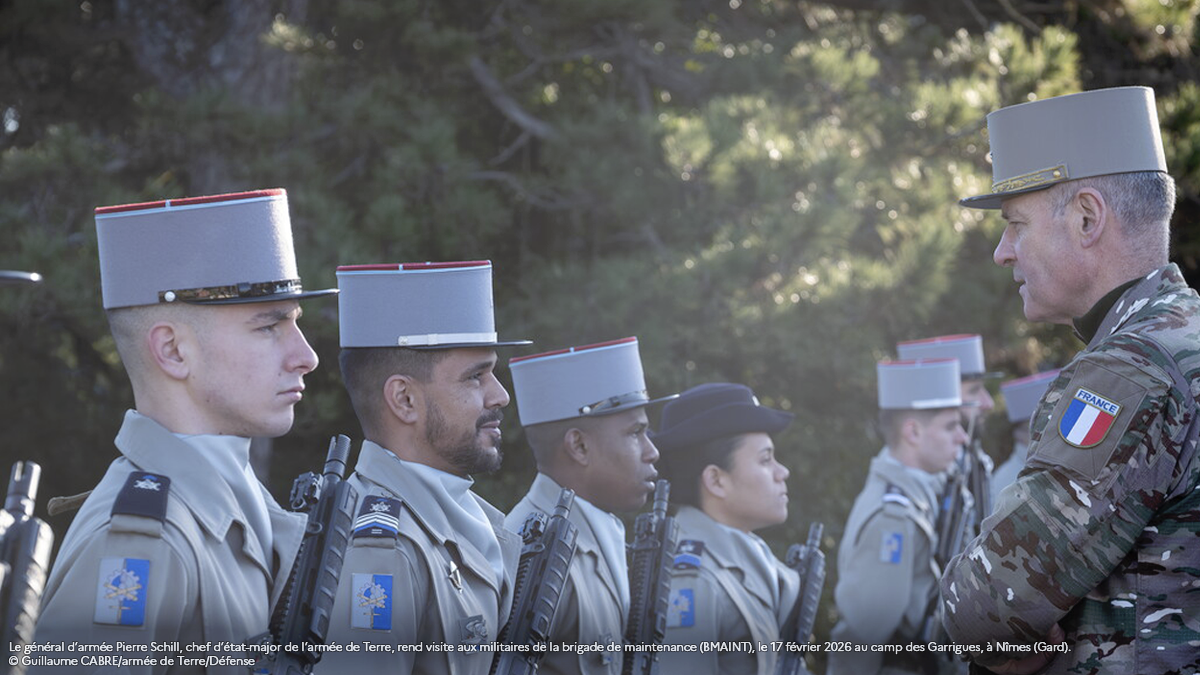
Since July 2021, General Pierre Schill, Chief of Staff of the French Army, has been in charge of this unit. A Saint-Cyrien and infantry officer in the marine corps, and an auditor at the IHEDN in 2011-2012, General Schill has served in Chad, Somalia, the former Yugoslavia, the Central African Republic, Senegal and Côte d'Ivoire. As an officer, his various postings have taken him to many regions of France: Languedoc, Pays de la Loire, Poitou, Polynesia, Brittany and Paris, where he was deputy chief of staff to the President of the Republic and head of the «use of forces» division of the Armed Forces General Staff.
HOW DO THE LOCAL ROOTS OF THE ARMY DEFINE THE IDENTITY OF YOUR UNITS? AND TO WHAT EXTENT IS THE REGIMENT, IN THE REGIONS, THE MOST CONCRETE FACE OF THE NATIONAL COMMITMENT?
The link between regiment and territory dates back to the creation of the Army regiments in the 16th century.e The French Revolution placed the nation above territories by numbering the regiments. Today, the geographical distribution of garrisons is the result of the history of the army, which is intertwined with that of the country. There are two complementary aspects to this: the first is that the identity of each regiment is nourished by its local roots, and the second is that each regiment is a local, decentralised representation of the nation's commitment.
Firstly, regimental identity is rooted in the local area. A regiment is part of its history, its heritage, and sometimes what we might call its «terroir», i.e. a local culture, a heritage of memories, a human fabric. This proximity nurtures a unique collective identity, based on memory, tradition and responsibility. Some units bear on their flag the names of battles fought on these same lands; others have developed, over the decades, solid links with the local population, elected representatives, businesses, schools and associations.
Many non-commissioned members, non-commissioned officers and officers settle in the region where they serve. Operational reservists, who are often involved in local civilian life, embody this direct link between the army and society. Partnerships with companies, schools and local authorities reinforce this continuity between the military community and the civilian world. This deep-rootedness enriches the esprit de corps of a regiment; it gives meaning to the commitment. Serving in a unit whose history is linked to its location reinforces the sense of belonging and responsibility towards the population we protect.
«EACH GARRISON IS THE EXPRESSION OF A PART OF NATIONAL DEFENCE».»
There is a second, complementary dynamic: the regiment is also a decentralised expression of national sovereignty. The defence of the country is organised from and for the territories. Each garrison is the expression of a part of national defence; each garrison participates in territorial protection and crisis management. It is the closest thing to the people that the regal function of defence is maintained.
There is therefore a reciprocal and virtuous relationship. The area shapes the regiment; the regiment protects the area. The town welcomes, supports and accompanies; the regiment contributes to economic vitality, social cohesion and local resilience.
IHEDN'S REGIONAL SESSIONS AIM TO TRAIN LOCAL MANAGERS (ELECTED REPRESENTATIVES, COMPANY DIRECTORS, SENIOR EXECUTIVES) IN DEFENCE ISSUES. HOW IMPORTANT IS IT FOR THE ARMY TO WELCOME THESE AUDITORS TO YOUR GARRISONS?
This is not just an issue for the land forces; it is first and foremost important for defence as a whole and for the nation. Armies lead battles, but it is nations that win wars. Current conflicts demonstrate this once again. IHEDN students assume a share of the responsibility for the continuity of national life.
In a world marked by the uninhibited use of force, the hybridity of threats and the superimposition of states of competition, contestation, confrontation and confrontation, knowledge of defence and preparation for shock management are factors of operational superiority. Resilience is not just a military issue: it affects territories, infrastructures, the economy and society as a whole. The regional sessions thus help to structure a genuine «regional strategic community», capable of understanding risks, anticipating disruptions, mobilising skills and taking coordinated action.
The army's territorial coverage is a major asset in this dynamic. Present in mainland France and overseas, it offers students direct access to operational reality. Being welcomed into garrisons transforms an often abstract perception of defence into a concrete experience. Auditors discover the life of units, with operational preparations, alerts, deployments, logistical manoeuvres and support.... They realise that, in an acute crisis, they would not be observers but players. The IHEDN sessions do not offer observation but empowerment.
Finally, these sessions create personal and institutional links. A crisis does not leave time to «get to know each other». Trust and fluid relations are built upstream. This is what IHEDN is all about: building national capacity for insight and action through training.
DURING THESE SESSIONS, THE AUDITORS DISCOVER THE OPERATIONAL REALITY OF THE FORCES. WHAT DO YOU HOPE THESE LOCAL DECISION-MAKERS WILL TAKE AWAY FROM THEIR TIME «UNDER THE FLAG» OR IN CONTACT WITH YOUR UNITS?
I hope they remember two things: the culture of results and the fraternity of arms.
In combat, the result comes first. The mission is either accomplished or it is not; the bullet is either on target or it is not; you are either alive or you are not. This requirement shapes the army's operational activities: mission preparation, training, clear-sighted assessment of a situation and rapid decision-making. The culture of results is also a culture of responsibility: the leader must take responsibility for the choices made and the results obtained. This results-oriented culture is not unique to the battlefield. It permeates our approach to crises.
In a deteriorated situation, the nation will need decision-makers capable of setting a course, prioritising, acting under uncertainty and assuming the consequences of their decisions. The experience of serving in the armed forces helps us to understand the need to make decisions under pressure, in a short space of time, with limited resources.
I hope they will also remember the fraternity of arms. It is the foundation of a working army, of its moral strength. Fraternity goes beyond the cohesion we build with those we choose, fraternity of arms is cultivated with comrades who are given to us. It is a reciprocal commitment. In a world where threats seek to fracture societies through influence or disinformation, this fraternity of arms is an example of social cohesion. It is a testament to the nation.
THE ARMY OFTEN PROVIDES LOGISTICAL AND EDUCATIONAL SUPPORT FOR THESE SESSIONS. HOW DO YOUR DEFENCE BASE COMMANDERS OR CORPS COMMANDERS PERCEIVE THIS ROLE OF TRANSMISSION TO REGIONAL CIVIL SOCIETY?
They see it as one of their missions. They carry it out with a sense of responsibility and determination to achieve the objective. Base commanders and corps commanders prepare their units for combat. This mission includes outreach and communication activities that explain, structure and maintain the link between the army and the nation.
In each département, the Délégué militaire départemental (DMD) (Departmental Military Delegate) implements this coordination as closely as possible: first point of local contact, relay for the Ministry of the Armed Forces and the defence system, advisor to the civilian authorities, interface between the armed forces and local players.
A REGIMENT IS A MAJOR PLAYER IN LOCAL LIFE. HOW CAN IHEDN STUDENTS, WHO ARE OFTEN INVOLVED IN THE REGIONAL ECONOMY, BETTER CONNECT WITH THIS MILITARY ECOSYSTEM?
Army units have a major impact on the local fabric: direct and indirect employment, consumption, housing, children's schooling, services, crafts, SMEs. They enhance the attractiveness of an area. But, conversely, the attractiveness of an area strengthens our ability to recruit and retain personnel, and our operational capability.
The IHEDN auditors, who are economic players, can contribute to this link through concrete actions such as access to housing, partnerships for the employment of spouses or assistance with retraining. They also play an important role in the innovation developed by the units.
The partnership between the French army and the Association des maires de France et des présidents d'intercommunalité (AMF - Association of French Mayors and Chairmen of Inter-municipal Councils) is consistent with this approach. The agreement signed in October 2025 aims to strengthen the army-nation link and territorial resilience, by facilitating coordination with local authorities, encouraging local initiatives, boosting the network of defence correspondents, supporting HR and housing policies, and promoting heritage. Its ambition is to give a national framework to an already existing local reality, to transform «neighbourly relations» into active collaboration.
WITH 30,000 OPERATIONAL RESERVISTS, THE ARMY IS VERY MUCH A PART OF EVERYDAY LIFE IN FRANCE. IS THIS THE MOST EFFECTIVE WAY OF SPREADING THE DEFENCE CULTURE ADVOCATED BY THE IHEDN IN THE DÉPARTEMENTS?
Today, the reserves are one of the most powerful levers for disseminating a defence culture. With 30,000 operational reservists in the army by the end of 2025, and a trajectory of increasing numbers towards 50,000 set out in the 2024-2030 military programming law, the reserve is a pillar of our model.
The strength of the Reserves lies in their dual role. The reservist is both a soldier and a player in civilian life: «to be a reservist is to be a citizen twice over». They carry out the responsibilities associated with their military commitment while at the same time playing an active role in the economic, social and institutional fabric of their local area. They bring to the army skills from the civilian world - industrial, digital, legal, medical - and, in return, disseminate in society a concrete understanding of military requirements. This circulation of knowledge and experience creates continuity between the life of a community and its defence.
«THE RESERVE EMBODIES A FORM OF DISTRIBUTED DEFENCE».»
The reserve is also a lever for resilience and helps to strengthen national cohesion. In a context where adversaries can target perceptions, confidence or information, it embodies a form of distributed defence. It acts as an intermediary between the armed forces and the civilian world. Through their presence in companies, government departments and local authorities, reservists help to make organisations more robust and risk-aware. They form a human network that consolidates the country's internal strategic depth.
The citizens' reserve follows an identical logic, complementing the operational reserve. It enables volunteer citizens to put their expertise, network and influence at the service of the defence culture. In particular, it targets economic players, elected representatives and young people.
YOUR ARMY ALSO MANAGES A VAST NETWORK OF MUSEUMS AND MEMORIAL SITES. HOW CAN THESE PLACES BE USED TO ANCHOR STRATEGIC THINKING IN THE HISTORY OF TERRITORIES?
First of all, I'd like to emphasise their aesthetic interest: our museums and places of remembrance are first and foremost places of culture, not to say art. The works on display are expressions of our national heritage. They are also concrete remnants of our history. The paintings, uniforms and flags each recall a moment in history, with its context, its political and military decisions and its commitments. Since 1945, France has not known war on its mainland; these museums remind our generations that war has a human, material and moral cost. It involves the whole of society.
The network of museums under the supervision of the Délégation au patrimoine de l'armée de Terre, like all the places of remembrance throughout France, constitutes a unique cultural and historical network. It anchors the memory precisely because it is not a substitute for reflection. Preparing for the future requires studying past events, not in order to reproduce them but to understand the dynamics at work and draw lessons for action.
IN ADDITION TO TECHNICAL TRAINING, THE REGIONAL SESSIONS CREATE SOCIAL LINKS. IN YOUR OPINION, WHAT IS THE MAIN BENEFIT OF THIS MIX OF LOCAL MILITARY AND CIVILIAN STAFF IN TERMS OF NATIONAL COHESION?
The main virtue of this mix of military and civilian managers lies in the creation of a community of responsibility. It is complementary.
An officer in garrison operates in a unique environment: permanent availability, mobility, operational standby duty. Local civilian managers operate according to a different professional logic, with their own constraints and timeframes. The regional sessions provide an opportunity for these cultures to meet. It's not just a question of affinity or networking; it's about creating mutual understanding based on an awareness of shared responsibility in the face of crises.
In the French Army, fraternity of arms refers to the bond that unites men and women engaged in a common mission, regardless of their differences. It is not based on choice, but on a shared desire to serve. On a regional scale, this logic can inspire a broader form of strategic solidarity: military and civilian personnel share responsibility for protecting the community.
IN THE FACE OF HYBRID THREATS THAT CAN AFFECT ANY PART OF THE COUNTRY, HOW CAN THE COMBINATION OF IHEDN TRAINING AND ARMY ACTION BE FURTHER STRENGTHENED IN THE REGIONS?
This pairing is strengthened by all the initiatives that contribute to structuring a shared strategic culture that enables everyone to identify critical vulnerabilities, anticipate surprise effects and understand the coordination mechanisms between the armed forces, government departments and local players. In this respect, community crisis management exercises are an excellent way of acquiring the reflexes that are essential in the event of a real crisis, and of testing the decision-making and action chains upstream.
The aim is to make the most of what already exists: the network of DMDs, the network of defence correspondents, partnerships with local authorities, the operational and civic reserves, and action aimed at young people. The IHEDN acts as a catalyst: it creates a community of trained, connected decision-makers capable of speaking a common language and acting coherently.
WHAT MESSAGE WOULD YOU LIKE TO SEND TO FUTURE AUDITORS WHO ARE PREPARING TO JOIN A REGIONAL SESSION?
I would first like to congratulate them. Taking part in an IHEDN session means agreeing to devote time and energy for a greater good. It is an act of responsibility and dedication that honours those who choose it.
The world in which we live is demanding; it is dangerous. It is marked by assertive power struggles, a decline in respect for international law and an unprecedented technological revolution. We are not at the mercy of this world; we can shape it. This responsibility requires men and women, both military and civilian, capable of analysing it without naivety and acting with a sense of responsibility.
This is what an IHEDN session offers: an understanding of the mechanisms of defence and a better appreciation of the fact that defence is a matter for the whole nation.
 French
  English