
IHEDN Mondays are now available as audio files!
Click below to listen:
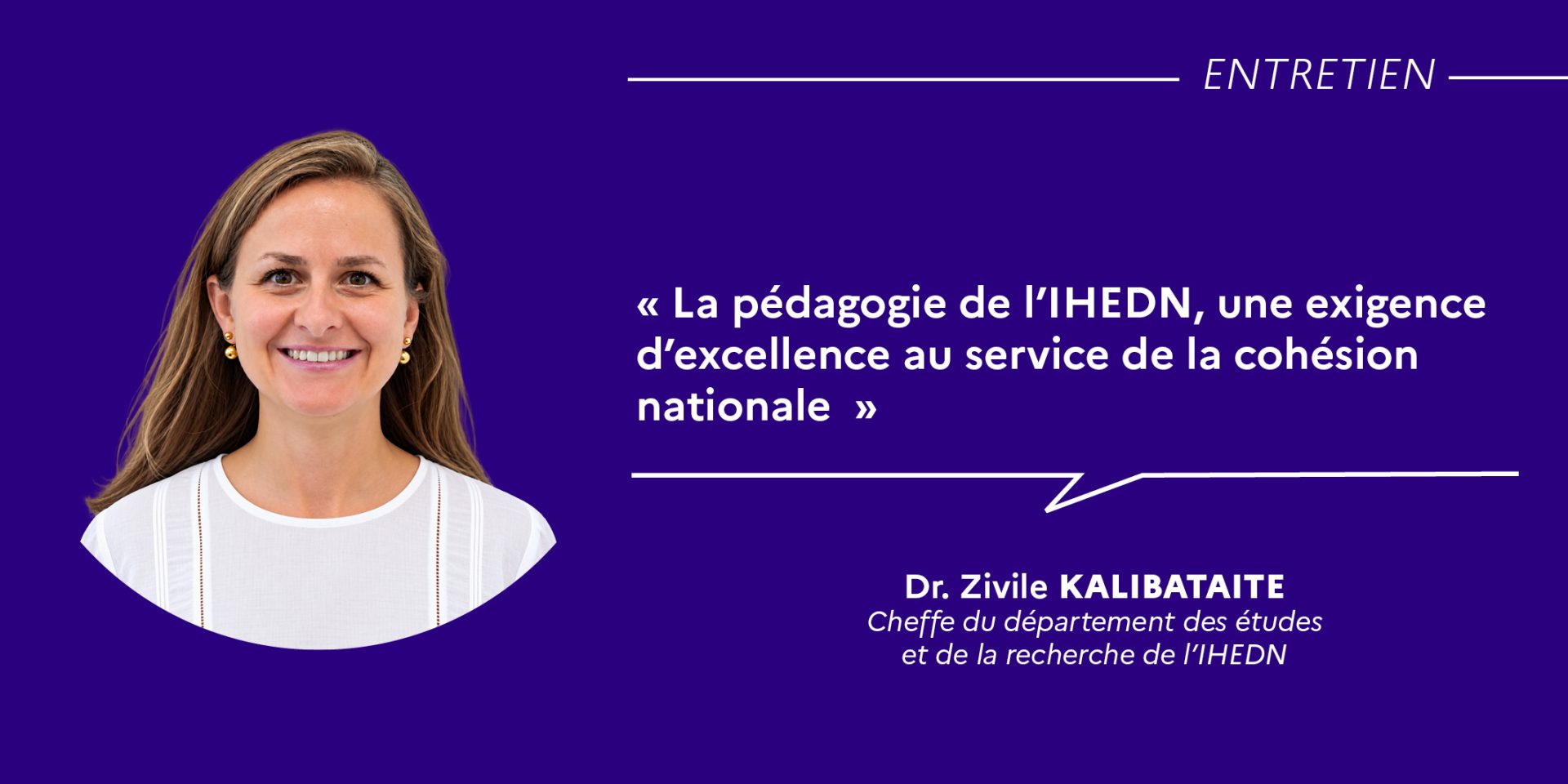
Živilė Kalibataitė, who holds a PhD in political science, is a specialist in defence and security issues, particularly in the Baltic region. Her thesis, supervised jointly by the University of Namur and the University of Paris-Est and supported by the Directorate-General for International and Strategic Relations (DGRIS), focused on «International recognition through the projection of armed force: the case of Lithuania’s policy on overseas military intervention (1994–2019)». Since September 2026, she has been head of the Studies and Research Department at the IHEDN, having previously served as its deputy director.
For 90 years, the IHEDN has been fostering a shared culture of defence and security, thereby contributing to the country’s cohesion and resilience. Its motto, «understand in order to act; understand one another in order to act together», is embodied in a proven and original teaching model, which enables every trainee, whatever their background, to gain a better understanding of strategic issues, develop their analytical skills and apply these insights to decision-making and action. IHEDN’s teaching approach aims to make the trainee an active participant in their own training, capable of questioning, challenging, arguing and contributing to collective thinking.
From the first session in 1936, attended by 30 participants, to the numerous courses, seminars and sessions in 2026, which together attract more than 2,500 participants a year, excellence and high standards have guided the Institute’s objectives, teaching methods and pedagogical developments.
Training in the common security and defence culture: the Institute’s educational objectives
In his inaugural speech from the College of Advanced National Defence Studies, delivered on 15 October 1936, Admiral Castex laid the foundations for what continues to underpin the Institute’s objectives since its inception, namely:
«To bring about a fruitful union amongst all those who, in whatever capacity, are involved in the work of national defence. There must be no barriers between them. […] And all this naturally requires that we know one another, that we have worked together, that we have lived, worked, thought and reflected together.»
At the heart of this formulation, the inter-ministerial and interdisciplinary nature of national defence is already evident; this constitutes one of the cornerstones of the Institute’s educational approach. Given the multifaceted nature of the threats that may endanger the security and territorial integrity of the country, as well as the lives of its people, the defence of the nation must indeed draw upon a wide range of fields of action (military, diplomatic, economic, technological, educational, etc.). Consequently, fostering a shared culture of security and defence requires taking a resolutely open-minded approach to these challenges, by bringing together different perspectives, areas of expertise and experiences.
The IHEDN builds its educational programme around this dialogue between sectors, disciplines and stakeholders. Within the Institute, military and civilian personnel, researchers and practitioners come together to present, discuss and examine the various aspects of national defence. The wide range of topics covered and the diversity of the speakers’ backgrounds are thus a key feature of every course, seminar and session at the Institute.
The breaking down of silos to foster a comprehensive understanding of defence and security issues is also facilitated by the very composition of the intake of trainees. The Institute takes care to bring together a diverse range of profiles, career paths and experiences, drawing from the public and private sectors, the civilian and military spheres, research and civil society.
This approach creates the conditions for dialogue and a fruitful exchange of views. These exchanges lead to mutual enrichment, which helps to broaden everyone’s analytical perspectives. The diversity of the audience thus represents a genuine educational resource in its own right.
The educational triptych: a balance between knowledge, experience and collective reflection
The IHEDN bases its teaching model on a three-pronged approach that combines, in a unique way, lecture-debates, study visits and committee work. This format enables participants to acquire knowledge whilst developing skills. It also encourages participants to take an active part in the programme and helps to foster a sense of belonging, which encourages continued engagement beyond the duration of the programme.
The lecture-debates provide students with an intellectual framework for understanding and analysis. They enable students to draw conclusions, share analytical frameworks and identify issues, whilst bringing together different areas of expertise. Thanks to this foundation of knowledge, students deepen their understanding of defence and security issues and acquire the tools needed to grasp their complexity.
To put this knowledge into context through practical experience, participants also take part in study visits. During these assignments, they meet with stakeholders from both the public and private sectors, visit military and industrial facilities, and undertake immersive experiences that enable them to gain a practical understanding of the diverse realities faced by those working in the defence and security sectors. Study missions abroad, for their part, offer a unique opportunity to compare their perspectives with external realities and to gain a concrete understanding of the strategic challenges faced by France’s partner countries. These field experiences consolidate theoretical knowledge and help to develop a critical mindset that is contextualised and firmly rooted in reality.
Committee work, the third pillar of the educational triptych, is probably the most original form of training, but also the most demanding and transformative. Working in small groups, known as committees, participants collaborate to develop a rigorous analysis and formulate proposals in response to complex, often innovative topics, which are always linked to real-world concerns of public authorities. Through a tried-and-tested methodology, participants thus acquire skills in analysis, foresight and decision-making, which they can apply in their professional contexts.
Beyond the acquisition of knowledge and skills, IHEDN’s three-pronged educational approach ultimately offers all participants a unique human experience. It creates the conditions for strengthening collective cohesion and resilience by fostering an enlightened mindset and promoting a sense of belonging to a community committed to defence and security.
Evaluating teaching methods without compromising on core principles: the pursuit of excellence
However, the continuity and stability of the Institute’s educational objectives and methods do not equate to monotony and lethargy. On the contrary, the pursuit of excellence is based on a dynamic of continuous improvement, which leads the Institute to regularly review its practices and adapt its programmes. This approach is underpinned by the systematic collection of feedback from course participants, feedback from project teams, and close dialogue with key decision-makers and recognised experts in the fields covered by the Institute. It enables the Institute to identify relevant developments, experiment with new approaches and adapt the content of its training programmes to changes in defence and security challenges.
For example, more interactive training methods, focusing on experiential learning and simulation, were introduced at IHEDN in the early 2020s. Through role-play exercises, case studies, serious games or crisis management simulations, participants are placed in an active learning environment. They must take a stance, put forward arguments and make decisions, whilst constantly interacting with others and operating in a changing and uncertain context.
At IHEDN, the pursuit of excellence goes hand in hand with a commitment to intellectual integrity. Whatever pedagogical changes are introduced, the requirement for rigour, honesty and responsibility in the production and use of knowledge remains at the heart of our training programmes. With this in mind, the rise and widespread adoption of artificial intelligence now call on us to rethink our practices and renew our teaching approaches whilst upholding these standards.
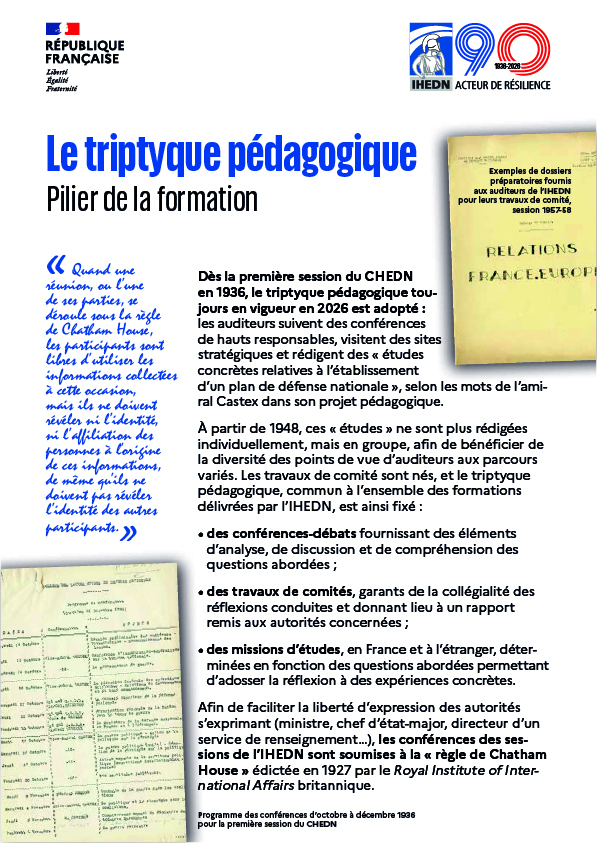
Excerpt from the IHEDN’s 90th-anniversary exhibition.
 French
  English