
IHEDN Mondays are now available in audio format!
Click below to listen:
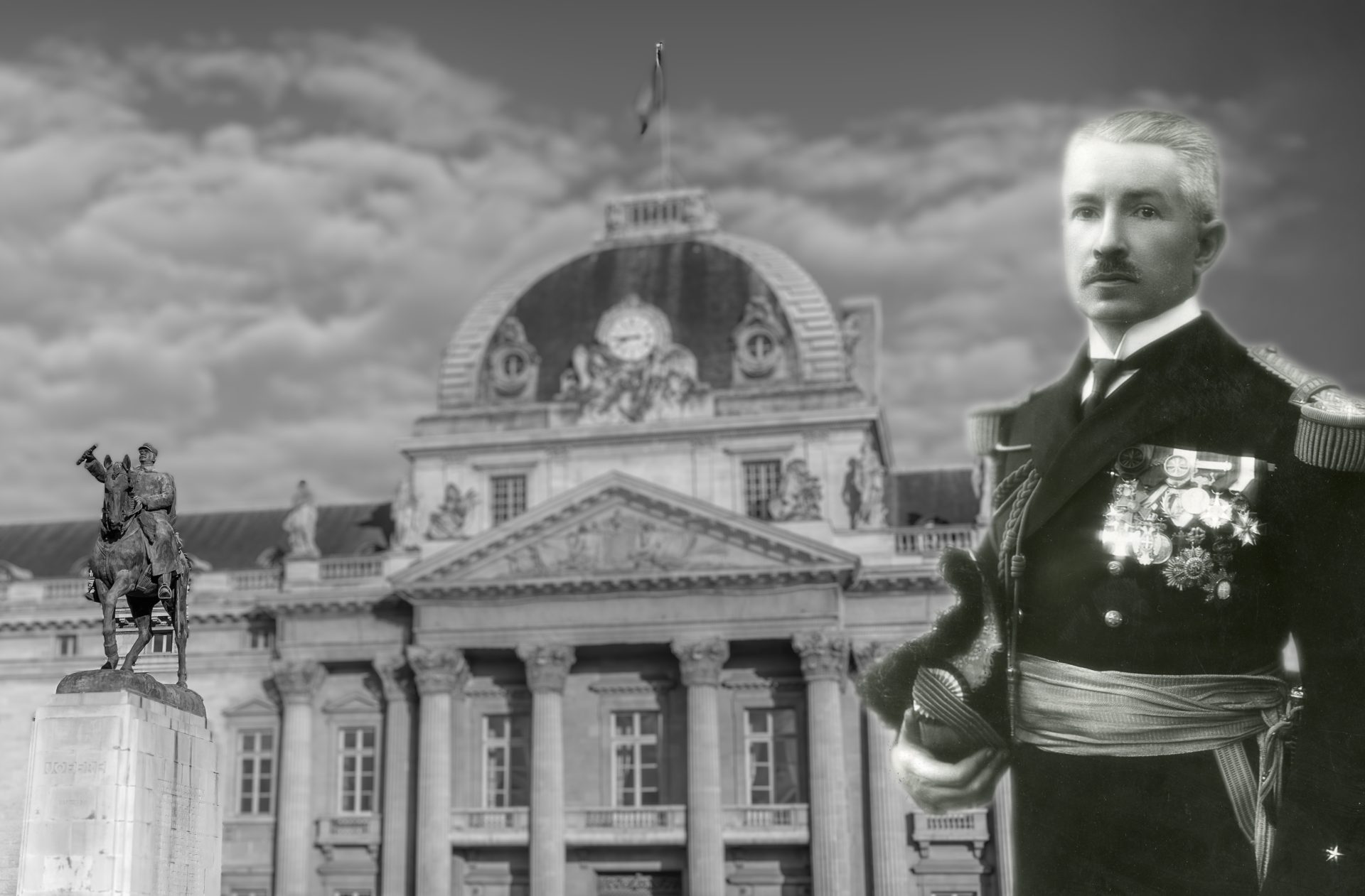
Born in Saint-Omer (Pas-de-Calais), the son of an infantry captain who went on to become a major general, Raoul Castex belonged to that generation of officers marked by the reconstruction of French naval power. He graduated top of his class from the École navale in 1896, and went on to a career that took him from Indochina to the Mediterranean.
Where his peers often content themselves with action, Castex stands out for his uncommon power of analysis. For him, the sea is not just a battlefield, it is a political and economic space. «His thinking is based on an in-depth knowledge of history, which, in his view, should serve as a source of reflection and guidance for strategy,» says Rear Admiral Bertrand Dumoulin, Secretary General of the Defence Academy of the École Militaire (ACADEM).
In this year when, in addition to the 90th anniversary of the IHEDN, we are celebrating 400 years of the French Navy, the legacy of Raoul Castex is also a reminder that France is a maritime power whose destiny has sometimes been played out on the seas.
THE «FRENCH CLAUSEWITZ» OF THE SEA
It was through his monumental work, Théories Stratégiques (published in five volumes between 1929 and 1935), that Castex earned his place in the pantheon of great military thinkers. Often compared to the American Alfred Mahan (1840-1914) or the Prussian Carl von Clausewitz (1780-1831), he went beyond the strictly naval framework to develop a global strategy incorporating innovations that his predecessors had not seen, such as submarines, aviation and the notion of «total war».
At the end of 1996, the great strategist Hervé Coutau-Bégarie, the architect of the re-publication of the «Théories» six decades after their publication, declared at the École Militaire:
«Admiral Castex's influence was great. He was read, and still is, all over the world, particularly in Spanish-speaking countries and in Japan, where the Theories have been translated in their entirety despite their 3000 pages, but also in the United States, throughout the Mediterranean world, in Sweden and even in Soviet Russia, which translated extracts at the height of the Stalinist purges.
Even today, when the US Navy sets out to develop a new manoeuvre-based doctrine, it turns to Admiral Castex for a translation of Volume II of his Theories on strategic manoeuvre.»
In his presentation of the 1996 reprint, Coutau-Bégarie emphasised that this «monumental work goes beyond maritime strategy to encompass general strategy and geopolitics». Castex understood before anyone else that victory did not depend solely on the strength of cannons, but on the synergy between the political, the economic and the military. This global vision is the cornerstone of what we now call national defence.
1936: THE BIRTH OF IHEDN
In 1936, with tensions rising in Europe, Admiral Castex put his most ambitious project into practice: the creation of the Collège des hautes études de défense nationale (CHEDN), which became the Institut des hautes études de défense nationale in 1948.
At the time, the intuition of the first director of the IHEDN was revolutionary: to prepare the nation for the challenges of tomorrow, the worlds had to be decompartmentalised. For the first time, he brought together senior military officers and civilian executives in the same training programme. As he writes,
«It is a question of giving those who will lead the country an awareness of the necessary solidarity between all forms of national activity.»
Even if the newspaper forgot the civilian auditors of the new college, Le Figaro of 7 September 1936 summed up the consensus of the time around the figure of Raoul Castex:
«For an admiral to be chosen as director of the Collège des hautes études de défense nationale, which will soon be up and running in Paris, his personality had to stand out. But the decree appointing Vice-Admiral Castex to this post came as no surprise. It could even be said that it was expected, because no general officer in the army, navy or air force would have had the same authority to found a training programme designed to prepare an elite group of officers in all branches of the armed forces for the exercise of high command».»
The other great inspiration behind the future IHEDN, Charles de Gaulle, now President of the French Republic, paid tribute to Admiral Castex in a letter congratulating him on his elevation to the rank of Grand Cross of the Legion of Honour in 1959:
«I have not forgotten what my own training owed to what I knew and read of you and your lessons in strategy, nor to the example you set through your services.»
As the IHEDN celebrates its 90th anniversary, the shadow cast by Admiral Castex remains immense. According to Hervé Coutau-Bégarie, he was «at the pinnacle of naval strategic thinking and one of the great names in strategic thinking in general». For Admiral Dumoulin, Raoul Castex was «both a thinker and a visionary, a precursor in many fields and an officer, an excellent sailor, with a strong character, often not very indulgent towards his superiors».
90 YEARS ON, A LIVING LEGACY
According to Lieutenant General Hervé de Courrèges, 38e and current director of the IHEDN, «Castex the sailor objectively sought throughout his work to develop a joint culture that was still in its infancy at the time»:
«On the subject of land combat, he wrote: «The power of the sea is therefore most interesting insofar as it contributes to victory on land; only in exceptional cases does it alone bring total victory». As for the importance of air power, he described it as follows: «Air superiority becomes a necessary condition for full superiority at sea».»
In a world marked by the return of high-intensity and hybrid threats, the method he established at the IHEDN - multidisciplinary study, adversarial debate and a high viewpoint - has never been more relevant. In honouring Raoul Castex, we celebrate not only the founder of an institution, but also the spirit of intellectual resistance and the desire to build a defence culture shared by all citizens.
For his current successor, «Castex continues to inspire the IHEDN, as his thinking on the different dimensions of strategy and, consequently, of war, proves highly relevant when we examine the current conflicts in Ukraine and the Near and Middle East». General de Courrèges quotes some of the founder's words, which sum up his approach to national defence, and pays tribute to him:
«He wrote: «War does not only require military action. You also have to fight in the diplomatic, economic, financial and moral arenas. It's total war». Looking around him at the wide range of courses offered by the IHEDN, which cover all areas of conflict, Castex must be very proud of his legacy and of what he has sown.»
By 2030, the French Navy will honour the great sailor and strategist with the launch of the Defence and Intervention Frigate (FDI). Admiral Castex, currently under construction in Lorient.
To find out more, click here:
The IHEDN would like to thank France Ferran, a relative of Admiral Castex, for her very useful documentation for this article.
 French
  English