
IHEDN Mondays are now available in audio format!
Click below to listen:
In 2026, European strategic issues will be studied by all the Institute's auditors, during Europe Month as well as the rest of the year: regional sessions, cycles Jeunes and en intelligence économique, national session... each auditor will be required to grasp the many aspects of the European security and defence system, in its political, economic and industrial dimensions. At the same time, the Institute organises dedicated international sessions.
After the Second World War, the rebirth of the IHEDN in 1948 took place against a backdrop of the gradual structuring of European security, illustrated that same year by the signing of the Brussels Treaty. At the first post-war session, after the opening address, the audience listened to a speech on «The Brussels Pact, its purpose, current achievements and future prospects».
Subsequently, the Institute's links with the future European Union and also with the North Atlantic Treaty Organisation (NATO), founded in 1949 and headquartered in Paris since 1950, continued to strengthen. In the autumn of 1951, the IHEDN was joined in its premises in the Pavillon de l'Artillerie at the École Militaire by the NATO Defence College, created by the Director of the IHEDN, Vice-Admiral André Lemonnier, on the model of the French institute.
Admiral Lemonnier was responding to a request from the Supreme Commander of the Atlantic Alliance in Europe, the American General Dwight Eisenhower, for whom he was also naval deputy. When France left NATO's integrated command in 1966, the College moved to Rome and the organisation's headquarters to Brussels.
Later, in the 2000s, France and Germany supported the creation of a European security and defence training capability. The idea originated with the European session of the IHEDN, the first of which was held at the end of 1988. Until its demise in 2004, it trained 469 students from 35 countries across the continent, including those from the former Soviet bloc from 1993.
A STRUCTURING RELATIONSHIP WITH THE EUROPEAN SECURITY AND DEFENCE COLLEGE
Created in 2005, the European Security and Defence College (ESDC) is now a central framework for training in security and defence issues at European level. The IHEDN has represented France from the outset on its governance and pedagogical council. As the College's director, Fergal Ó Regan, points out,
«The relationship between the CESD and the IHEDN is all the more unique in that, through its own institutional structure and the close links with French security, defence and diplomatic bodies that stem from it, the IHEDN's involvement with the CESD has always reflected France's dedication to the College's project.»
Each year, the IHEDN actively contributes to the design and implementation of training courses covering a wide range of contemporary strategic issues, in partnership with a number of European institutions: BAKS (Bundesakademie für Sicherheitspolitik, Germany), the Egmont Institute (Belgium), CASD (Centro Alti Studi per la Difesa, Italy), CSDA (Cyprus Security and Defence Academy, Cyprus), IDN (Instituto da defesa nacional, Portugal), the Intelligence College in Europe, and others.
The choice of topics reflects the ongoing dialogue between the ESDC, the IHEDN and the Member States on the emerging strategic and security issues facing the European Union. Director Ó Regan sums up the concrete contributions of this work:
«It's not just the length of IHEDN's involvement with the ESDC that counts, it's above all its quality: over the two decades of the ESDC's existence, IHEDN has contributed to our development through excellent training, always at the cutting edge of current affairs, with a strategic reading of the political issues that dominate the field of security and defence.»
In 2026, the IHEDN is organising 9 courses under the aegis of the CESD:
- Courses Cyber Diplomacy (Advanced) in January in Brussels
- Senior Strategic Course - module 1 in February in Brussels
- Maritime Safety Issues course in Nicosia in March
- Senior Strategic Course - module 2 in March in Berlin
- Courses Challenges of Space for CSDP and the EU in April in Brussels
- Senior Strategic Course - module 3 in May in Rome
- Hybrid Threats Challenges in June in Brussels
- Courses Drone Security in October in Brussels
- The EU Intelligence Framework in Paris in December
- Hybrid Threats Challenges in December in Brussels
THE MANY FACETS OF SECURITY AND DEFENCE IN THE FRENCH AND EUROPEAN CONTEXT
Auditors trained on CESD courses are of 27 nationalities from the Member States. With an average of 40 auditors per session, a total of approximately 250 European auditors are trained each year by the IHEDN as part of the CESD courses ( Senior Strategic Course is divided into three modules).
Fergal Ó Regan would like to emphasise the importance of IHEDN's educational contribution to these various courses:
«IHEDN brings a great deal of added value to the CESD's teaching model. Thanks to its institutional anchorage and its perspective combining research and practice, IHEDN approaches training from the same prism as CESD. This is evident not only in the choice of subjects covered in the activities organised jointly with the ESDC, which are always highly relevant to Europe, but also in the quality of their preparation and implementation.
Indeed, the IHEDN regularly makes available to the CESD its professionalism, the fruit of 90 years of experience, as well as a network of civilian and military contributors of exceptional quality, covering the many facets of security and defence, whether in the French or European context».»
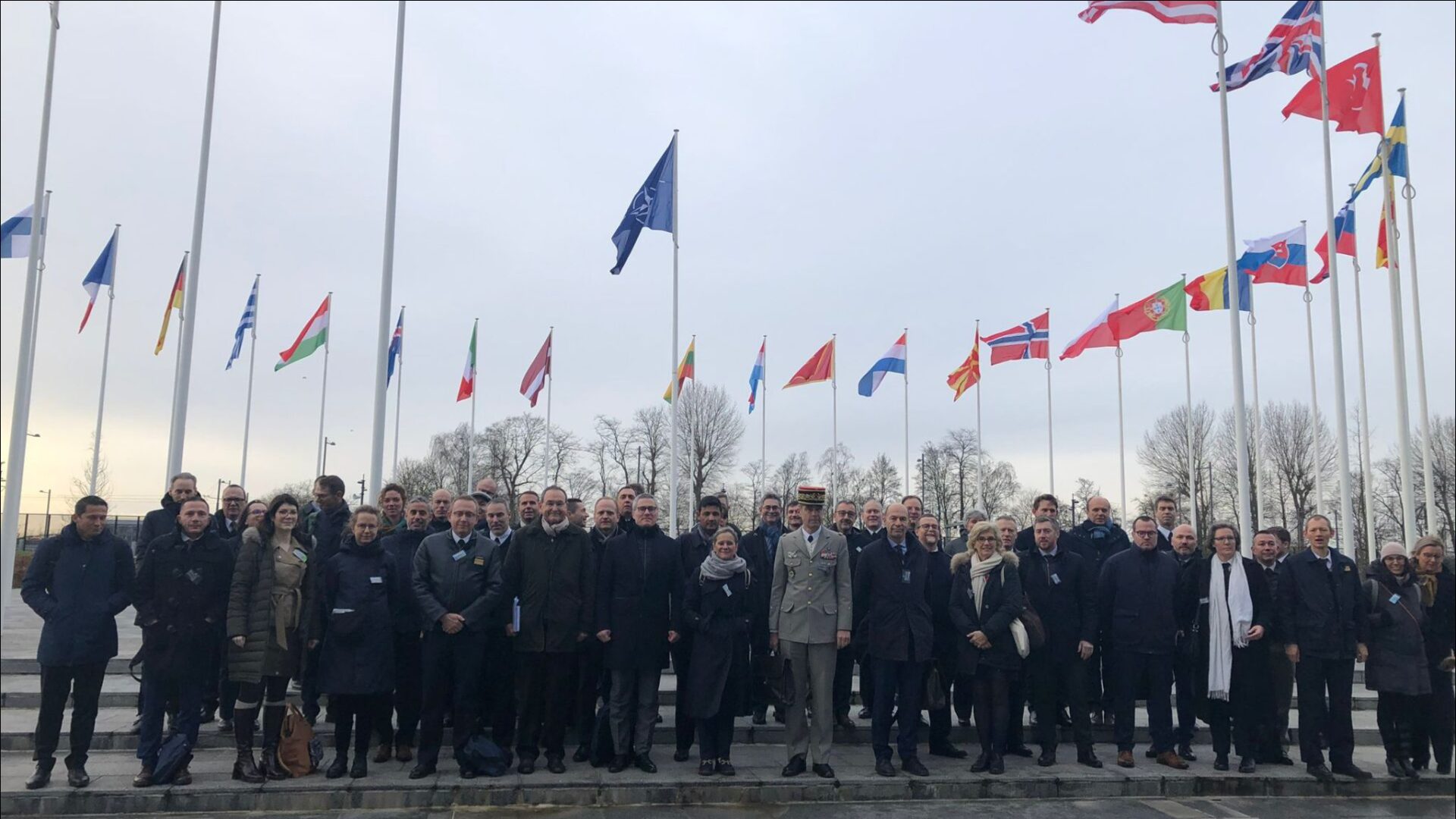
Represented in Brussels, as close as possible to the institutions of the European Union and NATO, the IHEDN brings together high-level speakers from the European institutions, Member States, the defence industry and the private sector. think tanks like our partner IRSEM Europe. These training courses and activities organised in Brussels give participants direct access to European decision-making mechanisms and contribute to a better understanding of the dynamics of cooperation in the field of security and defence.
In addition to the CESD courses, IHEDN regularly organises study visits to Brussels for students in the 5 majors of the national session. These trips enable direct exchanges with European institutions: the European Parliament, the Commission, the European External Action Service and the Council of the EU.
THE EUROPEAN SESSION OF HEADS OF DEFENCE, A MAJOR EVENT FOR 37 YEARS
In addition, the IHEDN organises seminars such as the one on the future of the European strategic compass in December 2025 in Brussels, and bipartite sessions in partner states, such as the one in Moldova in February 2026 for the Armed Forces General Staff and the Ministry of Defence's Directorate General for International and Strategic Relations.
Another major continental event for the IHEDN is the Session européenne des responsables d'armement (SERA), an annual training course bringing together nearly 80 auditors from EU countries, as well as the UK, Norway, Switzerland, Turkey and organisations such as the European Commission, the European Defence Agency, the European Investment Bank and the OCCAr (Organisation conjointe de coopération en matière d'armement).
Initially initiated by the CHEAr (Centre des hautes études de l'Armement), this course has been run by the IHEDN since 2010. The 37e edition kicked off in Paris in March on the theme of « Innovate, finance, scale up: building urgently Europe's defence of tomorrow ".
Armaments Engineer Caroline Salahun, President of SERA (and head of the IHEDN national session department), explains the contribution of this session:
«The SERA is an excellent forum for exchanges between high-level European officials in the armaments sector, from both government and industry, providing a better understanding of European defence issues, sharing experience and collectively reflecting on the best ways to strengthen European capabilities.
The links forged during the session are likely to facilitate cooperation and contribute to the development of a common culture, which is particularly useful in the current context of European rearmament and the growing importance of EU initiatives on these issues.»
As noted by Ambassador Aurélia Bouchez, Head of the Europe and International Affairs Department at the IHEDN, «the Institute's European commitment has been gradually strengthened to support the development of the European Union in terms of security and defence, in close collaboration with its institutions and partners».
BRING NATIONAL STRATEGIC CULTURES CLOSER TOGETHER THROUGH HIGH-LEVEL DIALOGUE BETWEEN CIVILIAN AND MILITARY DECISION-MAKERS
This commitment will primarily benefit the training of auditors," says the diplomat:
«The European dimension of IHEDN courses is a major asset for its students, giving them a practical understanding of decision-making mechanisms, institutional balances and the dynamics of cooperation at European level. By exposing its students to high-level contacts from European institutions, NATO and the Member States, IHEDN helps to train decision-makers capable of operating in an increasingly integrated strategic environment.»
The presence of an IHEDN representation to the EU and NATO in Brussels also strengthens links with the Alliance and fosters exchanges between these two essential frameworks for Euro-Atlantic security, while contributing to a better understanding of their complementarities.
Ultimately, therefore, it is Europe's collective security that benefits from the Institute's actions at continental level, as Ambassador Bouchez sums up:
«For several decades, the IHEDN has been fully involved in the European dimension of defence and security issues. Both in Brussels and in the Member States, it helps to bring national strategic cultures closer together and to structure a high-level dialogue between civilian and military decision-makers».»
 French
  English