
IHEDN Mondays are now available in audio format!
Click below to listen:
Director of the Institut de recherche stratégique de l'École militaire (IRSEM) since 2024, and a university professor at Sciences Po Paris, Martial Foucault was previously director of the CEVIPOF (CNRS, Sciences Po's political research centre). An economist and political scientist by training, he was a professor in the political science department at the University of Montreal and director of the Centre of Excellence on the European Union (McGill University/Université de Montréal). He has worked as a consultant for the French Ministries of the Armed Forces and the Economy, the Agence Française de Développement, the Quebec Ministry of Public Finance, the Direction générale de l'armement and the European Commission.
In 2004, the IHEDN awarded a prize for his doctoral thesis in economics on the financing of European defence; the Institute then welcomed him as an auditor for the national session in 2024-25, in the Defence Policy major. End of 2025, he published in the Revue d'économie financière an article entitled «Militarised interdependence: the return of economic geostrategy». In this interview, he sheds light on this concept and its use by powers such as the United States and China, and summarises the challenges it poses for France and the European Union.
HOW HAS THE ECONOMY BECOME A WEAPON OF CONFLICT? WHEN DO YOU DATE THE CURRENT PERIOD?
The economy has always been a mainspring of national power. From the industrial revolutions of the 18th century onwardse In the 21st century, international competition also involves innovation, mastery of technological standards, productivity gains and, ultimately, economic domination.
For the current period, the changeover began in the second half of the 20th century.e In the 19th century, a new paradigm emerged: that of generalised economic interdependence (or a totally open economy). With the opening up of markets, the unprecedented intensification of the movement of capital, goods, technologies and, to a lesser extent, labour, powers can no longer rely solely on their internal resources. They have to secure global supply chains of raw materials, components, energy, data and skills.
Never before has international trade reached such a volume (+900% since 1980) and value in 2024 (33,000 billion dollars). Trade flows therefore serve the ambitions of economic power.
But the corollary of this development is the emergence of increasingly conflictual relations, confirming what the American essayist Edward Luttwak described in 1990 as the «logic of war in the grammar of trade». States are now pursuing strategic objectives using economic instruments: the United States through tariffs and technological controls, China through its central role in the refining of many critical minerals and in certain industrial chains, Taiwan through its decisive role in advanced semi-conductors, and the Gulf monarchies through their ability to influence energy markets.
Because this interdependence not only produces prosperity, the economy becomes a weapon of conflict when the survival of a national model depends on resources, flows or technologies controlled elsewhere. In other words, the more interdependence there is, the more dependence can become an exploitable weakness.
WHAT DOES THE NOTION OF MILITARISED INTERDEPENDENCE MEAN?
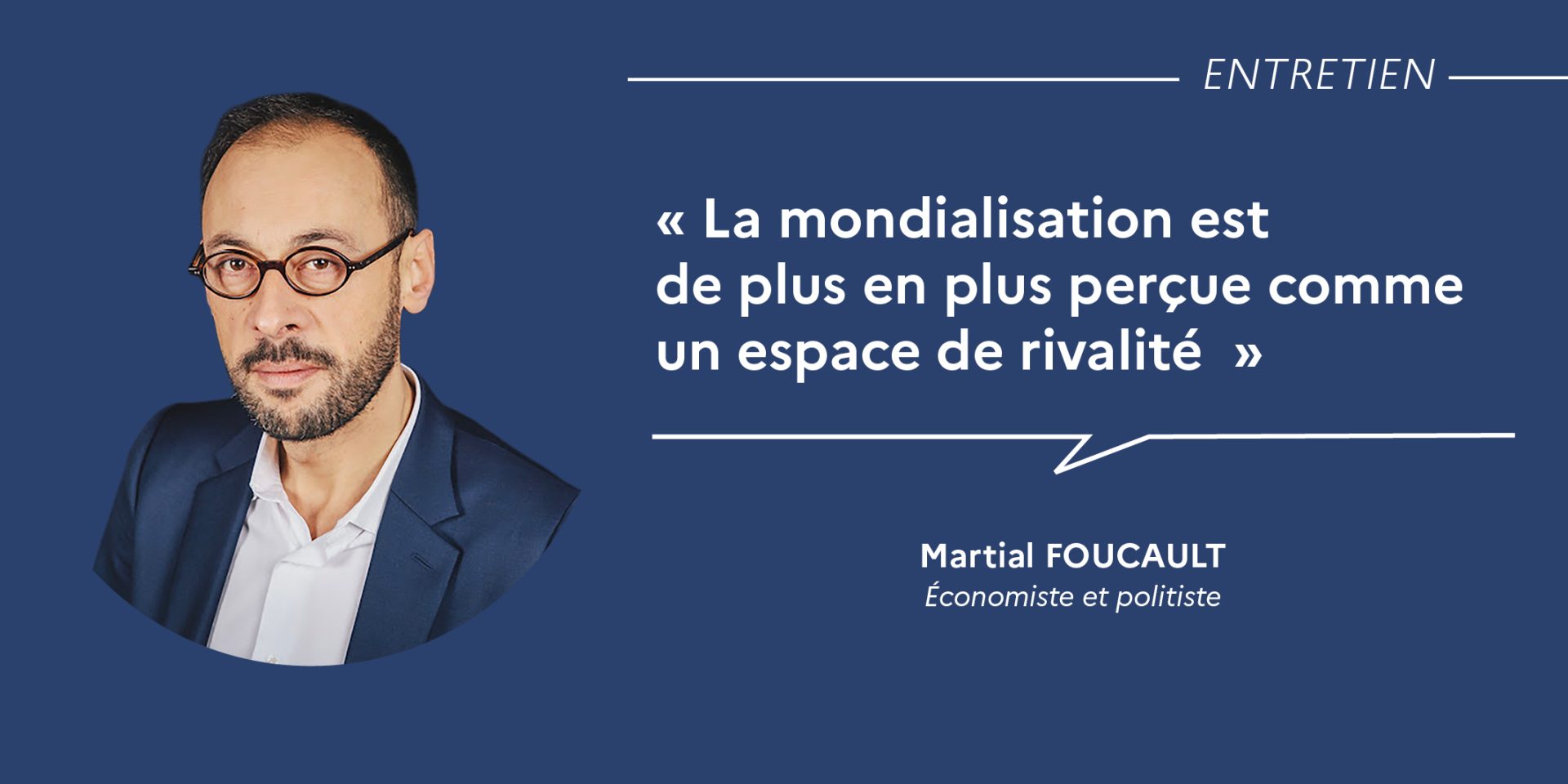
The notion of militarised interdependence is based on a simple observation: globalisation is no longer perceived as a positive-sum game, in which everyone gains from openness, but increasingly as an area of rivalry, where the gains of some can translate into the losses or vulnerability of others.
There are two reasons for this change. Firstly, because the rules of the game appear to be less stable than they used to be: the World Trade Organisation no longer has the same capacity for arbitration or supervision as it did at the height of its power in the 1990s.
Secondly, because economic openness has revealed the other side of the coin: by multiplying dependencies, it has also exposed states to new forms of pressure and weakened their sovereignty.
«IN A NETWORKED WORLD, THE STATES THAT CONTROL THE CENTRAL NODES CAN TRANSFORM THIS POSITION INTO NEGOTIATING OR COERCIVE POWER».»
It is in this context that political scientists Henry Farrell and Abraham Newman developed, in 2019, the concept of weaponized interdependence, which can be translated as «militarised interdependence» or «weaponisation of globalisation». Their idea is as follows: in a networked world, states that control the central nodes - financial, technological, logistical, informational - can transform this position into negotiating or coercive power. However, two important phenomena need to be distinguished.
The first is that globalisation has not dispersed power; it has often concentrated it. International networks rarely operate horizontally. They are structured around central points, according to a logic of the following type hub-and-spoke (star network). Those who control these centres can monitor, block, punish or exclude.
The second is the emergence of the fragmentation paradox: the more states seek to increase their security by fragmenting the global economy (by forming trading blocs or repatriating value chains to their own shores), the more they generate economic costs, increase global vulnerability and, paradoxically, reduce collective security.
This is exactly what is happening today between the United States and China. The two powers are seeking to reduce their dependence in sectors deemed critical, whether electronic chips, batteries, rare earths or cutting-edge technologies. But this quest for autonomy comes at a price: it raises production costs, accentuates block logics and reduces the benefits expected from interdependence.
YOU WRITE THAT ECONOMIC GEOSTRATEGY IS RECONFIGURING INTERNATIONAL RELATIONS. IN WHAT WAY?
Yes, because since 1945 the international order has been implicitly based on a compromise. The United States guaranteed part of collective security, while a relatively open economic order promoted growth, the expansion of trade and, more broadly, the stability of the international system.
In this context, interdependence was often seen as a factor for peace. The idea, in essence a very classic one, was that trade reduces the incentives for conflict. Montesquieu summed it up in a famous phrase: «trade softens morals». For several decades, this intuition served as the intellectual compass of the liberal order.
But this pattern breaks down when American hegemony is challenged and new powers seek to reshape the rules of the game. From then on, global trade flows were no longer just vehicles for prosperity; they also became levers for rivalry. States increasingly used sanctions, embargoes, technological restrictions, offensive industrial policies and trade discrimination as instruments of power.
«THE CHALLENGE IS NO LONGER JUST TO TRADE, BUT TO KNOW WHO YOU DEPEND ON».»
Globalisation, far from reducing conflict, is exposing countries to critical dependencies: energy, health, minerals, semi-conductors, electronic components, food, shipping and data. The challenge is no longer simply to trade, but to know on whom we depend in order to continue to produce, treat, travel, defend ourselves or innovate.
This is reconfiguring international relations in three ways.
- Firstly, because the hierarchy of powers is becoming more fluid. Power is no longer measured solely in terms of military divisions or GDP, but in terms of the ability to control a bottleneck: a technology, a metal, an infrastructure, a currency, a network.
- Secondly, because we are seeing the emergence of more fragmented groupings: a Western bloc itself shaped by divergent interests, an Indo-Asian area structured by the rise of China and India, and a global South seeking to take advantage of the rivalry between the great powers.
- Finally, because interdependence does not always reduce the risk of war; it can sometimes increase it. The case of semiconductors is illuminating. Taiwan accounts for more than 90 % of the world's production of the most advanced chips. This concentration creates a systemic dependence for other economies. If this vital capacity is threatened, certain states may be tempted to act preventively to protect their own economic security.
In reality, interdependence is being challenged more and more explicitly by managers who are no longer prepared to bear the costs and prefer to deploy a strategy of pressure or rupture.
DO YOU THINK FRANCE AND THE EUROPEAN UNION ARE EQUIPPED TO FIGHT ON THIS GROUND?
Europeans are in for a rude and painful awakening. The delay in achieving strategic autonomy is forcing the European Union to rethink from top to bottom its international relations, the solidity of its economic partnerships, the reliability of its alliances and, more broadly, its ability to defend its interests in a more conflict-ridden world.
For a long time, Europe thought that openness was enough to produce stability. Now it is discovering that uncontrolled openness can also lead to vulnerability. The COVID-19 crisis provided a glimpse of the damaging dependencies, but the war in Ukraine was a major wake-up call in this respect: energy dependency, industrial weakness in certain sectors, lagging behind in critical technologies, exposure to decisions taken elsewhere.
In concrete terms, when Europe accepts the new American tariff policy without much opposition, it is agreeing to pay the United States (more than in the past) in exchange for protection in terms of security. This is the return of an old strategic fact: protection is never free. Such a choice, which has not been debated by national or European democratic bodies, raises two questions.
«HOW CAN WE REGAIN POWER WITHOUT GIVING UP OPENNESS, SECURE OUR DEPENDENCIES WITHOUT IMPOVERISHING OURSELVES?»
The first is sustainability: is such a geo-economic compromise tenable in the long term for economies already facing competition from China, the energy transition and public finances under strain?
The second is democratic: can such a compromise be accepted in the long term if it is neither clearly debated nor genuinely accepted?
In the past, France and the EU may have adopted a wait-and-see attitude and abandoned strategic industrial policies, but there is little alternative to thinking at European level, given the critical size of this economic area, and to developing a common security policy that is less aligned with that of the United States.
The success of this shift will depend on the answers to the following three questions: how to regain power without giving up openness, how to secure our dependencies without impoverishing ourselves, and how to conduct this strategic reorientation without bypassing democratic debate.
 French
  English