
IHEDN Mondays are now available in audio format!
Click below to listen:
Sylvie Bermann, who speaks Chinese and studied at the Sorbonne, INALCO, Sciences Po Paris and the Beijing University of Languages and Cultures, is a diplomat accustomed to firsts: she was France's first female ambassador to China, a permanent member of the United Nations Security Council, from 2011 to 2014, and then to the United Kingdom (2014-2017) and Russia (2017-2019). In 2019, she became the first woman to be appointed French ambassador.
By decree of 24 January 2020, Sylvie Bermann was appointed Chair of the IHEDN Board of Directors, a position she held for two terms, until 23 January 2026. On 24 January, He was succeeded by French ambassador Pierre Lévy - as he did as ambassador to Moscow from 2019 to 2024.
The author of several books, Sylvie Bermann published «L'Ours et le Dragon» (The Bear and the Dragon) in 2025, in which she traces relations between Russia and China, published by Tallandier. She talks a lot about these two countries, as well as their heads of state Vladimir Putin and Xi Jinping, in this interview conducted at the end of January 2026.
SINCE 2020, THE WORLD HAS SEEN COVID-19 AND VARIOUS CONFLICTS WITH A GLOBAL IMPACT, SUCH AS IN UKRAINE AND THE MIDDLE EAST. DOES THIS DECADE MARK THE START OF A NEW ERA?
Yes, I think that we are truly in an era of rupture, which began precisely when I took up my duties as head of the IHEDN Board of Directors, with the health crisis. This was indeed a shock for the whole world, a global crisis whose consequences I don't think we have yet measured. Once it was over, we tried to forget about it, but I think that a certain number of countries got caught up in it.
There was the erratic management of Donald Trump's first term. Europe, on the other hand, tried to define a health policy that did not exist in the treaties. It did so fairly quickly, but the longer-term consequences are relations of mistrust between states.
Then each country turned in on itself. And I think that the effects on Vladimir Putin were largely responsible for the aggression in Ukraine, because he had previously admitted that he was afraid of contagious diseases. He shut himself off both geographically (he couldn't see anyone) and psychologically.
Businessmen could no longer see him, nor could Liberals, because he was too afraid of the virus, and he demanded that an oligarch isolate himself for 15 days before being able to meet him, almost shouting from the back of a room. This is not conducive to discussion and reflection. He only saw a very small circle of people, and was more receptive to what some of them offered him - in this case, the brothers Yuri and Mikhail Kovalchuk.
IN 2022, «PUTIN WAS THINKING ABOUT PREPARING HIS LEGACY».»
Putin was 70 years old, he was thinking about preparing his legacy, and the «recovery» of Ukraine seemed possible, given that Zelensky was very unpopular at the time and the Americans had withdrawn pitifully from Afghanistan. The idea was that with the West weakened, there would be no intervention. And then he started writing about Ukraine and Russia forming a single country. At that point, Putin had no more contradictions, no more dialogue, and on top of that, all his national and international activities had come to a halt.
China was locked in at the time of Covid. The world's mistrust of China also began at that time. So I really think we need to look beyond the immediate effects of this crisis.
Covid has had other consequences, internally for each country, on the isolation of people in general, who no longer feel like coming back to the office, preferring to work from home. The individual freedom so dear to Western societies has drifted towards individualism. This individualism has also been denounced by Asians, not just the Chinese: the refusal to wear masks, to be vaccinated, and so on.
So much for the Covid crisis. And the other element of this rupture was the invasion of Ukraine by a permanent member of the United Nations Security Council: a high-intensity war in Europe which constituted a major shock. This shock also revealed a division between what was later called the Global South and the West...
The current period brings to mind Antonio Gramsci's famous phrase: «The old world is dying, the new world is slow in appearing and in this chiaroscuro monsters are emerging».»
DOES U.S. FOREIGN POLICY SINCE DONALD TRUMP'S RETURN TO POWER, AND ESPECIALLY WHAT WE HAVE SEEN SINCE THE BEGINNING OF 2026, SIGNAL THE END OF THE WEST AS A GEOPOLITICAL «BLOC»?
I think so, because the United States was considered to be at the head of the Western world, which we still call (which I think is totally anachronistic) «the free world», a term that refers to a bygone era. In any case, there has been a very clear break between Europe and the United States with the return of Trump.
Europe did not expect it, because it thought that the first mandate was simply a parenthesis. And yet, under Joe Biden, we have already seen that the United States does not wish us well, if only with the AUKUS affair, the submarine contract between Australia and France that was abruptly terminated in favour of the United States.
But at the time of Donald Trump's first term, there was still a military and civilian administration that operated in the traditional way. Donald Trump didn't like this at all, because he saw them as being in the way. So he prepared for his second term in office with a loyal team, made up of both «MAGA» and "MAGA" members.» [EDITOR'S NOTE: «Make America Great Again »] and neo-conservatives who are loyal to his policies.
Everything he is doing today, in fact, he announced during his first term of office, in particular the rapprochement with Russia. Admittedly, there was no war at the time, but his fascination with Putin already existed. And if he was unable to bring about rapprochement with Russia, it was precisely because his first administration had prevented him from doing so.
We remember the meeting in Helsinki in 2018, which was supposed to be a prelude to a visit by Trump to Moscow and a visit by Putin to Washington. Trump had shocked many by vindicating Putin against his own security services. So his administration prevented him from doing what he wanted to do. But since his return to power, he has been relaunching this.
The rest we saw at the start of 2026 was extremely eventful. First and foremost Maduro's kidnapping, A dictator, to be sure, but kidnapped illegally, even with a façade of legality on the pretext that he was a wanted narco-terrorist. This special operation, perfectly successful from a military point of view, could still pose problems.
TRUMP'S FOREIGN POLICY «IS PART OF A LEGACY» LOGIC»
Then the Greenland affair, For a few days, the whole world was abuzz with concern about Donald Trump's desire to take control of the island, either diplomatically or by force. After all, we are talking about the annexation, in one form or another, of a country that is also a member of NATO - not exactly, since it is a territory associated with Denmark, but linked to NATO.
Then there are the risks of intervention in Colombia, Mexico, Cuba (which would be revenge for the failed landing on the Bay of Pigs in 1961), and Iran. Its military installations were already hit last summer, which was a good thing, because it weakened the country - with the help of Israel, which adopted the octopus strategy by cutting off all its tentacles: Hezbollah, Hamas, the Houthis, and some militias in the region too.
At first it was thought that Trump had an isolationist policy, but in reality it is also an imperialist policy. It's America First, it's « Make America Great Again ». It's all part of his legacy. He wants to leave his legacy by expanding the territory, as American presidents had done before him, by proclaiming his «Donroe» doctrine» the return of American control, from Alaska to Tierra del Fuego, over the whole of what he calls the Western Hemisphere.
«The wording »Donroe" is a little strange, but it does reveal his intentions. This has implications for relations with China and with the global South too, because it puts a stop to this very dominant Chinese presence. It means that he is putting his hand back on the region that he considers his own. In fact, it has renamed the Gulf of Mexico the Gulf of America. There are many symbols of this.
Finally, something else seems more serious to me: his hostility towards Europeans. He also announced this during his first term in office, and I was surprised that no one paid any attention to it, so I reminded people of it very often. He said that the Europeans were worse enemies than China, and that when he had finished with China, he would attack them.
DO YOU THINK THAT EUROPEAN STRATEGIC AUTONOMY IS ACHIEVABLE? WHAT ROLE CAN FRANCE PLAY IN THIS?
France has been talking about strategic autonomy for a very long time, particularly since 1998 and the Franco-British agreement in Saint-Malo on the establishment of an autonomous European defence. This principle was accepted at the Helsinki Summit in 1999. A number of procedures were then put in place.
But the British have always been careful, if not with the help of the Americans then at least at the behest of the Americans, to avoid duplication of resources. As a result, the EU has not been able to fully develop its instruments. All the same, it has been able to carry out around twenty autonomous operations in the Balkans and Africa, and quite successfully at that. But these were expeditionary force-type operations, not collective defence.
Collective defence remained within the framework of NATO, whereas France, from the outset of European integration, advocated a «powerful Europe». Our partners rejected this formula because they were counting on the American umbrella. They undoubtedly preferred a distant tutelage to a close one like France's, and strategic autonomy has not progressed much.
The French President's speech at the Sorbonne, In 2017, the European Council set out objectives, including in the field of defence, with the creation of a number of instruments, including financial ones, and closer ties with the United Kingdom - which is a bit of a paradox, given that it was they who prevented progress on European defence, and who are now the closest to us.
But all this remains, I wouldn't say wishful thinking, but a question of political will. Because we have always told our partners that we were not against the United States or NATO. But that if the United States were not prepared to follow our lead, if it did not share our interests, we needed to be able to work together and defend ourselves together.
France did not succeed in convincing us. Today, more and more, faced with the hostile behaviour of the United States, there is real reflection, there are statements here and there, including from Chancellor Merz and several other states. Then, when confronted with reality, it becomes difficult and the divisions return.
«IF THERE IS ONE AREA WHERE EUROPEANS SHOULD BE ON AN EQUAL FOOTING WITH THE UNITED STATES, IT IS THE ECONOMY».»
We congratulate ourselves on having intervened in Greenland, sending a few soldiers as a vanguard to show our resolve. It is said that it was thanks to the unity of the Europeans, but only eight countries went, and Italy said from the outset that it would not be there. The Eastern European countries, which are only interested in the Russian threat, didn't go either.
Then, when it comes to armaments, it's very difficult. It means having a genuine defence industrial and technological base, and also buying European. Yet many countries, including the Danes, who are threatened by the United States, continue to buy F-35s, aircraft over which the Americans retain a stranglehold even once they have been sold. So all this is problematic, and is likely to take a very long time.
I fear that many Europeans will remain under the same illusion, saying to themselves: «Trump is just a parenthesis, we're going to get back to normal. There's going to be the mid-term elections, that's going to be the end of his absolute power.» Then they'll say to themselves, «There's the 2028 elections». But J.D. Vance can win those too, and he's no friend of the Europeans, especially the European Union! It is the European Union that is crystallising hostilities. So for that reason, European autonomy will take time.
For the moment, Europe has neither the logistical capabilities nor the intelligence resources - I know that the French President said that 40% of the intelligence supplied to the Ukrainians was French, but I'm not sure that it was of the same quality. In terms of ammunition, we're not there either. So there is a real problem in terms of armaments. Not to mention all the artificial intelligence and high technology that the European Union does not have. So much for military autonomy.
And to achieve military autonomy, we also need autonomy in the scientific and economic spheres. And as the world's largest trading bloc, we must have the will to use the tools we have acquired, such as the instrument of coercion. But when Donald Trump summoned the Europeans in the person of Ursula von der Leyen to his golf course in Scotland, we bowed down without negotiating.
But what made Donald Trump bend with China was that China said no. Admittedly, China has economic clout. But if there's one area where Europeans should be on an equal footing with the United States, it's the economy. And we haven't.
So there you have it, we're a long way off. I think there is a clear awareness that this is an absolute priority for Europeans. But it won't happen tomorrow.
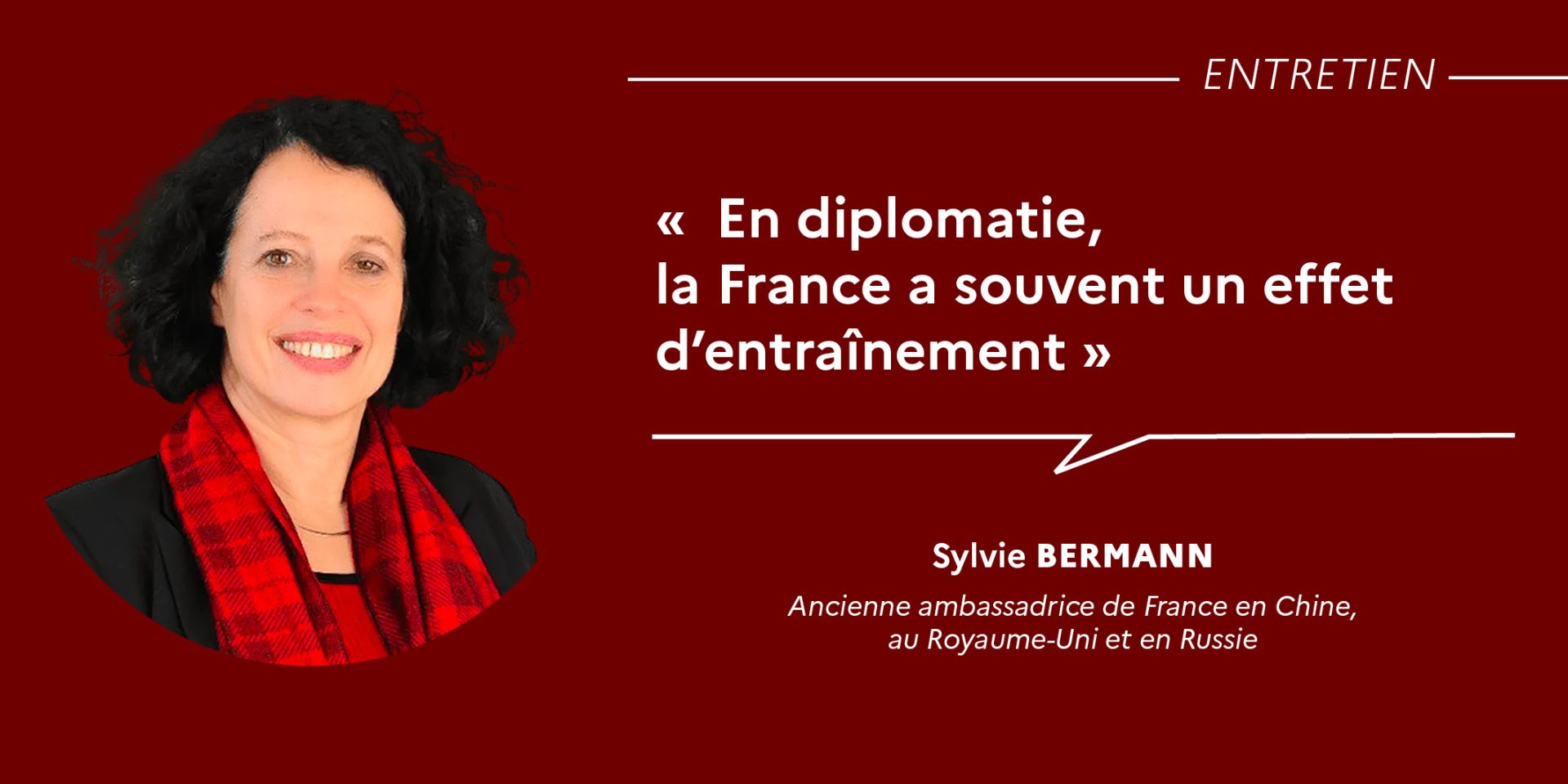
As we have seen, France often has a knock-on effect. We are an endowed power and a permanent member of the Security Council, which gives us greater weight than the others. Unfortunately, we are struggling economically, and that plays into our hands.
WHAT EXACTLY DOES THE TERM «GLOBAL SOUTH» MEAN? DOES THIS NOTION SEEM RELEVANT TO YOU?
If you talk to our politicians, they will tell you that there is no such thing as the Global South. Nonetheless, these countries use the term, and resentment was aroused at the time of the war in Ukraine: «You tell us that when you have a war in Europe, it's a world war and we should be interested in it, whereas you're not interested in what's happening at home». This resentment is shared by many countries. It's a bit like «the rest against the West», the rest of the world.
The contours of this «global South» are difficult to define today. It includes emerging powers such as India, Brazil, Argentina, Saudi Arabia and South Africa, as well as smaller countries, but it is still largely dominated by China.
Initially, two institutions exist in the south. The BRICS and the Shanghai Cooperation Organisation. These two institutions have evolved and grown in importance as the G7 has lost relevance and visibility. But they are not at all structured.
The global South is not made up of homogenous countries, but it does represent roughly half the world today, and around 40% of world GDP. So it's not insignificant, and we have to reckon with it. The BRICS have expanded, with six new countries, compared with the forty or so applicants. The Shanghai Cooperation Organisation came out of the closet in Tianjin in September 2025, when the Chinese President was flanked by Putin and Narendra Modi, who had previously had difficulties with China.
WITH THE SOUTH, «WE NEED TO BE A LITTLE LESS ARROGANT AND LESS PREACHY».»
I spent ten years in the UN system, both at France's Permanent Mission to the United Nations and as Director of International Organisations and the United Nations at the Quai d'Orsay. There was this Group of 77, but it was frustrated and a minority. And in 2022, when we voted on Ukraine, we realised that they weren't voting with us: either they abstained or they didn't even turn up to vote. There was a growing rift between these two worlds.
It's not inevitable, but we need to change our approach, to be a little less arrogant and less preachy. We have to agree to talk to each of these countries (especially not with a bloc), in a more respectful way, to see what we can do together. President Sarkozy has already begun with his trips to India, Vietnam and Indonesia. This shows an awareness and a desire to get closer to these countries.
France is in trouble with the Sahel countries, of course, from which we were driven out. But I believe that the European Union, which had a web of relations and agreements with these countries, needs to approach them differently. We must not adopt a bloc-to-bloc relationship, which is the tendency of the Chinese and Russians. At the BRICS meeting in Kazan with Vladimir Putin in October 2024, the Russian press started talking about a world majority.
WHY IS THERE TALK OF A «NEW COLD WAR» BETWEEN THE UNITED STATES AND CHINA?
Because this is a systemic rivalry of a different type to that which existed at the time of the first Cold War, which had no economic dimension because the USSR did not count in that respect. Nor is it an ideological rivalry, because on the one hand, the Chinese couldn't care less about each other's regimes, and on the other, Trump is totally indifferent to the defence of values or democracy.
This rivalry is systemic in the sense that it is part of Thucydides« trap: the established power is afraid of the rising power. Joe Biden's former Indo-Pacific adviser said: »England has taken over from France. We have taken over from England. And it is out of the question that it should now be China's turn." I talk about this in my latest book.
Today, the sinews of war are technological, and it was when the United States decided to ban the sale of miniaturised chips to China that this cold war began. In this context, Taiwan is very important, with TSMC the best chip manufacturer in the world. We don't know what Xi Jinping will do, or Trump for that matter. During his first term in office, he held up a globe and said: «See where China is. See where Taiwan is. And so we're not going.» I don't think he'll start a war with China over Taiwan, and I'm not sure the Chinese will invade Taiwan, they'll try to stifle it instead. But nothing is predictable... The Americans have opened a TSMC factory by forcing the Taiwanese's hand a little, so it remains to be seen whether they will manage to acquire the same skills. What they obviously don't want is for Beijing to get its hands on it. China is working on miniaturisation, and has made a lot of progress, but is not yet on the same level as Taiwan.
IN WHAT WAY ARE CHINA AND RUSSIA, TWO COUNTRIES WITH WHAT THEY CALL «UNLIMITED FRIENDSHIP», AT THE HEART OF THE CURRENT RESHAPING OF THE WORLD?
Because they are the two continental powers, two permanent members of the Security Council, even if it is now paralysed. When I left Russia, the Director of Asia at their Ministry of Foreign Affairs, who is now Russia's ambassador to Beijing, told me: «Thanks to Donald Trump, we haven't had such good relations with China since Catherine II», in the 18th century.e century. It's an incredible statement! For my book, I went back a long way, before Catherine II, and I realised that he was telling the truth.
Relations were good when the two empires were more or less on an equal footing. But when the Manchu Empire began to decline in the 19the In the 19th century, the Russians took advantage of this, and the Tsarist empire took a million square kilometres in the Amur region. During the Communist period, things got even worse, just when you might have thought that it would bring them closer together. There was a friendship agreement, an alliance between the Russian «big brother» and the Chinese «little brother». That's why China doesn't want any more alliances: big brother has shown total contempt for little brother. This has caused a schism in the communist movement that has reverberated around the world.
«THERE IS NO NATURAL SYMPATHY BETWEEN THE RUSSIAN AND CHINESE PEOPLES».»
It was not until the arrival of Gorbachev that the two countries were reconciled. But what remained was an enmity between the peoples, or if not an enmity, at least a lack of understanding and interest. These two cultures have nothing in common. The Russians claim to be part of a European culture, even if Putin is now talking about Eurasianism for political reasons. But the Russians don't subscribe to this, they see the Chinese as backward peasants who haven't fully grasped the evolution of China.
As for the Chinese, they are still somewhat resentful of the way they were treated. They also feel that Russia was a failure, because the Soviet Union had much more than China: great laboratories, great universities, great mathematicians and scientists, whereas in China the Cultural Revolution closed down the universities. Today, China is the leader in a large number of fields, including artificial intelligence.
So there is no natural sympathy between the two peoples or interest between cultures. On the other hand, Xi Jinping and Vladimir Putin have made a deliberate, strategic choice of strategic partnership, of ’friendship without limits«, based on the fact that they have a common enemy, and that »the enemy of my enemy is my friend«. It really is an adage that always works in diplomacy.
I don't think China appreciated the invasion of Ukraine, because it is against interference in a country's internal affairs. It had very good relations with Ukraine, with thousands of Chinese students in the country and cooperation, including on the nuclear front. But China has no interest in Russia's failure, insofar as they have this common enemy and have an interest in maintaining close relations.
COULD RUSSIA HOLD OUT WITHOUT CHINA'S SUPPORT?
It is clear that by importing gas and oil that were banned in Europe, China enabled Russia to fuel its war effort. And even if it refrains from selling arms, it supplies machine tools containing products of a dual nature that can be used in war.
This enables Russia to compensate for the European Union sanctions, which China does not consider to be violated, since it does not consider them to be legal sanctions unless they have been approved by the Security Council. When it is threatened by the United States, it is a little careful because sanctions can affect Chinese factories. It is cautious. But it is true that continued trade does help Russia.
Their shared desire is for a world that is no longer dominated by Western rules. A de-dollarised world, which would prevent the Americans from imposing extraterritorial sanctions. They are fighting against interference in their internal affairs or those of other states that belong to the global South. They have a shared vision of a multipolar world, the opposite of American or Western hegemony.
IN TERMS OF PERSONALITY AND GOVERNANCE, WHAT DO YOU SEE IN COMMON BETWEEN XI JINPING AND VLADIMIR PUTIN, WHOM YOU HAVE MET ON SEVERAL OCCASIONS?
Yes, I've seen them both quite often. Xi Jinping, in his contacts with foreigners, is a more smiling, more debonair person. Not like Vladimir Putin, who is always impassive, a little « pokerface ». He doesn't smile with foreigners, whereas he smiles and laughs a lot in Russia. That's what struck me when I first arrived.
Internally, their two regimes have hardened and deprived a number of people of their freedom. There is no longer any freedom of information. The Internet is controlled and opponents are imprisoned. There is indeed a similarity here. This is also the case, as I was saying, with their vision of the world, a world that is not Western but multipolar and that, in their minds, they can more or less control.
The two of them get on very well: I've seen them together, and that really shines through. They're the same age too, a year apart, I think that counts: they've lived through the same world events, albeit not in the same way. They dream of immortality: they are elderly leaders who would love to stay in power indefinitely. Putin has amended the Constitution to stay in power until 2036. Xi Jinping is in power for an indefinite period, whereas his predecessor Deng Xiaoping had set the rule of alternating every 10 years.
There is therefore more closeness between the two leaders than there is between the two peoples, for ideological as well as geopolitical and strategic reasons.
DURING YOUR TWO TERMS AS CHAIRMAN OF THE IHEDN BOARD, HOW HAS THE INSTITUTE ADAPTED TO THIS STRATEGIC CONTEXT?
The Institute has changed a great deal under the three directors I have known. I can mention the single national session and its five majors, effective since 2021. Emphasis has also been placed on regional sessions. This is very important, because IHEDN's work cannot be confined to the 7e arrondissement.
The number of auditors from overseas has been increased, both in the national session and in the regional sessions organised overseas. I would also like to emphasise the strengthening of the economic intelligence and youth cycles. We have re-established a scientific council, which had been abandoned for several years, and the research sector has been developed. In this respect, the work of the IHEDN Endowment Fund and its two chairs is important.
These developments have enabled the IHEDN to become an integral part of strategic thinking and training in France. With the clear threats facing France and the EU, it is important to be prepared to respond to them, both in the military sphere in the strict sense and in terms of hybrid actions.
It was essential to develop these different dimensions, and the IHEDN has done this very well. There is now an unprecedented influx of applications, because it is an excellent course, and all those who have taken it are absolutely delighted and recommend it to others. This record number of applications shows that IHEDN's contribution to the spirit of defence and strategic thinking has become essential in France.
The important thing is that the Director and the Chairman of the Board work well together. This has been the case during my two terms in office.
 French
  English